

A Guide To Smarter Food Truck Design
Long before you start sketching layouts or shopping for equipment, your food truck design journey begins with one thing: the menu. It sounds simple, but the type of pizza you plan to sell—whether it's quick New York slices or custom-built artisanal pies—is the single decision that will shape everything else. Think of your menu as the blueprint for your entire mobile pizzeria.
I've seen so many new owners make a critical mistake right at the start. They underestimate just how much the menu dictates operational efficiency. Designing a food truck isn't just a game of Tetris, trying to fit equipment into a tight space. It's about building a system where your specific menu can be executed flawlessly, especially when the orders start flying.
A truck slinging pre-made slices by the dozen needs a totally different setup than one crafting gourmet pizzas to order. For instance, a high-volume, slice-and-go model is all about speed. That means you'd prioritize a big deck oven for holding and reheating, a smaller pizza prep table for a handful of toppings, and a point-of-sale (POS) system placed right at the window for rapid-fire transactions. The whole workflow is dead simple: heat, serve, repeat.
Aligning Your Menu With Your Mobile Kitchen Design
Defining Your Service Model
Your service model is where your menu concept meets reality. It dictates how customers interact with your truck and, just as importantly, how your team moves inside it. Let’s look at two very different pizza truck scenarios I've seen play out.
-
The Festival Favorite: This truck is built for pure speed at huge events like concerts or street fairs. The menu is intentionally limited to 3-4 heavy hitters like cheese, pepperoni, and maybe a veggie option. The layout would be built around a massive serving window, a powerful conveyor oven that churns out pizzas nonstop, and a pizza prep table set up for lightning-fast assembly of just those core ingredients.
-
The Artisanal Craftsman: This truck is all about quality and customization, often parked at farmers' markets or booked for private catering. The menu is adventurous, with unique toppings and doughs. The design here would feature a much larger, more robust pizza prep table with tons of refrigerated pan capacity. Instead of a conveyor, they’d likely have a traditional deck oven that offers the precise heat control needed for that perfect artisan bake, even if it’s a bit slower.
A food truck's success is a direct reflection of its workflow. If your menu promises speedy service but your layout creates bottlenecks between the pizza prep table and the oven, you'll fail to meet customer expectations and lose business during peak hours.
Mapping The Customer Journey
You absolutely have to visualize the entire customer experience before you build anything. Where will they stand to order? Where do they wait? And where do they pick up their food? Getting these answers right helps you place every component strategically.
Your POS system, for example, needs to be right at the front of the service window, ready for the next person in line. The pickup area should ideally be separate to prevent a crowd from forming and blocking new customers. This customer flow has a direct impact on your interior layout.
If customers pay and pick up at the same spot, your oven and finishing station have to be within arm's reach of that window. This reality forces you into a more compact, hyper-efficient design. This menu-first approach ensures every piece of equipment, especially your pizza prep table, serves a clear, profitable purpose.
Blueprint For Success: Mobile Pizzeria Layout and Workflow
Once you’ve locked in your menu, it’s time to bring that vision to life in the real world. This is the part where napkin sketches evolve into a detailed floor plan. The goal here isn't just about cramming equipment into a tight space; it's about engineering a smart, efficient system that won't buckle under the pressure of a dinner rush.
Think of your food truck layout as an assembly line. Forget the classic "work triangle" you see in a big, square restaurant kitchen. In a mobile pizzeria, everything has to flow in a straight line. Every single step—from pulling raw dough from under the pizza prep table to handing a finished pizza to a customer—needs to move seamlessly in one direction to keep things from turning into chaos.
This whole process is driven by your menu. The items you sell dictate the layout you need, and that layout determines how well you can actually serve your customers.
This visual really drives home the point: a killer food truck is built menu-first. Every design decision you make has to support the food you're making and the way you're serving it.
Establishing Dedicated Work Zones
The secret to an efficient linear workflow is creating distinct zones for each stage of the pizza-making process. Mapping these out on a scaled floor plan is a non-negotiable step that will save you from making incredibly expensive mistakes down the road. A well-planned layout keeps your crew from constantly bumping into each other and makes a long, grueling shift feel a whole lot easier.
Generally, your pizza truck workflow should follow this natural progression:
- Receiving and Cold Storage: This is your ingredient starting line. Your main refrigerator or under-counter units should live here, usually near the back of the truck. This makes stocking deliveries a breeze and keeps raw ingredients separated from the hot line.
- Dough and Ingredient Prep: Right next to your cold storage is where the initial work happens—think portioning dough, chopping veggies, or slicing pepperoni. Keeping this zone close to the fridge cuts down on unnecessary movement.
- Pizza Assembly: This is the heart of your entire operation, and it’s anchored by your refrigerated pizza prep table. It needs to be perfectly positioned with easy access to both the dough prep area and the oven.
- Cooking: Your pizza oven is the star of the show. Its placement is critical and dictates the rest of your flow. It must be located right after the assembly station and have proper ventilation and safety clearances.
- Finishing and Serving: The final stop. This zone is right next to the service window and is dedicated to slicing the pizza, boxing it up, and getting it into the customer's hands.
Maximizing Every Square Inch
On a food truck, space isn't just a commodity; it's gold. Smart design means you have to think vertically. Don't just plan your floor—plan your walls.
A crowded, inefficient layout is a profit killer. I’ve seen trucks where staff had to take three extra steps just to get from the prep table to the oven. During a lunch rush, those wasted seconds add up to dozens of lost orders and frustrated customers.
Vertical shelving mounted above your pizza prep table and countertops is perfect for storing boxes, utensils, and dry goods. This keeps your primary work surfaces clear and ready for action. Under-counter refrigeration is another game-changer, giving you crucial cold storage right underneath valuable counter space.
For a deeper look at how different setups can work, you can explore some common food truck layouts to see how other pizza restaurants optimize for different kinds of service.
A Real-World Scenario
Let's imagine a truck that specializes in gourmet, made-to-order pizzas. The owner sketches out a plan with the pizza prep table near the back and the oven up front by the serving window. On paper, it looks okay.
But in the real world, this layout is a disaster. It creates a massive bottleneck. The employee building the pizza has to physically carry it several feet past the person taking orders, creating a constant traffic jam in a tiny space.
A much better design puts the prep table and oven in a direct, uninterrupted line. This allows the pizza to be assembled, cooked, and served in one smooth motion. This simple change can boost your order output by 20-30% during peak hours, which goes straight to your bottom line.
Choosing Your Core Equipment For A Pizza Food Truck
Once you've mapped out your workflow, it's time to get into the fun part: picking the hardware. The equipment you choose isn't just a random collection of stainless steel; it's the very engine that will power your mobile pizzeria. Every single piece needs to be selected for its efficiency, toughness, and ability to fit into a tiny space. And right at the heart of it all is the refrigerated pizza prep table—arguably the most critical piece of gear in your entire truck.
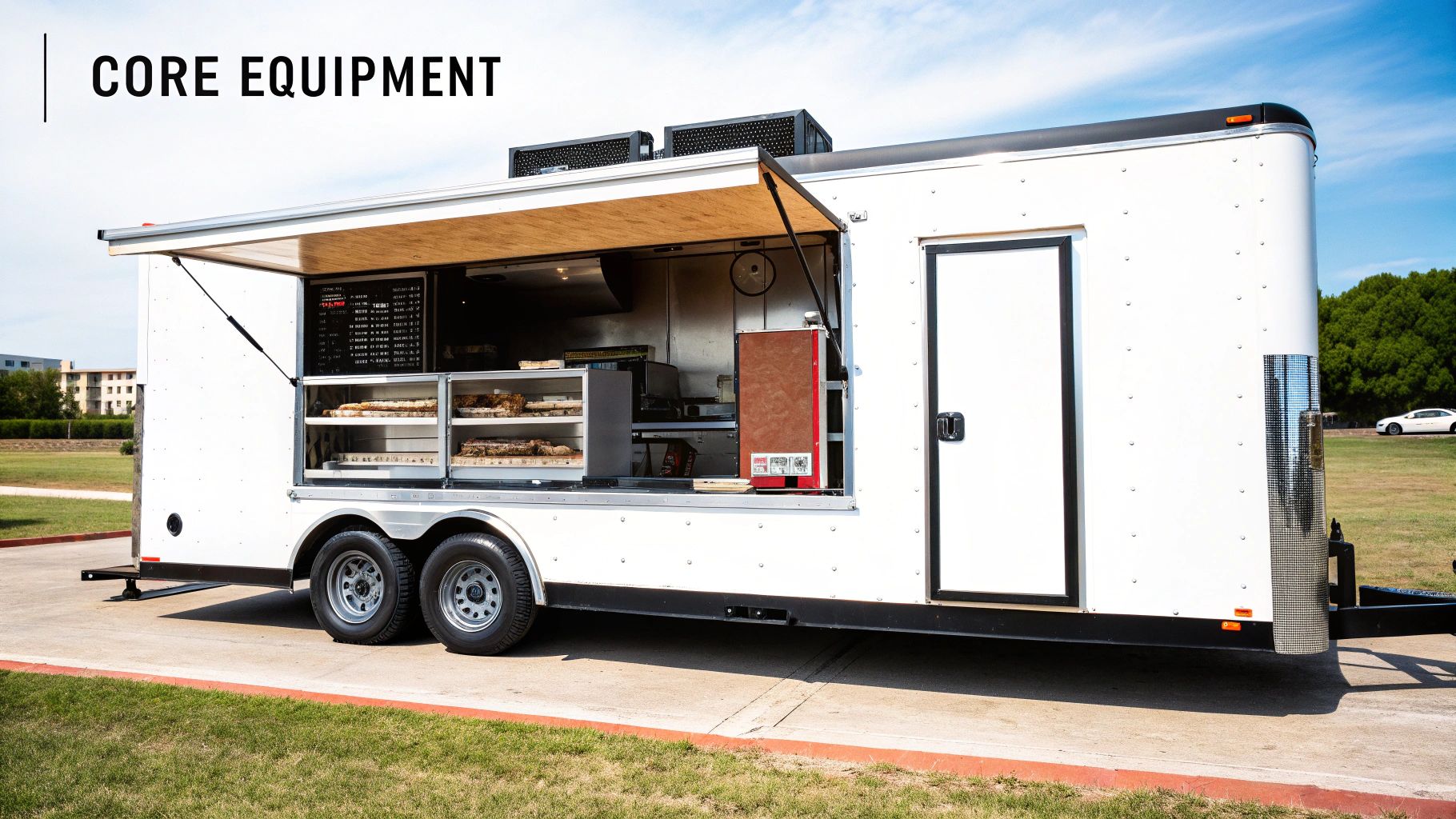
Think of this table as your command center. It’s where your cold storage for toppings meets your assembly line, and its size directly impacts how fast you can sling a pizza out the window. Getting this right is a delicate balance between your menu's complexity, the physical limits of your truck, and how many hungry customers you expect to serve.
Selecting The Right Pizza Prep Table
The size of your pizza prep table is one of the biggest decisions you'll make, full stop. It dictates how many different toppings you can keep chilled and ready to go, which in turn affects your menu variety and service speed. Go too small, and you’ll create a bottleneck during a rush. Go too big, and you'll eat up precious real estate that could have been used for something else.
Here’s how the common sizes usually break down in the real world of mobile pizzerias:
- Compact Models (44-inch): These are perfect for pizza trucks with a laser-focused menu—think classic pepperoni, cheese, and maybe one or two others. They're fantastic space-savers but will definitely limit your topping options.
- Mid-Size Models (67-72 inch): For most mobile pizzerias, this is the sweet spot. They offer a great balance, giving you enough pan capacity for a diverse menu without completely taking over the truck's interior.
- Large Models (93-inch): You'll only see these in high-volume trucks or those rolling with an extensive, gourmet menu. They offer maximum storage but demand a larger truck and a serious amount of power.
Food trucks are all about clever design, and this is where a good prep table really shines. A standard 72-inch pizza prep table can easily replace a bulky reach-in fridge. It can hold 33 lbs of mozzarella at a perfect 33-41°F while giving you a 12-inch cutting board for assembly. This kind of setup can slash your prep time by 25%—a huge deal when you realize 92% of customers choose food trucks because they want fast service.
Your pizza prep table isn't just a fridge with a cutting board on top; it's the heart of your entire assembly line. Splurging on a high-quality, NSF-certified model from a trusted name like Atosa or True ensures the reliability and food safety you absolutely need in a mobile kitchen.
Choosing the right pizza prep table size is crucial for balancing your menu's complexity with the limited space inside your food truck. This table breaks down the common options to help you decide.
Pizza Prep Table Size And Capacity Comparison
| Model Size (Inches) | Typical Capacity (Pans) | Best For | Example Brands |
|---|---|---|---|
| 44" | 6-8 | Small trucks, limited menus (e.g., cheese, pepperoni, margherita) | Atosa, Avantco |
| 67" - 72" | 9-10 | Most versatile; balances space with menu variety | True, Turbo Air |
| 93" | 12+ | High-volume trucks with extensive, gourmet topping options | Migali, Dukers |
Ultimately, a mid-size table is often the safest bet, but if your pizza brand is built on a massive selection of toppings, you'll need to plan your truck layout around a larger unit from the start.
The Great Oven Debate Deck Vs. Conveyor
Your choice of oven is another cornerstone decision, and it’s driven almost entirely by your service model. In the food truck world, it really comes down to two main players: deck ovens and conveyor ovens. Each has its pros and cons for a pizza kitchen on wheels.
Deck Ovens Deck ovens are for the artisans. They give you incredible heat control, which is how you get that perfect, crispy-chewy crust people rave about.
- Pros: Amazing bake quality, great heat retention, and a classic, authentic cooking process.
- Cons: Slower output, requires a skilled operator to constantly rotate pizzas, and they take up more space.
Conveyor Ovens Conveyor ovens are built for one thing: speed. You set the temperature and belt speed, and it cranks out a consistent pizza every single time.
- Pros: High-volume output, incredibly easy to use (less training needed), and super consistent results.
- Cons: Less control over the final bake, can be more expensive upfront, and often use more energy.
For most food trucks trying to serve as many people as possible during a lunch rush, a compact conveyor oven is the logical choice. It takes human error out of the equation and gets pizzas into customers' hands fast. But if your entire brand is built on that handcrafted, artisan promise, a deck oven is non-negotiable.
Essential Supporting Equipment
Beyond the pizza prep table and oven, you'll need a few other key pieces of equipment to run a functional and legal mobile pizzeria. Remember, every item has to be chosen with your limited power supply and space in mind.
- Under-Counter Refrigeration: This is a must for storing bulk items like dough balls, blocks of cheese, and drinks. Tucking these units under your counters is the best way to maximize your workspace.
- Specialized Ventilation: A proper ventilation hood and fire suppression system aren't optional—they are required by law. These systems have to be professionally installed to handle the intense heat from a pizza oven and meet all local health and fire codes.
- Dough Mixer: If you plan on making fresh dough right on the truck, a compact commercial stand mixer is a must. A 20-quart model is usually a good starting point for most pizza truck operations.
By carefully picking each piece of equipment to fit your specific menu and workflow, you create a cohesive system that’s built for success on the road. For a more detailed list, take a look at our complete guide on essential food truck kitchen equipment.
Power, Water, and Staying on the Right Side of the Law
A pizza food truck is a kitchen on wheels, which means you're the captain of your own utility company. Getting your power, water, and gas systems dialed in isn't just about making sure the lights turn on; it's a fundamental issue of safety, efficiency, and legal survival. I've seen too many new owners get this wrong, leading to failed inspections, sudden shutdowns, and expensive fixes that could have been avoided.
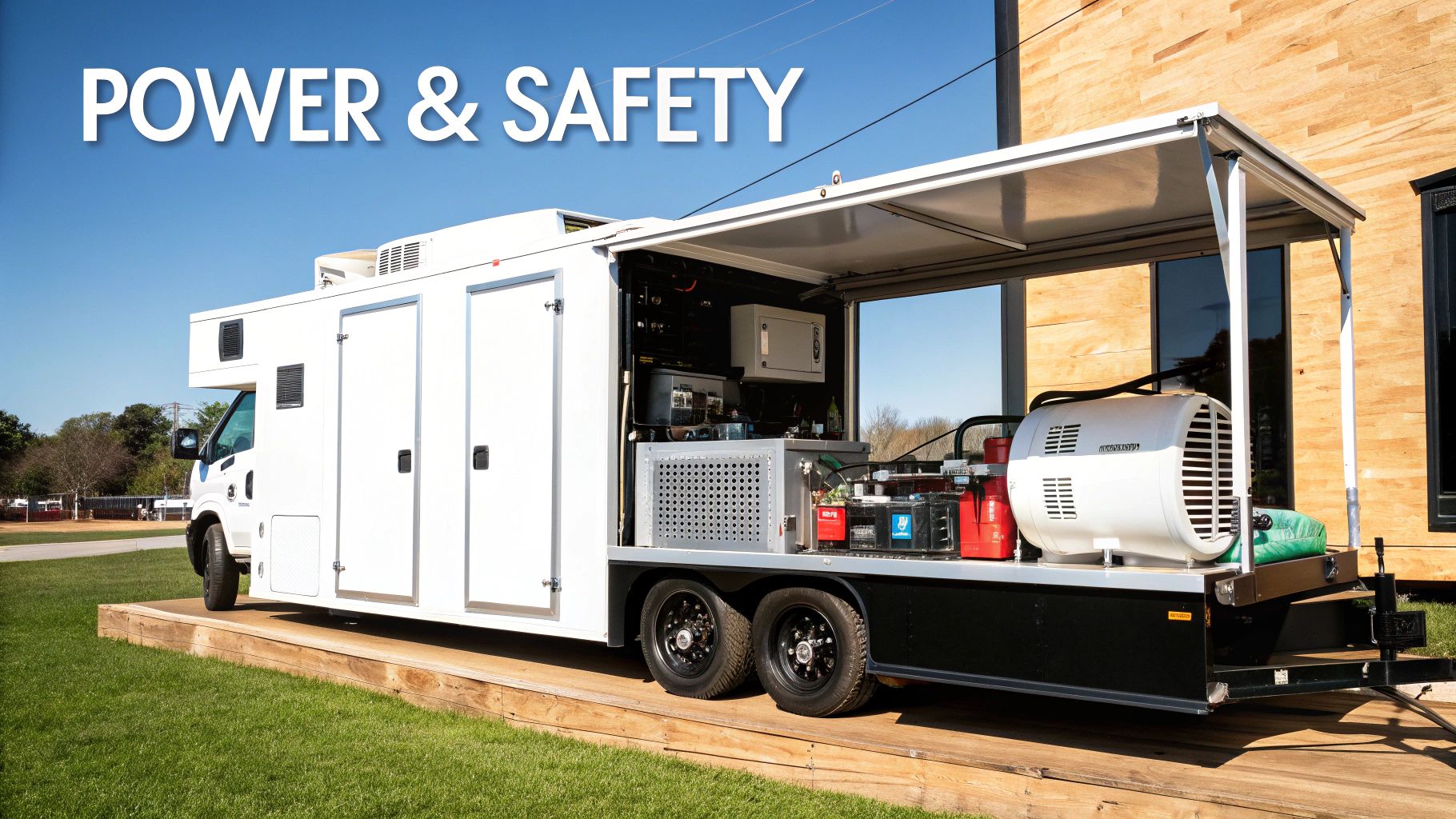
Before you can even think about what generator to buy, you need to know exactly how much juice your pizza operation is going to drink. This all starts with a power audit—a step many newcomers skip, much to their later regret.
Nailing Your Power Audit
A power audit is just a fancy way of saying you need to add up the wattage of every single thing you plan to plug in. We're talking everything from that power-hungry pizza oven and your refrigerated prep table down to the little things like your POS system and interior lights. Every appliance has a data plate that lists its voltage and amps; multiply those two numbers, and you've got your wattage.
When you're doing the math, you need to plan for two distinct scenarios:
- Startup Wattage: This is the big one. Appliances with compressors—like your pizza prep table and any under-counter fridges—need a massive jolt of power just to get going. This initial surge can be 2-3 times their normal running wattage.
- Running Wattage: This is the power you'll need to keep everything humming along at the same time during a crazy-busy lunch rush.
Here’s the pro move: add up the running wattage for all your equipment. Then, find the single largest startup wattage figure from your list (likely the pizza prep table). Add that startup number to the total running wattage of everything else. That final number is your absolute bare-minimum generator requirement. To be safe, add a 20-25% buffer on top of that. This prevents you from redlining your generator and gives you a little wiggle room if you decide to add more equipment later.
Sizing Up Your Water and Gas Systems
Nothing gets a health inspector's attention faster than your water system. Your local regulations will spell out the minimum size for your freshwater and greywater tanks. A common rule of thumb is that your greywater tank must be at least 15% larger than your freshwater tank. This is non-negotiable and prevents any chance of a nasty overflow.
A classic rookie mistake is underestimating how much water you’ll actually use. A standard three-compartment sink plus a separate handwashing sink (both required almost everywhere) will drain a small freshwater tank faster than you think, potentially shutting you down mid-service.
For high-heat equipment like pizza ovens, propane is usually the way to go. This isn't a DIY job. Your entire system must be installed by a licensed pro, properly enclosed in a ventilated and secured cage, and loaded with all the required safety shut-offs. The size of your propane tanks is tied directly to the BTU rating of your gear—the higher the BTUs, the more fuel you'll burn and the bigger your tanks will need to be.
Compliance, Ventilation, and Fire Safety
If there's one area where inspectors don't mess around, it's ventilation and fire suppression. You are legally required to have a commercial-grade ventilation hood over any equipment that produces heat or grease—and yes, that absolutely includes your pizza oven. Its job is to suck all the heat, smoke, and greasy air out of your tiny kitchen and vent it safely outside.
That hood must work in tandem with an automated fire suppression system. These are typically wet chemical systems designed specifically for Class K grease fires, with nozzles aimed right at your cooking equipment that trigger automatically if things get too hot.
And don't forget about electrical safety, especially with all that water around. You'll need comprehensive ground fault protection to prevent shocks. Any outlet near a sink must be a GFCI outlet—it's a simple requirement that can literally save a life.
Navigating the maze of local codes can be a headache, as the rules can change dramatically from one county to the next. Before you build anything, you have to understand the specific food truck permit requirements for every single area you plan to operate in. A truck that passes inspection with flying colors in one city could be shut down in the town next door.
Building an Interior That Lasts: Durable and Sanitary Materials
Think of your pizza truck's interior as a battlefield. It’s constantly under assault from the intense heat of your pizza oven, the splash of cleaning chemicals, and the non-stop vibrations from just being on the road. The materials you pick for your walls, counters, and floors aren't just about looks; they're a critical investment in durability, safety, and your ability to sail through a health inspection.
This is the point where your design moves from a drawing to a real, working pizza restaurant. A professional look is great, but sanitation is everything. Your goal is to build a mobile kitchen that makes daily cleaning simple, eliminates any risk of cross-contamination, and keeps the health inspector happy.
The Stainless Steel Standard
When it comes to surfaces in any commercial kitchen—especially one on wheels—one material is king: NSF-certified stainless steel. It's the non-negotiable industry standard for a bunch of good reasons. Its surface is completely non-porous, meaning it won’t trap bacteria, soak up weird smells, or stain. That makes it incredibly easy to wipe down and sanitize.
Think about your main work areas. The countertops where you prep, the backsplash behind your pizza prep table, and the walls near your oven are all going to see high heat, grease, and moisture. Stainless steel shrugs it all off without warping, rusting, or breaking down. This kind of resilience is exactly why modern food trucks have become such efficient, long-lasting businesses.
The best food truck designs focus on this kind of durability, with features like NSF-compliant refrigeration and stainless steel that can handle the constant heat from a pizza oven. In fact, owners with well-planned trucks often report that 60% hit profitability in their first year, and many credit smart layouts for cutting their setup time by 30%. You can dig into more insights on how smart design boosts profitability from the U.S. Chamber of Commerce Foundation.
Choosing Commercial-Grade Flooring
The floor of your pizza truck will take more abuse than any other surface. It has to be tough enough to handle dropped equipment, constant foot traffic, and some pretty aggressive cleaning. But most importantly, it has to be safe. A greasy, slippery floor is a disaster waiting to happen in a cramped, fast-paced kitchen.
You absolutely need commercial-grade, non-slip flooring. Here are the top choices I see in successful pizza trucks:
- Diamond Plate Aluminum: This is a classic for a reason. It's incredibly durable and has that cool industrial look. The raised pattern gives you excellent grip, even when things get wet.
- Commercial Vinyl Flooring: Modern commercial vinyl is a fantastic option. It's installed as a single seamless sheet, so it's water-resistant and has a built-in textured surface for slip resistance. It's also a bit easier on your feet and back after a long shift.
Your flooring choice directly impacts staff safety and how long your nightly cleanup takes. Never, ever use materials like tile with grout lines. They are impossible to properly sanitize in a truck and will be an instant red flag for any health inspector.
Ultimately, the materials you choose will shape the day-to-day reality of working in your truck. Going with high-quality, easy-to-clean surfaces like stainless steel and proper non-slip flooring is a foundational piece of a successful food truck design. It ensures your mobile pizzeria isn't just efficient, but is also built to meet the highest standards of safety and sanitation from day one.
Common Food Truck Design Questions Answered
As you get closer to your build-out, the big-picture dreams start turning into nitty-gritty questions. Getting these details right is the difference between a smooth launch and a string of expensive headaches. Let's tackle the most common questions I hear from aspiring pizza truck owners to help you build with confidence.
What Is The Ideal Size For A Pizza Food Truck?
There’s no magic number, but the sweet spot for most pizza trucks is between 16 and 22 feet long. The right size for you boils down to your menu and how you plan to operate.
A nimble 16 to 18-foot truck is often perfect if you're running a focused menu with a two-person crew. You'll love the better maneuverability for city streets and tight event spots, not to mention the lower operating costs on things like fuel and insurance.
But if you’re dreaming bigger—multiple pizza styles, sides like wings and salads, maybe a drink station—you’ll need the breathing room of a 20 to 22-foot truck. That extra space is critical for accommodating a larger oven, a longer pizza prep table for all your toppings, and that all-important extra storage.
One piece of advice: always check local city ordinances before you buy. Some towns have strict length restrictions for street parking, and you don't want to find that out the hard way.
How Much Does A Pizza Food Truck Interior Cost?
The cost to build out a pizza truck interior is all over the map. It really depends on whether you start with a new or used truck and the quality of your equipment. A smart, functional build using a used truck and reliable second-hand gear can get you started in the $40,000 to $60,000 range.
If you go for a brand-new, custom-built truck loaded with top-of-the-line equipment, you can easily blow past $120,000. No matter your budget, the big three cost drivers are always the same: the pizza oven, the professional ventilation and fire suppression system, and the generator.
Don't just focus on the big-ticket items. All the small stuff—shelving, your POS system, initial smallwares—can add up faster than you think. A detailed budget with a 10-15% contingency fund is the best defense against those surprise expenses that can stall your launch.
The only way to get a truly realistic budget is to create a detailed equipment list and get multiple quotes from reputable food truck builders.
More Prep Space Or More Cooking Capacity?
This is the classic food truck dilemma, and the answer goes right back to your service model. This choice will define your truck's entire workflow.
Prioritize Prep Space If: Your concept is all about made-to-order, gourmet pizzas with tons of fresh, unique toppings. If that's you, a massive pizza prep table—think 72 or even 93 inches—is your most valuable player. It lets you keep every ingredient perfectly organized, chilled, and ready to go for a smooth, efficient assembly line.
Prioritize Cooking Capacity If: Your business is built for speed. We're talking high-volume, quick-service slices or a very limited menu. In this world, a beast of a conveyor oven that can consistently churn out pizzas is way more important than a huge prep area. Speed is the name of the game.
The most successful trucks usually find a smart balance. They might pair a moderately sized (67-inch) pizza prep table with a super-efficient oven. This setup gives them enough flexibility for custom orders while still having the muscle to crush the lunch rush, hitting that sweet spot between quality and speed.
Beyond your kitchen's function, don't forget how your truck looks. Great branding is what pulls customers in off the street. Integrating your logo into every customer touchpoint is key, and modern tools can make this simple. For example, adding scannable elements like QR code stickers with your logo on your menu board or pickup window can instantly send customers to your online menu or social media, making their experience even better.
Ultimately, every single decision in your food truck design, from the length of the truck to the focus of your kitchen, has to directly support the kind of pizza experience you want to create.
Ready to build the heart of your mobile pizzeria? At Pizza Prep Table, we specialize in providing the high-quality, NSF-certified refrigerated prep tables that are essential for any successful pizza truck. Explore our wide selection of models from top brands to find the perfect fit for your unique food truck design at https://pizzapreptable.com.