

Food Truck Storage Ideas for Your Mobile Pizzeria
Imagine the difference between a pizza truck where the crew is constantly tripping over each other and one where every single ingredient, tool, and pizza box is exactly where it needs to be. That’s the magic of a smart layout. This isn't just about being tidy; it's about building a mobile pizzeria where brilliant food truck storage ideas are the engine driving your speed, quality, and, most importantly, your profits.
Your Pizza Truck Layout Is Your Secret Weapon
We're going to walk through how to turn a tiny footprint into an incredibly effective pizzeria on wheels. From picking dual-purpose workhorses like refrigerated pizza prep tables to mastering the art of vertical storage and keeping everything food-safe, you’ll get real-world strategies that tackle the unique puzzle of a pizza truck. Let's design a space that works as hard as you do.
The Foundation of Pizza Truck Success
For a pizzeria on wheels, your layout isn't a secondary thought—it's the absolute core of your business. A well-designed space has a direct line to how many pizzas you can push out the window every hour. Every wasted second spent digging for toppings or hunting for an extra dough box is lost money, especially during that chaotic lunch rush when every tick of the clock counts.
But here’s the good news: the right food truck storage ideas can turn those tight-space limitations into your greatest strength. With a solid plan, even the smallest truck can run circles around bigger, disorganized competitors. It all starts by choosing equipment that does more than one job.
Why Your Pizza Prep Table Is the MVP
In the world of pizza trucks, the undisputed champion of efficiency is the refrigerated pizza prep table. This single piece of gear is your command center, rolling three essential functions into one compact unit:
- Topping Station: An integrated, refrigerated rail keeps your cheese, pepperoni, veggies, and sauces perfectly chilled and right at your fingertips.
- Prep Surface: A dedicated cutting board gives you a sanitary, tough space for stretching dough and building your masterpieces.
- Bulk Cold Storage: The under-counter fridge provides a surprising amount of room for backup ingredients, dough trays, and other prepped items.
By pulling these jobs together, the prep table frees up priceless floor and counter space. It completely eliminates the need for separate refrigerators and prep counters—luxuries most food trucks just don't have room for.
One study of mobile pizza vendors found that operators who invested in custom, modular storage saw a 25% jump in stock capacity. That directly translates to higher sales potential and happier customers, proving how much these strategic equipment choices matter.
Optimizing your entire workflow around this central hub is the key. For a much deeper look into how to arrange all your equipment for the best possible flow, you should explore some detailed guides on effective pizza truck layouts.
Blueprint Your Pizza Truck Before You Buy Anything
I can't tell you how many times I've seen food truck owners get excited, buy a bunch of shiny new equipment, and then realize it doesn't fit. Don't be that person. Before you even think about a specific pizza prep table, you need a rock-solid plan. This pre-build blueprint is easily the most important step in the entire process.
Your menu is the starting point for everything. A simple truck slinging classic pepperoni and cheese pizzas needs way less refrigerated topping space than a gourmet setup with a dozen fresh vegetable and meat options. Be realistic: how many pizzas are you cranking out during your busiest hour? That number directly tells you how much storage capacity you'll need.
Forecasting Your Pizza Storage Needs
Think through your entire inventory, not just the fun stuff. For a pizza truck, this breaks down into three critical storage categories you have to get right.
- Refrigerated Storage: This is for your cheese, meats, sauces, and prepped veggies. The goal is to figure out the cubic footage required to get you through a peak service day without having to constantly restock.
- Dough Storage: Dough boxes are bulky, and they're non-negotiable. You have to account for enough refrigerated space to properly proof and store every single dough ball you'll need for a full day's service.
- Dry Goods Storage: This covers your flour, canned goods, and spices. But most importantly, it includes your pizza boxes. Underestimating box storage is a classic rookie mistake that turns your workspace into a cluttered, inefficient mess.
Getting your storage right isn't just about being organized. It's about building a profitable business.
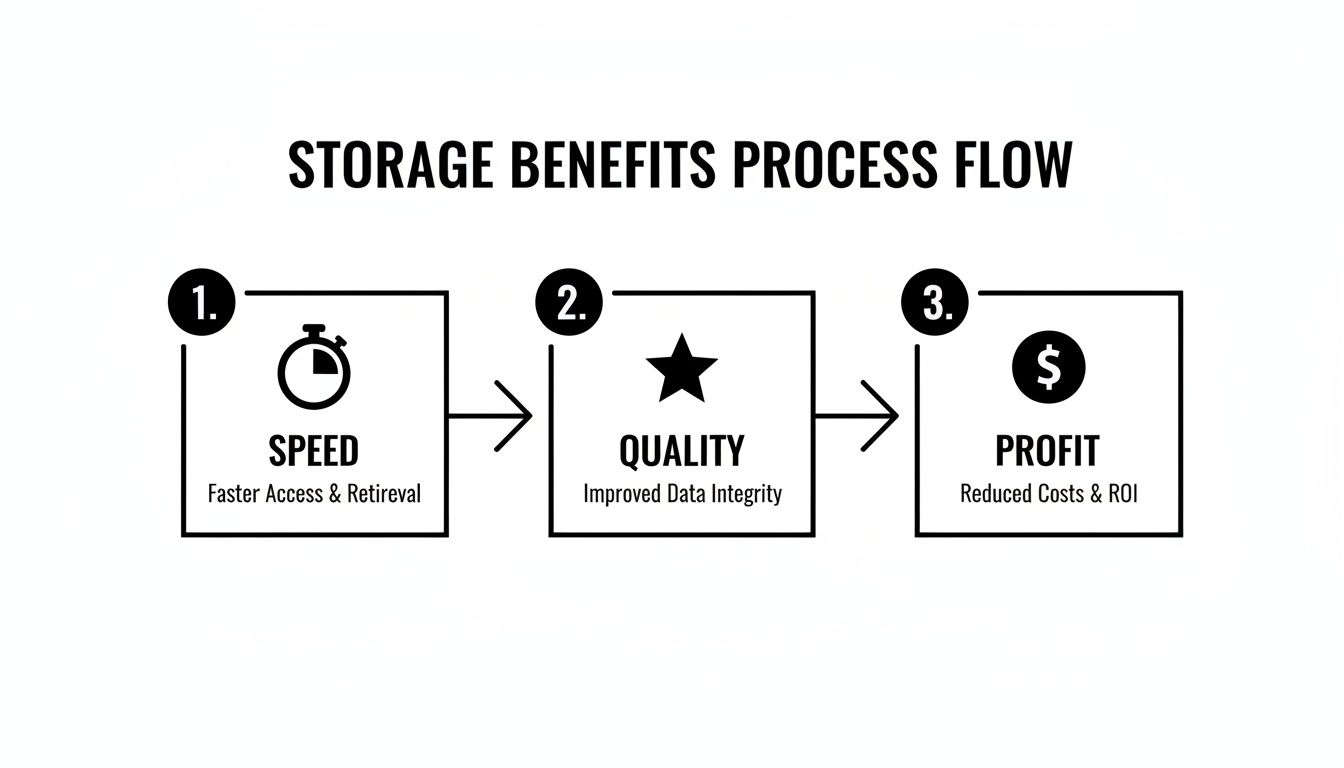
As you can see, a smart layout leads directly to faster service. Faster service means better pizza quality, which ultimately drives your profit. It's a simple, powerful formula.
Measure Twice, Buy Once
Okay, you've got your inventory list. Now it's time to get up close and personal with your truck's interior. Grab a tape measure, a notepad, and get to work. Measure everything. And I don't just mean the basic length and width—you need to account for every awkward angle, permanent fixture, and weird quirk of the space.
Pay close attention to the things that can completely derail an otherwise perfect layout. Note the exact location and dimensions of wheel wells, because they eat up valuable floor space right where you might want to put an under-counter fridge. Also, measure the placement of your service window and entry doors, as these dictate customer flow and create no-go zones for tall equipment.
The most common—and costly—error pizza truck owners make is buying equipment that doesn't fit. A detailed sketch, even a simple one, is your insurance policy against this mistake. It forces you to visualize the workflow and ensure every single piece has a designated home.
Create a simple, to-scale sketch of your truck's floor plan on graph paper. Then, cut out little paper rectangles representing your dream equipment—your pizza oven, prep table, fridge—and move them around. This hands-on approach is the best way to see your workflow in action, spot potential bottlenecks, and make sure there's enough clearance to actually move around.
If you're looking for ideas on planning functional, compact workspaces, you can even consult resources like a guide to lab workstations and tables, which has insights that apply to any efficient layout. This planning phase is where you build the foundation for a killer mobile pizzeria, making sure every inch is optimized before a single dollar is spent.
Choosing the Right Refrigeration for Mobile Pizza Making
When you're running a pizza truck, your refrigeration isn't just another piece of equipment—it's the heart of your entire kitchen. Making the right call here is non-negotiable. It will make or break your speed, your food safety, and ultimately, your profits on a day-to-day basis.
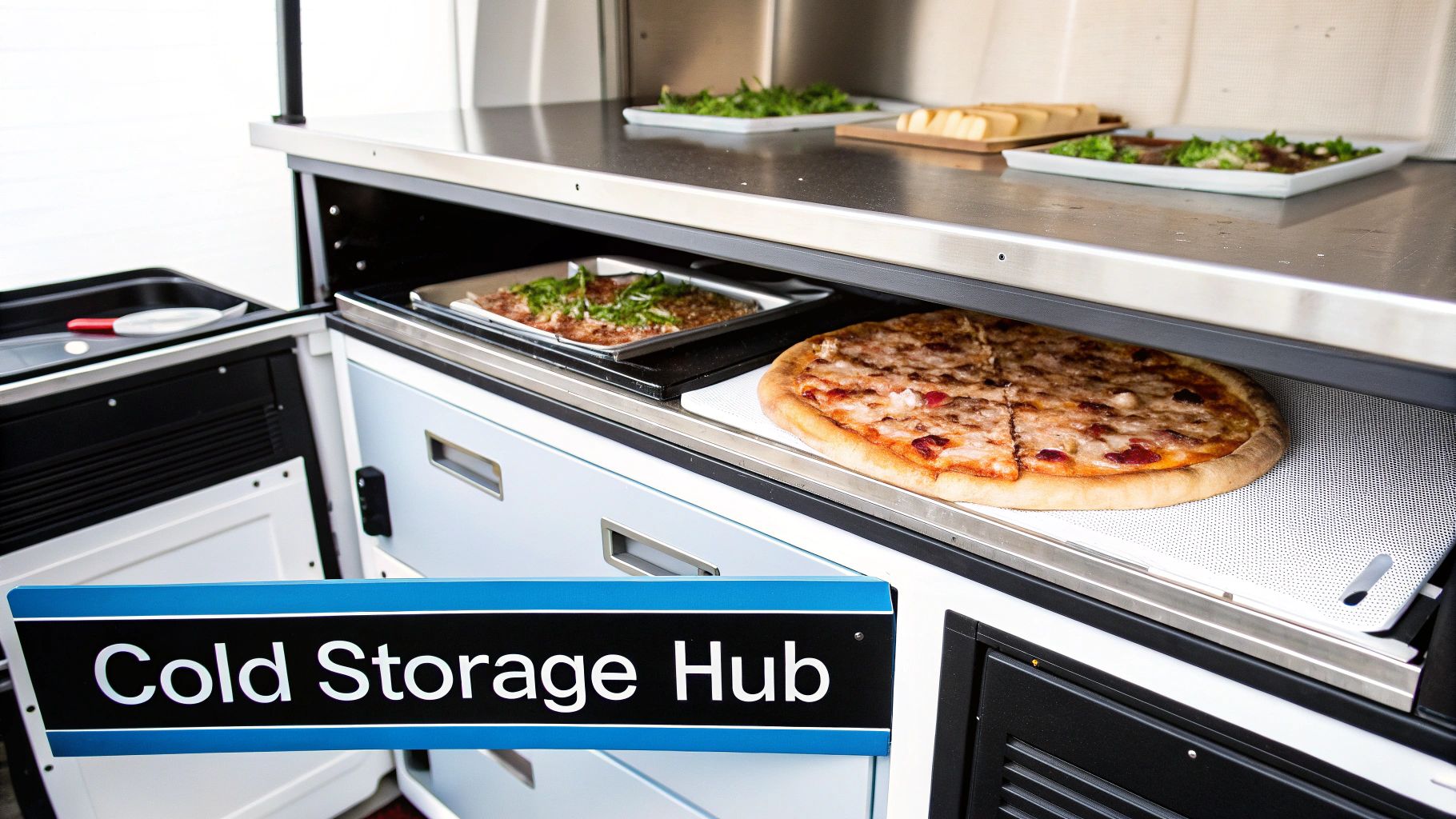
The undisputed champion of cold storage in any pizza truck is the refrigerated pizza prep table. This single piece of gear is your command center, rolling three mission-critical functions into one compact unit that saves you precious space.
- Refrigerated Topping Rail: This is where the action is. A row of chilled pans keeps your cheese, pepperoni, veggies, and sauces perfectly cold and right at your fingertips. No more wasted steps means faster pizzas.
- Dedicated Prep Surface: You get a big, built-in cutting board that’s both sanitary and tough enough for stretching dough and building pies all day long.
- Under-Counter Bulk Storage: Down below, you’ve got a spacious fridge, perfect for stashing backup ingredient pans, fresh dough boxes, and other cold essentials.
Sizing Up Your Pizza Prep Table
Getting the size right from the start is absolutely critical. A table that’s too small will create a massive bottleneck during a rush. One that’s too big will eat up valuable real estate you just don’t have. It's all about matching the unit to your menu's complexity and your honest sales projections.
A compact 44-inch model, for instance, is a fantastic starting point for a new pizza truck with a focused menu of classic pizzas. It gives you enough room for the essentials without cramping your style.
But if you're planning on a wider menu with gourmet toppings or you’re expecting to be slammed, a larger 67-inch model isn't a luxury—it's a necessity. That extra space for toppings and backup ingredients will be your best friend when service gets crazy.
To help visualize the trade-offs, here’s a quick guide to common prep table sizes and what they offer.
Pizza Prep Table Size and Capacity Guide
| Table Size (Inches) | Typical Ingredient Pan Capacity | Under-Counter Storage (Cu. Ft.) | Best For |
|---|---|---|---|
| 44" - 48" | 6-8 (1/3 size pans) | 10 - 15 | Startups, trucks with simple menus, or operators with limited space. |
| 60" - 72" | 8-12 (1/3 size pans) | 15 - 20 | Growing businesses, trucks with diverse menus, and high-volume sales. |
| 90"+ | 12+ (1/3 size pans) | 25+ | High-volume event trucks, commissaries, or trucks with complex menus. |
Think about your busiest hour. The goal is to create a seamless workflow where every ingredient is logically placed and easy to grab without thinking.
Invest in the right-sized pizza prep table from day one to avoid costly upgrades down the road. Be realistic about your menu and peak demand to make a choice that supports your growth, not hinders it.
Don't Forget the Supporting Cast
While the pizza prep table is the star of the show, it can't do everything alone. You'll almost certainly need at least one other refrigeration unit to handle items that don't belong on the prep line.
An under-counter refrigerator is the perfect teammate. Use it for drinks, backup sauces, or extra dough trays. By placing it strategically, you ensure that grabbing a soda for a customer doesn't interrupt the pizza-making flow. These units tuck neatly under countertops, giving you vital cold storage without eating up floor space.
If you want to dive deeper into finding the right units, checking out a guide on the top picks for food truck fridges can give you some great ideas tailored for mobile kitchens.
This Is Non-Negotiable: Go Commercial-Grade
Here’s a rule I tell every new pizza truck owner: always, always buy NSF-certified, commercial-grade refrigeration. I know that residential fridge at the big-box store looks tempting with its low price tag, but it's a disaster waiting to happen on a truck.
Those home units aren't built to handle the constant vibrations of a moving vehicle or the wild temperature swings inside a steel box on a hot summer day. They’ll fail, and it’s just a matter of when.
Commercial units are engineered with powerful compressors, superior insulation, and durable stainless steel construction. They're designed for the chaos of a professional kitchen and will reliably hold safe food temperatures, even when the door is constantly opening during a rush. Investing in robust, road-ready equipment isn't just an expense—it's an insurance policy for your food, your reputation, and your business.
Mastering Vertical Space with Smart Shelving
In a pizza truck, floor space is gold. Every square foot you can keep clear for your crew and your big-ticket equipment is a massive win for efficiency. The single best way to do that? Look up. Mastering your vertical space with smart shelving isn't just one of many storage ideas; it's the core strategy that unlocks your kitchen's real potential.
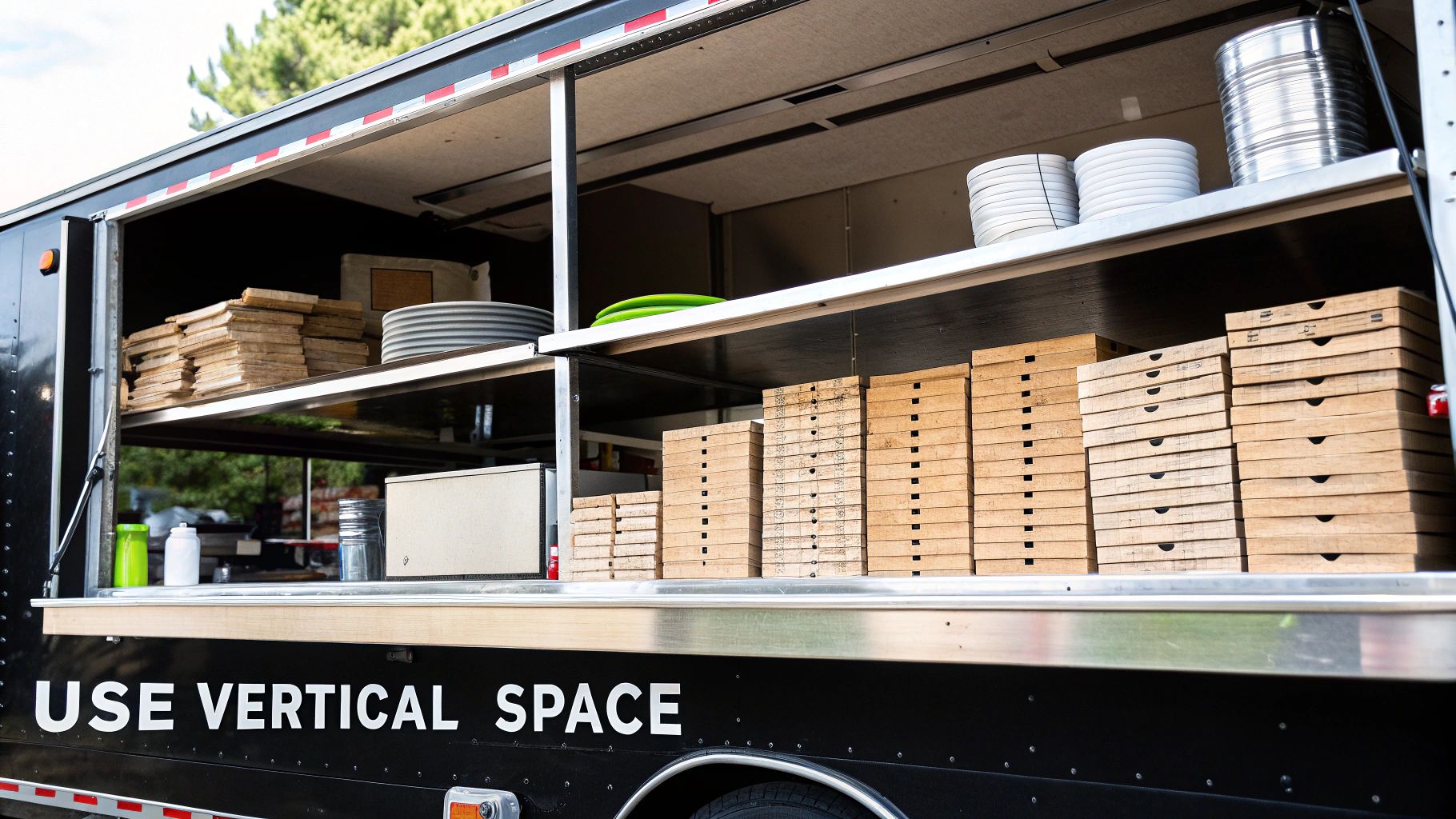
Going vertical turns your walls from simple boundaries into high-capacity storage zones. This move keeps your floors and precious countertops clear, creating a safer, faster workflow. When your team isn’t tripping over boxes or hunting for tools, they can focus on what really matters—making killer pizzas, fast.
Choosing Your Wall-Mounted Workhorses
For a pizza truck, your shelving has to be tough, sanitary, and perfectly matched to what you’re storing. Trust me, not all shelves are created equal, and this is a choice you want to get right from the start.
- Heavy-Duty Stainless Steel Shelves: This is your go-to. Stainless steel is non-porous, a breeze to clean and sanitize, and more than strong enough to hold stacks of pizza boxes, a stand mixer, or bulk containers of flour.
- Wire Shelving: For dry goods, wire shelving is a fantastic choice because it lets air circulate, helping to prevent any moisture buildup. It’s perfect for storing bags of flour, canned tomatoes, and other pantry items.
- Overhead Shelving: Installing shelves high up—maybe above your prep station or service window—is ideal for lighter stuff you don't need every minute. Think extra stacks of napkins, to-go containers, or cleaning supplies. This keeps them out of the way but still easy to grab.
The whole point is to create dedicated zones. Your pizza boxes should have their own shelf near the oven. Your dry ingredients should be grouped together by your dough prep area. For a deeper dive into different shelving types and how to best use them in a mobile kitchen, checking out these essential food truck shelving strategies is well worth your time.
Beyond the Shelf: Creative Vertical Solutions
While shelves are the foundation, some of the most effective storage ideas are the small, clever additions that reclaim counter space. These little tricks can make a surprisingly big difference in your daily grind.
A magnetic knife strip on the wall is a classic for a reason. It keeps your knives secure, sharp, and ready to grab without taking up a single inch of your prep table. Another great move is using wall-mounted racks or hooks for hanging utensils like pizza peels, spatulas, and cutting boards.
When you run out of horizontal space, the only way to go is up. A smart vertical storage plan can effectively double the usable storage in your truck, transforming a cramped kitchen into an efficient, profit-generating machine.
When you're trying to squeeze every bit of utility out of your truck, looking at resources with genius space-saving storage ideas, including smart wall solutions can spark some fantastic inspiration you can adapt for your mobile pizzeria.
The Critical Importance of Secure Installation
Listen up, because this is the most important rule for vertical storage in a food truck: everything must be bolted directly to the truck's frame.
Simply screwing a heavy shelf into the thin interior wall panels is a recipe for absolute disaster. The constant vibration and jostling from the road will rip it right out, sending your inventory crashing down. I’ve seen it happen.
You have to find the metal studs or structural frame of the truck and use heavy-duty bolts and brackets to anchor your shelves. If you're not 100% confident in doing this yourself, hire a professional. The cost of a proper installation is a drop in the bucket compared to the potential damage, lost product, and safety risks of a shelf collapsing mid-drive. It's a non-negotiable step for a safe and functional mobile kitchen.
Designing a Workflow That Actually Works
Having the right gear is one thing, but if your layout forces you to play human Frogger just to get from the fridge to the oven, even the best pizza prep table won't save you from a chaotic service. A truly killer workflow is all about mapping your storage and equipment to the natural journey of a pizza—from a ball of dough to a hot, boxed pie in a customer's hand.
Think of it like a straight line, not a tangled web. You’re building an assembly line in a box. Your cold storage, where the dough and bulk ingredients live, should be at the starting block. From there, the action moves seamlessly to your refrigerated pizza prep table, which is the heart of the entire operation. This is where you stretch the dough, lay down the sauce, and build your masterpiece.
Creating Your Pizza Production Zones
To cut down on kitchen traffic jams and keep service humming along, you need to think in zones. Each zone has one job, which stops your team from tripping over each other during the lunch rush and keeps movement to a minimum.
- The Cold Zone: This is home base for your under-counter fridges and dough storage. It's the first stop, so it needs to be accessible but tucked out of the main travel path.
- The Prep Zone: This is all about the pizza prep table. Every topping, sauce, and tool for building the pizza needs to be within arm's reach right here. Nothing else should be cluttering this critical space.
- The Hot Zone: This space is dedicated to your pizza oven and nothing else. It requires proper ventilation and should be positioned so it’s just a single step to slide a finished pizza inside.
- The Service Zone: Located right by the service window, this is your finishing station. Pizza boxes, cutters, and any final condiments should be neatly organized here to make that last hand-off lightning fast.
This zonal approach is a fundamental principle of professional kitchen design, adapted for the tight quarters of a truck. It’s what keeps the person building pizzas from colliding with the person taking orders.
Mobile Pizzeria Safety Protocols
A food truck isn't just a tiny kitchen; it's a kitchen on wheels, and that brings a whole different set of safety challenges. A smart layout is your first line of defense, but you also need rock-solid rules for when you’re moving and when you’re serving.
Before you even think about starting the engine, everything gets secured. This means under-counter units must be bolted to the floor, and anything on shelves needs to be locked down with bungee cords or stored in latched containers. A loose container of flour makes a mess you'll be cleaning for days; a shifting fridge is a genuine danger.
Temperature control is completely non-negotiable. Your refrigerated prep table and any other coolers have to hold food-safe temperatures (below 40°F) at all times—both on the road and during service. I always recommend using an independent thermometer to double-check your built-in gauges regularly. This isn't just good advice; it's a critical health code requirement that protects your customers and your business.
An organized pizza truck isn't just for looks. It directly leads to a 15-20% drop in order errors and a major boost in service speed. That efficiency is what separates a struggling truck from a highly profitable one.
At the end of the day, a logical workflow is the glue holding all your brilliant food truck storage ideas together. It transforms your truck from a collection of equipment into a high-performance pizza machine. With the global food truck market projected to hit USD 6.06 billion by 2030, efficiency is the key to carving out your piece of the pie. Dig deeper into the growing food truck market trends and you'll see—your workflow is your secret weapon.
Answering Your Pizza Truck Storage Questions
When you're designing a mobile pizzeria, a few questions always bubble to the surface. I've heard them from dozens of new operators, and getting these details right from the start can be the difference between a smooth service and a chaotic one. Let's tackle the big ones.
What’s the single most important piece of storage equipment for a pizza truck?
Hands down, it's the refrigerated pizza prep table. This thing is the undisputed MVP of any pizza truck, period.
Think about it: it's your topping station, your main prep surface, and a bulk refrigerator all crammed into one efficient footprint. This one piece of gear saves a massive amount of space by knocking out the need for separate refrigerators and work tables. In a truck where every inch is prime real estate, the pizza prep table is a non-negotiable cornerstone of your entire workflow and one of the best food truck storage ideas out there.
How do I keep everything from sliding around when I drive?
This is a huge safety issue that rookies often overlook. Simply screwing shelves into the thin interior walls of your truck is a recipe for disaster; they have to be bolted directly into the truck’s metal frame with heavy-duty brackets.
For any equipment sitting on countertops, use commercial-grade non-slip mats. You can also add brackets to lock them down for extra security. And this is critical: all your under-counter units like refrigerators or freezers must be bolted to the floor. No exceptions. This prevents any dangerous shifting while you’re on the move.
One of the most common mistakes new operators make is underestimating the forces inside a moving truck. Securing every single item, from shelves to salt shakers, isn't just about being organized—it's an essential safety protocol.
What containers work best for toppings and dough in a food truck?
Choosing the right containers makes a world of difference for both food safety and sheer efficiency. Get this right, and your service will feel ten times smoother.
- For Pizza Toppings: You have to use NSF-certified polycarbonate or stainless steel food pans that come with tight-fitting lids. They're specifically designed to fit perfectly into the refrigerated rail of your prep table, which keeps ingredients fresh, prevents spills, and makes cleanup a breeze.
- For Pizza Dough: Stackable, airtight dough boxes are essential. They aren't just containers; they are purpose-built to control the proofing environment, protect your dough from drying out, and stack perfectly to maximize your precious refrigerated space.
At Pizza Prep Table, we live and breathe this stuff. We specialize in providing the durable, NSF-certified refrigeration that forms the backbone of a successful mobile pizzeria. From compact units perfect for startups to larger models for high-volume trucks, we have the equipment to make your food truck storage ideas a reality. Explore our selection and find the perfect fit for your business at https://pizzapreptable.com.