

How to Open a Pizza Restaurant: A Complete Step-by-Step Guide
So, you’ve got a killer pizza recipe. That’s where it all begins. But turning that passion into a profitable business—that's a whole different ball game. It all starts with a rock-solid concept and a business plan that’s more than just a document for the bank. It's your blueprint for success.
Your Blueprint for a Successful Pizza Restaurant
Before you even think about stretching your first dough, you need to lay the groundwork. This isn't just paperwork; it’s the strategic foundation that will guide every single decision you make, from your menu to your marketing.
First things first: what’s your identity? Are you a classic New York-style slice shop with foldable, cheesy perfection? A Neapolitan pizzeria centered around a wood-fired oven? Or maybe a fast-casual spot offering build-your-own pies for the lunch crowd?
Nailing this down is critical. A clear concept helps you attract your ideal customer and gives you a fighting chance in a crowded market. Think about what makes your pizzeria different. Is it a secret family recipe for your sauce? A commitment to vegan options using house-made cashew cheese? Or maybe it’s your lightning-fast delivery service. This is your brand, and it’s what people will remember.
Laying the Groundwork with a Solid Plan
Once you know who you are, you need to build the plan. This document is your operational playbook, detailing everything from your mission statement to your five-year financial forecast. Trust me, you'll need it to secure funding, and it'll become the yardstick you measure your success against.
A good business plan forces you to answer the tough questions upfront. It should cover:
- Executive Summary: A quick, powerful overview of your entire vision.
- Company Description: What is your pizzeria, what’s its legal structure, and what unique value are you bringing to the table?
- Market Analysis: Who are you selling to? Who are your local competitors? What are the current trends in pizza?
- Operations Plan: How will you run the shop day-to-day? Think staffing, inventory, and customer service.
- Financial Projections: This is the big one. You need startup costs, revenue projections, and a break-even analysis.
This process transforms your dream into an actionable strategy, moving you from a great idea to a planned launch.
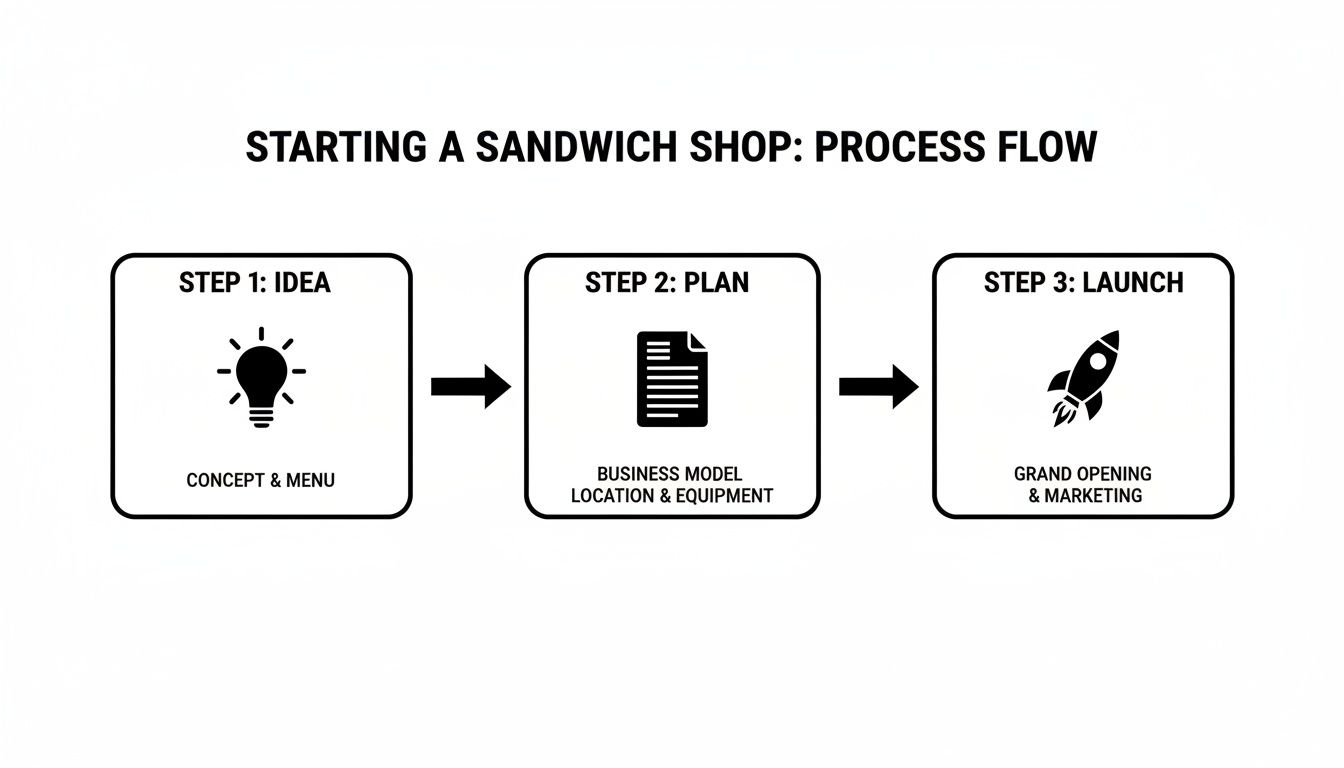
This visual really drives home that a successful opening is a deliberate progression. It’s not just about having a great idea; it’s about having a well-structured plan to bring it to life. For a deeper dive, our checklist for opening a restaurant breaks down these initial steps in even more detail.
Here's a quick look at the major milestones you should be hitting in this initial planning phase.
Initial Pizzeria Startup Checklist
| Milestone | Key Action | Why It's Critical |
|---|---|---|
| Concept Definition | Decide on your pizzeria's theme, style, and unique selling proposition. | This defines your brand and target audience, setting you apart from the competition. |
| Market Research | Analyze local demographics, competition, and foot traffic patterns for pizzerias. | Ensures there's a real demand for your concept in your chosen area. |
| Business Plan | Write a comprehensive plan covering financials, operations, and marketing. | It's your roadmap for success and is essential for securing any kind of funding. |
| Initial Budgeting | Create a detailed budget for startup costs, including an oven, pizza prep tables, and rent. | Prevents cash flow issues and helps you understand your true financial needs. |
Getting these steps right from the start will save you countless headaches and set a strong foundation for everything that follows.
Your business plan is more than a document for investors; it's a living guide for you and your team. It forces you to think through challenges before they arise and keeps everyone aligned with the same goals.
Ultimately, this planning phase is about minimizing risk and setting your pizzeria up for long-term success. The pizza market is massive and ever-growing, and a solid plan is your ticket to carving out your slice of the pie.
Crafting a Menu That Sells More Than Just Pizza

Your menu is so much more than a list of food. It's the heart of your pizzeria, the core of your brand, and the single biggest reason people walk through your door. While pizza is obviously the star of the show, a smart, well-rounded menu can dramatically widen your appeal and fatten your profit margins.
The secret is striking the right balance. You need the beloved classics to get people in the door, but you also need unique, signature offerings to get them talking. A perfect Margherita or pepperoni pizza is a safe bet for any customer. But a "Spicy Honey & Soppressata" pie? That's what they’ll remember, tell their friends about, and plaster all over social media.
This is especially true when you start thinking beyond the pie. Adding high-quality sandwiches to your lineup can capture an entirely different customer, particularly the always-lucrative lunch crowd. This isn't a wild guess; it's a calculated business move backed by some pretty compelling data.
Capitalizing on the Sandwich Craze
Never underestimate the power of a good sandwich. Roughly 47% of U.S. adults eat one every single day, making it a golden opportunity for any new pizzeria. With nearly half of those sandwiches eaten at lunchtime, it's no surprise that 44% of restaurants make them a priority on their menus.
Since 2020, trends have shown chicken as the king of proteins, while build-your-own options continue to draw in customers who want things their way. By leaning into these proven demands, you're tapping directly into what people already want. You can dive deeper into these sandwich trends from Tastewise.io.
This doesn't mean you need to pivot and become a full-blown deli. The real beauty here is leveraging the ingredients and workflow you already have for your pizzas. The same delicious meats, cheeses, and fresh veggies on your pizza prep table are the building blocks for incredible hot or cold sandwiches.
A well-equipped pizza prep table is surprisingly versatile. Its refrigerated rails keep sandwich toppings like lettuce, tomatoes, and onions just as fresh as pizza toppings, allowing your team to build both types of orders from a single, efficient station.
This synergy is where you find true efficiency. Your pizza dough can be baked into fantastic sandwich rolls. That rich pizza sauce is the perfect base for a meatball sub. Your specialty cheeses can turn a simple grilled cheese into something people will drive across town for. It's a brilliant way to minimize waste and streamline your entire supply chain.
The Art and Science of Food Costing
Your profitability lives and dies by your pricing, and that starts with obsessive food costing. You have to know the exact cost of every single ingredient that goes into an item, right down to the last pinch of oregano.
Here’s how you break it down for every recipe:
- List every ingredient: Don't forget anything, from the flour in the dough to the olive oil you finish the pie with.
- Calculate the cost per unit: Figure out what each ingredient costs by its purchase unit (e.g., cost per ounce of mozzarella, cost per slice of prosciutto).
- Sum the ingredient costs: Add it all up to find your total plate cost for a single pizza or sandwich.
- Set your menu price: A healthy target food cost percentage is between 28% and 35%. To get your menu price, just divide your plate cost by your target percentage. For example, a $3.50 plate cost divided by 0.30 (30%) gives you a menu price of $11.67.
And please, don't just set your prices and forget them. Food costs are constantly changing. Revisit your numbers at least once a quarter to make sure you're still hitting your margins. This discipline keeps you profitable without having to slam your customers with sudden, huge price hikes.
Sourcing Ingredients That Define Your Flavor
The quality of what you serve is a direct reflection of the ingredients you buy. Building solid relationships with reliable suppliers is one of the most critical steps in learning how to open a sandwich shop or pizzeria that lasts.
- For your dough: Don't just grab any old flour. Play around with different types. "00" flour is amazing for a classic Neapolitan-style pizza, while high-gluten flour gives you that chewy, foldable New York crust.
- For your sauce: Will you go with a top-tier canned tomato like San Marzano, or will you partner with local farms for fresh, seasonal tomatoes? Your choice here says a lot about your brand.
- For your toppings: This is where you can really set yourself apart. Sourcing cured meats from a local artisan or featuring seasonal veggies from a nearby farm isn't just about taste—it gives you an incredible story to tell your customers.
When you build a menu that's not only delicious but also strategically sound, you're building a resilient business. The powerful combination of pizza and sandwiches, anchored by smart costing and quality sourcing, creates an efficient, profitable operation that’s destined to become a neighborhood institution.
Designing Your Kitchen for Peak Pizza Production
Your kitchen is the engine of your pizzeria. It’s not just one piece of equipment, but a whole ecosystem that has to work in harmony. A well-thought-out layout is the real secret sauce behind a smooth, profitable dinner rush versus a chaotic, ticket-littered nightmare. The goal is to build a logical workflow that lets your team pump out perfect pizzas consistently, even when the pressure is on.
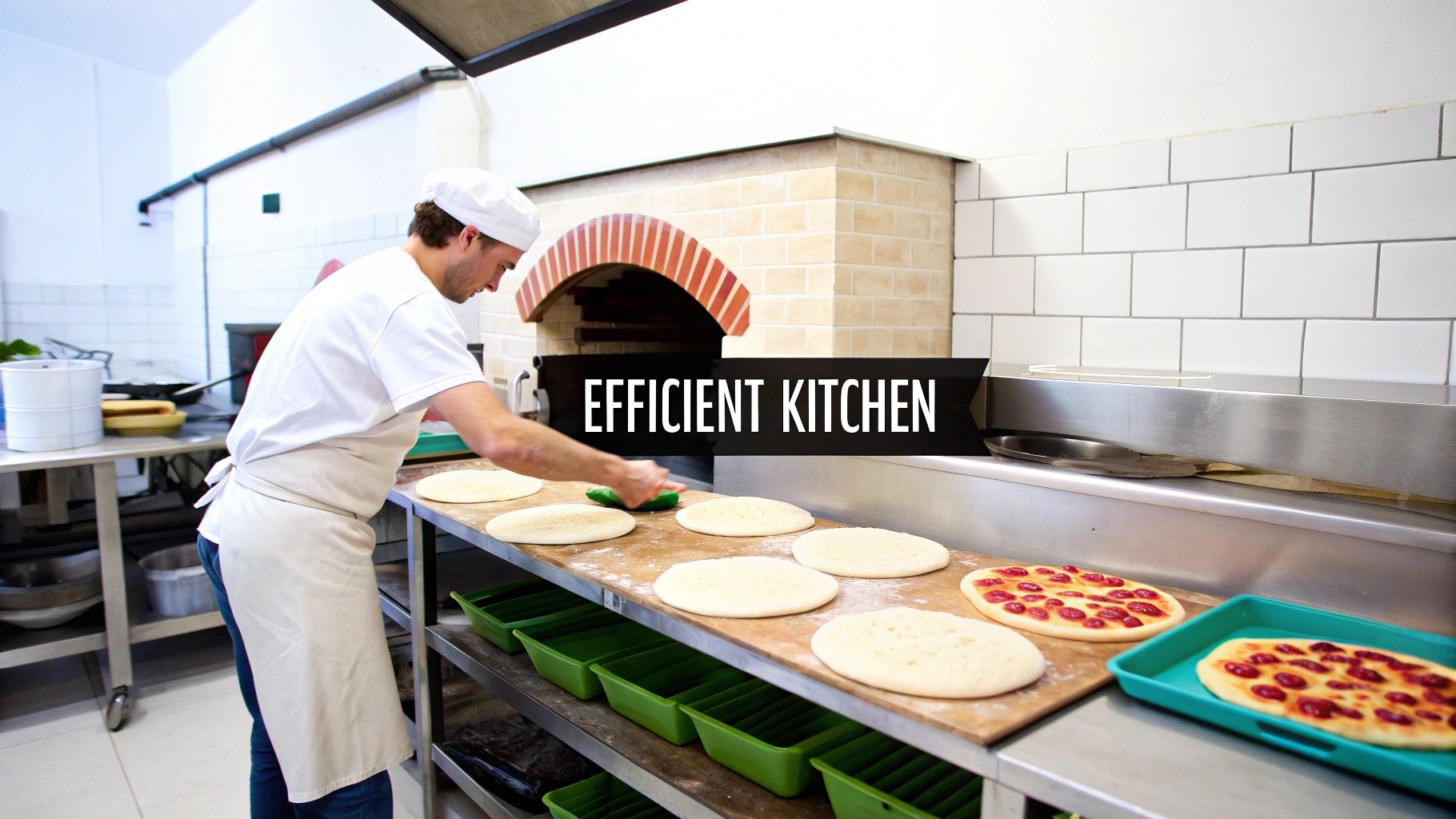
Think about the journey an order takes. It should start with cold storage, move to dough prep, flow right to the assembly line on a pizza prep table, and finish at the oven. Every step needs to minimize wasted motion. If your pizzaiolo has to walk across the kitchen for a container of olives, you’re losing precious seconds that add up to slow service and unhappy customers. If you're feeling overwhelmed, consider bringing in a professional restaurant design service to help map out a floor plan that makes sense for your space.
The Heartbeat of Your Operation: The Pizza Prep Table
While the oven might get all the glory, the pizza prep table is the true command center. This is where every single pizza gets built from the ground up. It’s a dual-function workhorse, giving you refrigerated storage right below an accessible prep surface. Its design directly impacts your speed, consistency, and food safety.
One of the first big decisions is picking the right size. A bustling pizzeria with a complex menu will likely need a spacious, NSF-certified 67-inch or even 93-inch pizza prep table. These larger units give you tons of refrigerated pan space for all your toppings and a generous cutting board for multiple employees to work side-by-side without bumping elbows.
On the flip side, a smaller counter-service spot or a food truck might find a compact 44-inch unit is a perfect fit. It delivers the core functionality you need without eating up valuable floor space. It all comes down to matching the equipment to your expected volume and menu.
Remember, the whole point of kitchen design is to eliminate friction. Every piece of gear, from the mixer to the prep table, should be placed to create an intuitive path from raw ingredients to a boxed-up pizza. That's how you build a kitchen that practically runs itself.
Essential Equipment for a Pizzeria Kitchen
Beyond the prep table, a few other key players form the backbone of a high-functioning pizzeria kitchen. Each one has a specific job to do, and getting this list right is non-negotiable when you're figuring out how to open a sandwich shop or a full-scale pizza restaurant.
Here's a look at the essential pizzeria kitchen equipment you’ll need to get started.
| Equipment Type | Primary Function | Key Feature to Look For |
|---|---|---|
| Commercial Mixer | Kneading large batches of pizza dough consistently. | A spiral or planetary mixer with a capacity that matches your daily production needs. |
| Pizza Oven | Baking pizzas to perfection with the right crust and melt. | The type that matches your pizza style—deck, conveyor, or brick—and its recovery time. |
| Dough Sheeter | Flattening dough balls into uniform pizza bases quickly. | Adjustable thickness settings to ensure consistency across different pizza sizes. |
| Walk-In Cooler | Bulk cold storage for dough, cheese, sauces, and produce. | Ample shelving and a reliable cooling system that maintains a consistent temperature. |
| Pizza Prep Table | The central station for assembling pizzas with refrigerated topping storage. | NSF certification, adequate length for your workflow, and durable stainless steel construction. |
When this specialized equipment is arranged in a logical flow, your kitchen can handle a serious rush without sacrificing the quality that people will come back for. You can dive deeper into these concepts by exploring professional commercial kitchen layout design principles.
Ultimately, laying out your kitchen is about more than just buying equipment. It's about strategically creating a workspace that supports your team, streamlines your process, and lets you deliver the best possible product. A well-designed kitchen is a direct investment in your pizzeria's success.
Navigating Finances and Legal Hurdles
This is where the dream meets the spreadsheet. Knowing how to open a sandwich shop or a pizzeria successfully means getting a handle on the numbers and cutting through the red tape long before your first customer walks in. The first and most critical step is building a startup budget that’s brutally realistic.
Your budget has to go way beyond the big-ticket items like a commercial oven or a new pizza prep table. You need to account for everything: security deposits, your first big inventory order, licensing fees, employee uniforms, and even a small marketing fund for your grand opening. These "little" costs pile up fast, and a detailed budget is the only thing that keeps them from sinking your launch.
Securing the Right Financing
Once you have a clear, honest number for your total startup costs, the next question is obvious: where does the money come from? Thankfully, you've got a few solid options, and each has its own pros and cons.
- SBA Loans: Backed by the Small Business Administration, these loans often have better terms and lower down payments than what you'd get from a traditional bank. They’re a very popular route for first-time entrepreneurs.
- Traditional Bank Loans: If you have a killer business plan and your personal credit is in good shape, a straightforward loan from a local bank or credit union can be a great way to get the capital you need.
- Equipment Leasing: This is an absolute game-changer for managing your cash flow. Instead of shelling out thousands for a pizza prep table or commercial refrigeration, you can lease it for a predictable monthly payment.
Leasing equipment, especially the expensive stuff, can dramatically lower how much cash you need upfront. This frees up your capital for other essentials like marketing and payroll, giving you the breathing room you absolutely need in those first critical months. For a deeper dive on what to expect, check out this comprehensive restaurant startup costs breakdown.
A classic rookie mistake is underestimating working capital. You need to have at least six months of operating expenses sitting in the bank before you open. This buffer will save you during the initial slow build-up as you find your customer base.
Simplifying Your Legal Checklist
With your finances lined up, it’s time to tackle legal compliance. The list of permits and licenses can feel like a mountain, but they are completely non-negotiable. Think of it as a checklist that protects your business, your team, and your customers.
Every state and city has its own set of rules, so your first calls should be to your local health department and city hall. That said, a few permits are pretty much universal for any business serving food.
Common Permits and Licenses:
- Business License: This is the basic permit to legally operate any kind of business in your town.
- Food Handler's Permit: You and every single employee touching food will need one. It’s a certification that proves your team knows the fundamentals of food safety.
- Health Department Permit: This comes after a thorough inspection of your kitchen and shop to make sure you meet all public health codes.
- Employer Identification Number (EIN): If you plan on hiring anyone (and you will), you’ll need this from the IRS.
Beyond the paperwork, you have to get familiar with workplace regulations. This includes things like the Australian workplace safety standards or the OSHA guidelines in your region. These rules cover everything from non-slip flooring to fire extinguisher placement, ensuring a safe environment for your crew. Getting these financial and legal steps right gives you the solid foundation you need to open your doors with confidence.
Building Your Team and Launching Your Brand
Great pizza is only half the battle. A perfectly crafted pie gets someone in the door, but the real experience—the thing that turns a first-time customer into a regular—comes down to your people and your story. This is where you move beyond ingredients and equipment and start building a team and a brand that people in your community genuinely connect with.
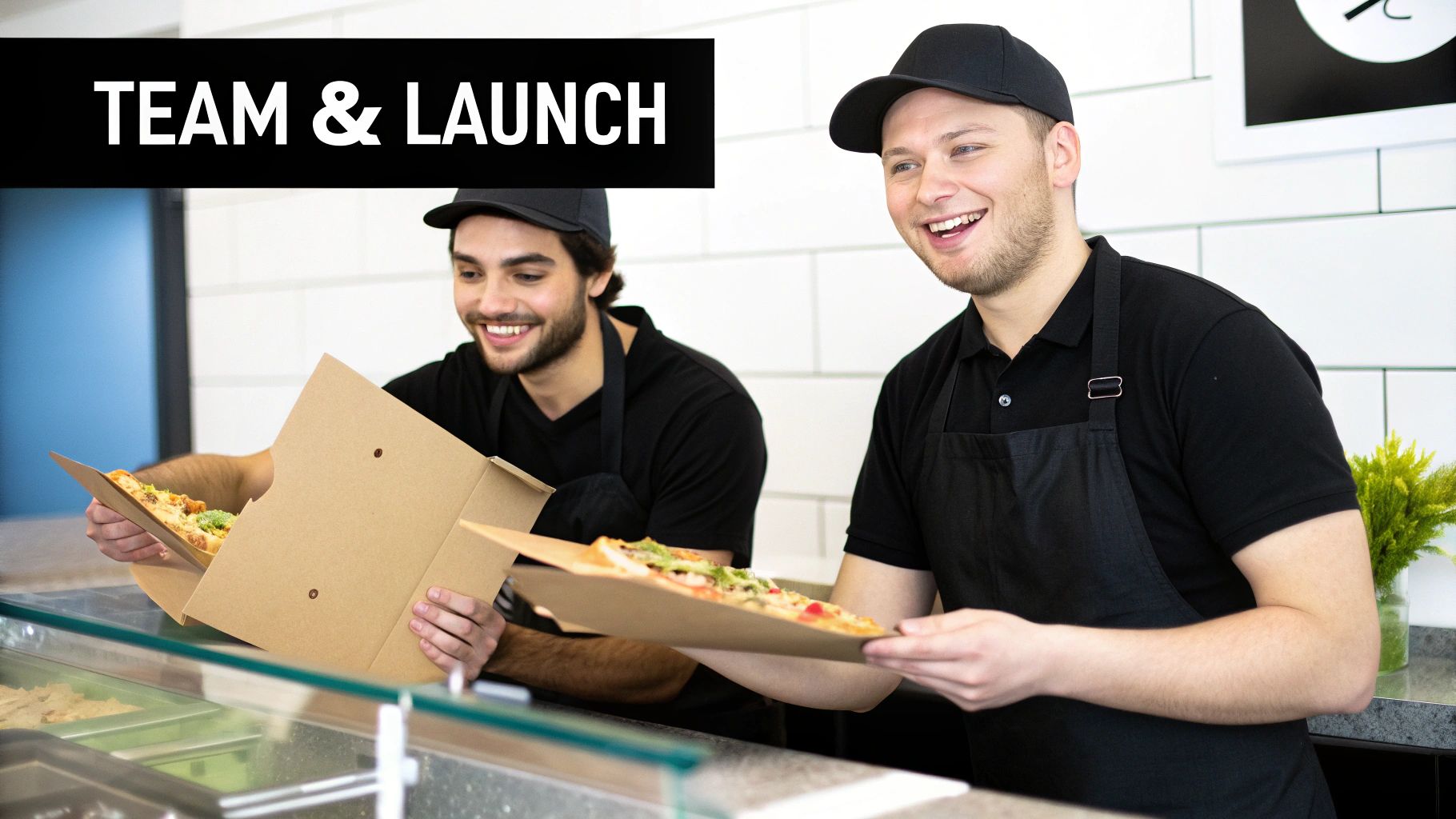
The crew you hire is the face, voice, and soul of your pizzeria. They aren't just making food; they’re creating the atmosphere and delivering the kind of hospitality that makes people feel welcome. Your mission is to find people who are just as obsessed with great customer service as you are with the perfect pizza.
Assembling Your A-Team
Finding the right people starts with knowing exactly what you’re looking for. Sure, you need reliable, hard-working employees. But in a pizzeria, you need something more: a natural spark of hospitality. Look for people who genuinely enjoy making others happy. You can teach someone how to stretch dough, but you can't teach them how to smile.
Once you’ve found them, training becomes the most important job you have. A solid training program is the bedrock of consistency, covering everything from the precise way to build your signature pizza to the friendly greeting every single customer should receive.
Your training checklist has to be comprehensive:
- Kitchen Proficiency: Every team member should understand the entire workflow, from the dough mixer to the pizza prep table to the oven. This ensures anyone can jump in and help during a crazy dinner rush.
- Menu Knowledge: Your staff needs to be able to describe every item on the menu with confidence. They should be able to answer questions, suggest pairings, or explain what makes your house-made sauce so special.
- Customer Service Standards: Define what great service looks like in your shop. This covers everything from how to handle a complaint gracefully to managing a flood of online orders without breaking a sweat.
- Food Safety Protocols: This is non-negotiable. Rigorous training on hygiene, temperature control, and avoiding cross-contamination is essential for keeping your customers safe and sailing through health inspections.
A well-trained, happy team is your single greatest asset. They’ll make better pizza, provide better service, and stick around longer, saving you the massive headache and cost of constant turnover.
Crafting a Brand That Connects
With your team ready to go, it’s time to tell your story. Your brand is so much more than a logo and a color scheme; it’s the promise you make to your customers. It’s what makes your pizzeria different from the one down the street, and it’s how you’ll carve out your space in a crowded market.
And it is a crowded market, but one with huge potential. While knowing how to open a sandwich shop can be lucrative, the pizza industry is a powerhouse. The US pizza market is valued at over $50 billion, with a constant demand for both classic favorites and innovative new styles. In a fragmented industry full of giants and independents, your unique brand and stellar team are how you stand out. You can dig into these sandwich market outlook findings on ResearchAndMarkets.com to understand how diverse food markets are evolving.
Your brand story has to be authentic. Are you a family using recipes passed down for generations? A modern spot obsessed with sustainable, locally-sourced ingredients? Whatever your angle is, weave it into everything—your menu, your decor, your social media, and how your team talks to customers.
Your brand is the reason someone chooses you over the competition before they’ve even tasted the food. It’s the feeling they get from your Instagram, the look of your menu, and the story you tell.
Launching with a Bang
Your launch plan is all about building a groundswell of excitement before you even unlock the doors. A successful grand opening doesn’t just happen by accident; it’s the result of a smart, targeted marketing push designed to get your community buzzing.
Start making noise a few weeks before you open. Use social media to post sneak peeks of your menu, introduce your new hires, and show off the space as it comes together. Run a contest for "free pizza for a year" to build an email list and a social media following before you’ve sold a single pie.
Consider a few pre-launch tactics that punch above their weight:
- Local Partnerships: Team up with a nearby brewery or coffee shop for a cross-promotion. Give them a stack of "free slice" coupons to hand out to their customers, and do the same for them. It’s an instant win-win.
- Influencer Outreach: Forget expensive ads. Invite local food bloggers and Instagrammers to a private soft opening. A few well-placed, authentic posts can generate more genuine excitement than you could ever buy.
- A Memorable Grand Opening: Make your first day an event. Think live music, a ribbon-cutting ceremony with the local chamber of commerce, and some killer introductory deals. This draws a crowd, creates a festive vibe, and gets people talking.
Your launch sets the tone for everything that follows. By combining a fired-up, well-trained team with a compelling brand story and a strategic launch, you’re not just opening another pizzeria. You’re building a neighborhood institution that people will be excited to support for years to come.
Got Questions? Let's Talk Shop.
Once you start getting serious about opening a pizzeria, the questions really start flying. It's completely normal. From figuring out startup costs to sweating the daily details, getting straight answers is the best way to dodge those rookie mistakes that can trip you up early on.
Think of this as our little sit-down to tackle the big questions head-on. Getting these answers sorted out will give you the confidence to move from the drawing board to your grand opening.
How Much Dough Do I Actually Need to Start?
This is the big one, and the honest answer is: it depends. The initial investment to get a pizza shop off the ground can swing wildly. A small, scrappy takeout and delivery joint might get started for around $75,000. But if you’re dreaming of a big, full-service restaurant in a hot neighborhood, you could easily be looking at $500,000 or more.
A few key things drive that number way up or down:
- The Commercial Pizza Oven: This beast is often the single most expensive piece of gear in your kitchen.
- Kitchen Equipment: We're talking commercial mixers, walk-in coolers, and, of course, your pizza prep tables.
- Rent and Renovations: Finding the right spot and then getting it built out to meet health codes can be a massive expense.
- Opening Inventory and Marketing: You need cash to stock the pantry and let everyone know you're open for business.
Here’s a pro tip: look into equipment financing or leasing. It’s a smart way to manage those huge upfront costs. This frees up your cash for the things you can't finance, like paying your new team and covering bills for the first few months.
Can You Really Make Good Money Selling Pizza?
Absolutely. Pizzerias can be seriously profitable. In fact, it’s not uncommon to see profit margins between 15% and 20%, which is way higher than many other types of restaurants. The magic is in the low cost of your core ingredients—flour, water, and yeast don't break the bank.
But here’s the catch: that profitability doesn’t just happen. You have to manage it relentlessly. Hitting those high margins means keeping a death grip on your food costs (especially cheese and proteins, which can fluctuate like crazy) and being smart about labor scheduling. Building a loyal following with amazing, consistent pizza is what keeps the money coming in long-term.
What’s the One Piece of Equipment I Can’t Skimp On?
Everyone thinks it’s the oven, and while that’s obviously crucial, I’d argue the true heart of your entire operation is the pizza prep table. It's the command center. It’s where every single pizza you sell comes to life. Its design and reliability have a direct impact on your speed, efficiency, and consistency.
A quality, NSF-compliant refrigerated prep table is a two-for-one powerhouse. It keeps all your toppings—sauce, cheese, veggies, meats—at a safe, fresh temperature while keeping them perfectly organized and right at your fingertips. Investing in a great prep table means your crew can work faster and churn out a consistent product, especially when the dinner rush gets chaotic.
What Are the Toughest Parts of Opening a Pizzeria?
Opening any restaurant is a grind, but pizzerias have their own unique set of challenges. Get ready for intense local competition (there's always another pizza place), the daily battle to maintain food quality and consistency, and the headache of managing volatile ingredient costs.
The only way to win is to have a strong identity. What makes your shop different? Is it an incredible sourdough crust? Over-the-top customer service? Your deep roots in the local community? You have to figure out what makes you special and shout it from the rooftops.
Beyond that, disciplined inventory management is non-negotiable if you want to control your costs. And a well-trained, motivated team is the only way to make sure every pizza that goes out the door is one you’re proud of.
Ready to build the engine for your new pizzeria? At Pizza Prep Table, we specialize in providing the high-quality, NSF-certified equipment you need to succeed. From versatile pizza prep tables to under-counter refrigeration, we have the tools to bring your culinary vision to life. Explore our selection and find the perfect fit for your kitchen at https://pizzapreptable.com.