

Choosing the Best Commercial Refrigerator for a Pizzeria
When you're outfitting a pizzeria, the best commercial refrigerator you can buy isn't a typical stand-up unit—it's your pizza prep table. This single piece of equipment is the command center for your entire kitchen. Get this choice right, and it will directly boost your speed, ingredient quality, and, ultimately, your bottom line.
Why Your Pizza Prep Table Is Your Most Critical Choice
The pizza oven might get all the attention, but the pizza prep table is where the magic really begins. I've seen it time and time again in pizzerias: a poorly chosen unit creates chaos during a rush, while the right one makes the whole operation feel smooth and effortless. It’s so much more than just a fridge; it's a purpose-built workstation designed to kill bottlenecks and streamline your entire pizza production line.
This specialized refrigerator rolls three essential components into one efficient footprint:
- A Refrigerated Topping Rail: This is where your cheese, pepperoni, vegetables, and other pizza toppings live, perfectly chilled and right at your fingertips. It’s a non-negotiable for food safety and lightning-fast pizza assembly.
- An Integrated Cutting Board: This gives your pizza-making team a durable, sanitary surface exactly where they need it, letting them stretch dough and build pizzas without taking a single extra step.
- Under-Counter Cold Storage: This section is your immediate backup, keeping extra ingredients, dough boxes, and sauces at the perfect temperature to minimize those time-wasting trips to the walk-in cooler.
The Foundation of an Efficient Pizzeria
Think of the pizza prep table as the heart of your pizzeria's workflow. Every single pizza order starts right here.
A table that's too small will need constant restocking during a dinner rush, grinding your ticket times to a halt. One with a weak refrigeration system can't keep toppings at a safe temperature, which leads to food waste and the kind of health code violations that keep pizzeria owners up at night. In fact, an inefficient prep station can slow down order completion times by up to 20%—a delay that customers definitely notice.
A well-designed pizza prep table is an investment in speed and consistency. It ensures every pizza is made with fresh, safely stored ingredients and gets to the oven faster, which is the key to turning tables and maximizing revenue on busy nights.
Choosing the best commercial refrigerator for your pizzeria means you have to look past simple cold storage. You're actually selecting the central hub that will define your kitchen's efficiency from day one.
For a deeper dive into what makes these units so essential, you can learn more about the features of a commercial pizza prep table in our detailed guide. Making the right choice here sets the stage for a profitable pizzeria, preventing costly workflow headaches before they ever have a chance to start.
Matching Prep Table Size to Your Pizzeria's Volume
Choosing the right size for your pizza prep table isn’t about what you can cram into your kitchen; it’s about what fuels your pizzeria's business. I've seen it a hundred times: a unit that’s too small creates a constant bottleneck during your busiest hours, forcing your team to waste precious time running to the walk-in for more pepperoni.
On the flip side, an oversized unit is just as bad. It eats up valuable floor space you could use for something else and burns more energy than necessary. The goal here is to find that perfect Goldilocks fit for your pizzeria's real-world output.
A small, takeout-focused pizzeria might find a 48-inch table with an eight-pan capacity to be the ideal workhorse. It’s compact, efficient, and holds just enough toppings for a steady but manageable flow of pizza orders. But for a bustling, full-service pizzeria with a diverse menu and heavy dine-in traffic, that same unit would be a disaster. In that scenario, a 93-inch mega-top model, which can hold 12 or more pans, becomes completely non-negotiable.
This infographic really drives home how the right pizza prep table directly impacts your speed, quality, and profit.
It underscores a critical point I always make to new pizzeria owners: a properly sized prep table is a direct investment in your kitchen's efficiency and your restaurant's financial success.
Measure for Success, Not Just for Space
Before you pull the trigger on a purchase, get out your tape measure and be meticulous. But don't just measure the footprint where the unit will sit. One of the most common—and costly—mistakes I see new pizzeria owners make is forgetting to account for proper ventilation clearance.
Most units require at least two to three inches of clearance on the sides and back for the condenser coils to breathe. Without that space, the compressor works harder, your energy bills climb, and the unit’s lifespan shortens dramatically. It's a simple step that saves you a fortune in the long run.
This is more important than ever as the commercial refrigeration market keeps growing. The global market was valued at about USD 85.6 billion in 2024, driven by demands for better efficiency. In the U.S. alone, where commercial refrigeration can gobble up 40% of a supermarket's energy use, manufacturers are focused on creating models that perform better while costing less to run. You can explore more about these market trends and equipment innovations to see why modern designs are so critical.
To help you visualize the options, I've put together a quick guide that connects table size to pan capacity and the type of pizzeria it's best suited for.
Pizza Prep Table Sizing Guide
| Table Size (Inches) | Typical Pan Capacity (1/3 size pans) | Best For | Estimated Footprint (Width x Depth) |
|---|---|---|---|
| 44-48" | 6-8 pans | Small pizzerias, food trucks, limited pizza menus | 48" x 32" |
| 60-72" | 9-10 pans | Mid-volume pizzerias, growing businesses | 72" x 32" |
| 93"+ | 12+ pans | High-volume pizzerias, chains, complex pizza menus | 93" x 32" |
This table should give you a solid starting point. Remember to always double-check the exact dimensions of any model you're considering, as they can vary slightly between manufacturers.
Doors, Drawers, and Tops
The final piece of the sizing puzzle is configuring your pizza prep table for your unique workflow. The choice between standard and mega-top units, and doors versus drawers, will define how your pizza team operates on the line.
- Standard Top vs. Mega Top: A standard top has two rows of pans. A mega-top squeezes in a third row, giving you 50% more topping capacity in the exact same footprint. If your menu is topping-heavy with lots of specialty pies, a mega-top is a no-brainer for your pizzeria.
- Doors vs. Drawers: Under-counter doors are great for storing bulky items like large sauce containers or blocks of cheese. Drawers, on the other hand, are perfect for organizing portioned ingredients and dough boxes, offering quick, ergonomic access without all the bending and reaching.
A lot of seasoned pizzeria owners I work with end up with a combination unit. They'll get a section of drawers for frequently used items right next to a door section for bulk storage. This hybrid approach often provides the best of both worlds, adapting to the dynamic needs of a busy pizza kitchen.
Must-Have Features for a High-Performance Pizzeria
Once you've figured out the right size, the real decision comes down to the features. This is what separates a basic appliance from the engine that drives your entire pizzeria. The best commercial refrigerator for a pizzeria isn’t about flashy bells and whistles; it’s about tough, practical functions that can handle the relentless pace of a dinner rush.
These are the non-negotiables—the features that directly protect your pizza ingredients, speed up your line, and pad your bottom line.
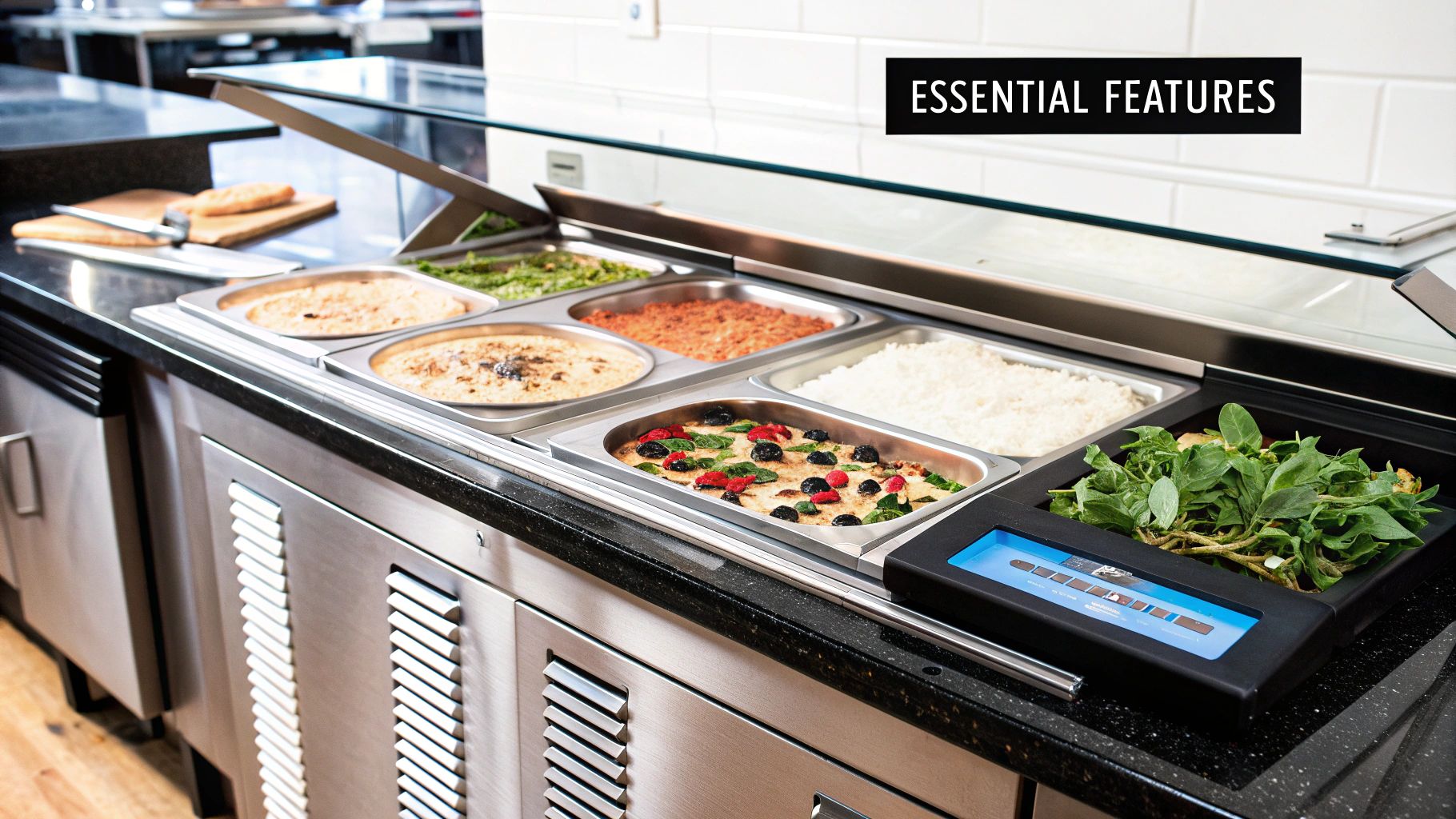
If you take away only one thing, let it be this: you need a powerful, forced-air refrigeration system. Picture a Friday night rush. That topping rail lid is going to be open way more than it’s closed. A standard, cold-wall system just can't recover fast enough, and you'll watch temperatures slowly creep into the danger zone.
Forced-air refrigeration, on the other hand, constantly pushes cold air around every single pan. It’s a game-changer for ensuring your pizza toppings stay at a consistent, food-safe temperature below 41°F, no matter how slammed your pizzeria gets.
Built for the Grind: Durability and Usability
Your pizza prep table is going to take a beating, day in and day out. That’s why the materials and the design of its core components are so crucial for getting real long-term value.
- Stainless Steel Grade: Always look for 304-grade stainless steel, especially for the top surface and the interior. Cheaper 430-grade steel is common, but it's far more likely to corrode when it's constantly exposed to acidic stuff like tomato sauce or vinaigrettes. 304-grade is simply built to last in a pizzeria environment.
- A High-Quality Cutting Board: Your team will be sliding dough, chopping ingredients, and building pizzas on this surface all day long. A thick, high-density polyethylene board is a must. It absolutely has to be removable for easy, deep cleaning and, ideally, reversible to double its lifespan.
A well-built prep table isn't just a purchase; it's a long-term investment in your pizzeria's operational stability. Prioritizing durable materials from the start prevents the constant cycle of costly repairs and replacements that can drain a restaurant's budget.
Smart Features That Save Time and Money
Finally, a few smaller features work together to make your pizzeria more efficient and profitable. These are the details that often get overlooked but have a huge daily impact on your workflow and operating costs.
Self-closing doors are a perfect example. How many times has a cook in the weeds left a refrigerator door slightly ajar? This simple feature stops cold air from escaping, which takes a massive strain off the compressor and lowers your energy bills over time.
Along the same lines, a digital thermostat gives you precise temperature control. You can dial in the exact setting you need for your pizza ingredients and easily monitor it to keep the health inspector happy.
And don't forget adjustable shelving in the under-counter storage. Your needs will change from day to day, from bulk bags of cheese to stacks of pizza dough boxes. Adjustable shelves give you the flexibility to reconfigure your storage on the fly, maximizing every square inch of cold space and keeping your line organized. These are the details that truly define the best commercial refrigerator for a demanding pizzeria.
Calculating the True Cost: Energy Use and Maintenance
The sticker price on a new pizza prep table? That’s just the opening bid in a long-term investment. I’ve seen too many pizzeria owners get hung up on the upfront cost, only to get slammed by high utility bills and expensive repair calls down the line.
The best commercial refrigerator isn't the cheapest one you can find today; it's the one that costs the least to own over its entire lifespan. Figuring out those long-term operating costs is what separates a smart equipment purchase from a costly mistake for your pizzeria.
The most obvious sign of an efficient unit is the Energy Star rating. Don't dismiss this as just a sticker. It's a certification from the EPA that guarantees the machine uses significantly less energy than standard models. Choosing an Energy Star-rated pizza prep table can literally put hundreds, if not thousands, of dollars back into your pocket each year.
This push for efficiency is a huge deal in the industry right now. New environmental laws are forcing manufacturers to get innovative with energy use and refrigerants, with the goal of creating about USD 4.6 billion in consumer savings over the life of the equipment. If you want to get into the weeds, you can learn more about the commercial refrigeration equipment market on FortuneBusinessInsights.com.
The Importance of Modern Refrigerants
Beyond the Energy Star logo, the type of refrigerant a unit uses has massive financial and legal implications. Old-school coolants like Freon are being phased out because of their environmental impact, and you don’t want to be stuck with a pizza prep table that’s about to become obsolete.
Modern pizza prep tables have switched to eco-friendly options, and R290 hydrocarbon is the new gold standard.
Here’s why it matters to your pizzeria: R290 isn't just better for the planet; it’s also much more efficient at transferring heat. That means the compressor doesn't have to work as hard, which translates directly to lower energy bills and a longer life for your unit. Picking a table with R290 refrigerant keeps you compliant with current laws and future-proofs your investment. Our guide on energy-efficient commercial refrigeration dives deeper into this topic.
Think of regular maintenance as preventative medicine for your pizzeria's most valuable kitchen asset. A simple, consistent cleaning schedule is the single most effective way to lower operating costs and avoid a catastrophic failure during a Saturday night rush.
Actionable Advice for Maximum Efficiency
You can buy the most efficient refrigerator on the market, but if you don't treat it right, you'll wipe out all those potential savings. A few simple, consistent habits will make all the difference in your pizzeria:
- Strategic Placement is Key: I can't stress this enough—never put your prep table right next to your pizza oven, fryer, or any other heat-generating equipment. All that ambient heat forces the compressor to run constantly, and your energy bill will skyrocket.
- Give It Room to Breathe: Make sure there are at least two to three inches of clear space around the back and sides of the unit. This isn't optional. The refrigerator needs that airflow to get rid of heat from the condenser coils.
- Clean Coils Quarterly: In a pizzeria, airborne flour and grease are your condenser coils' worst enemies. Clogged coils are the number one cause of premature compressor failure, which is an expensive fix. Set a recurring reminder on your calendar to clean them with a stiff brush and a vacuum every 90 days.
By looking at the total cost of ownership—from the initial price to ongoing energy use and maintenance—you can choose the best commercial refrigerator for your pizzeria with confidence.
Choosing a Reliable Brand and Making Your Purchase
You've done the hard work of figuring out exactly what your pizzeria needs. Now comes the final, crucial step: picking a brand you can trust and making the purchase. This is where all your research pays off and turns into a smart investment for your pizzeria. When you’re choosing the best commercial refrigerator, you’re really looking for a brand known for taking a beating in high-volume, demanding pizza kitchens and still coming back for more.
Some names just keep popping up for a reason—they're known for reliability and performance. But a good brand name is just the starting line. The real value is hidden in the details that make sure your new pizza prep table is a long-term asset, not a recurring nightmare. This is a big purchase in a market that's getting bigger all the time. In fact, the commercial refrigeration equipment market is expected to jump from USD 46.97 billion in 2025 to nearly USD 79.38 billion by 2034, which tells you there's a ton of innovation happening. You can learn more about the growth in commercial refrigeration on PrecedenceResearch.com.
Look Beyond the Logo
A brand's reputation is built on more than just solid steel and good compressors. It's the support system behind the product that really counts when you're in the weeds during a dinner rush. Before you pull the trigger on a pizza prep table, you need to dig into the critical factors that most people skim over.
- Compressor Warranty: The compressor is the heart of your unit, and it's by far the most expensive part to replace. I always tell pizzeria owners to look for brands offering a five-year or longer parts and labor warranty specifically for the compressor. That’s a huge sign of a manufacturer's confidence in their own gear.
- Local Service Availability: What good is a fantastic warranty if the nearest certified technician is three states away? Before you buy, make a few calls to local commercial appliance repair shops. Ask them which brands they service most often and, more importantly, which ones they can get parts for quickly.
Don’t just trust the marketing slicks or the five-star reviews on a dealer’s website. Get into the trenches. Find forums or Facebook groups for independent pizzeria owners and ask them about their real-world experiences. They’ll tell you things about specific pizza prep table models that a spec sheet never will.
Online Supplier vs. Local Dealer
Where you buy your pizza prep table can be just as important as what you buy. Both online suppliers and your local equipment dealer have their pros and cons, and the right call really depends on what you value most—price, support, or convenience.
To get a better handle on the top players, our detailed guide on the best commercial refrigerator brands for pizzerias breaks down the contenders and what makes them stand out.
Comparing Your Buying Options
| Factor | Online Supplier | Local Dealer |
|---|---|---|
| Price | Usually cheaper because they have less overhead. | Might have less wiggle room on price but can offer bundles for pizzerias. |
| Selection | A much wider variety of brands and models at your fingertips. | Limited to the specific brands they have partnerships with. |
| Support | You’ll likely be dealing with support over the phone or via email. | Can offer in-person help, installation, and follow-up service. |
| Delivery | Typically curbside delivery. You’re on your own for installation. | Often includes delivery right into your pizzeria and pro installation. |
Your Final Purchase Checklist
Okay, before you hit "buy" or sign that invoice, take a deep breath and run through this list one last time. Think of it as your final line of defense against a costly mistake for your pizzeria.
- Confirm Dimensions: Did you really double-check your measurements? I'm talking doorways, tight corners, and the final spot for the unit. Don't forget to account for proper ventilation clearance around the back and sides.
- Verify Electrical Specs: Does the unit’s voltage and plug type actually match the outlets in your pizzeria? This is a simple thing that can cause a major headache.
- Review the Warranty: Have you read the fine print? Understand what's covered under the general parts/labor warranty and the separate compressor warranty.
- Check Lead Times: How soon can you actually get the pizza prep table? A killer deal doesn't mean much if it shows up a month after your grand opening.
Taking a few extra minutes at this stage will ensure your new pizza prep table is ready to be a reliable workhorse from the moment it's plugged in.
Common Questions About Pizzeria Refrigerators
Choosing the right commercial refrigerator for your pizzeria is a big decision, and it’s natural to have a few nagging questions even after you’ve done your research. I’ve worked with hundreds of pizzeria owners, and these are the practical, real-world questions that always come up right before they pull the trigger on a pizza prep table.
Getting these details sorted out is what gives you the confidence that you’re not just buying a piece of equipment, but making a smart investment in the heart of your pizzeria.
What Is the Ideal Temperature for a Pizza Prep Table Rail?
Your refrigerated topping rail absolutely must stay between 33°F and 41°F (that’s 0.5°C to 5°C). This isn't just a suggestion—it's the non-negotiable food-safe zone that stops dangerous bacteria from growing on your meats, cheeses, and prepped veggies for your pizzas.
A quality pizza prep table will hold this temperature like a champ, even when your crew is slinging pizzas and opening the lid every ten seconds during a Friday night rush. Here’s a pro tip: don’t just trust the built-in display. I always tell my clients to double-check the temperature periodically with a separate, calibrated thermometer. It’s a simple step that ensures you’re always compliant and your pizza ingredients are always safe.
How Often Should I Clean the Condenser Coils?
In a pizzeria kitchen, flour dust and airborne grease are your refrigerator's worst enemies. They cling to condenser coils and can cause serious problems. You need to be cleaning those coils at least every 90 days. No exceptions.
When coils get clogged, they can’t breathe and release heat properly. This forces the compressor to work overtime, which means your energy bills will skyrocket and you'll drastically shorten the life of the unit. The fix is easy: unplug the unit, get the grille off, and use a stiff brush and a shop vac to clear out all the gunk. Set a quarterly reminder on your phone—it’s a tiny task that prevents catastrophic failures at your pizzeria.
Think of regular coil cleaning as the cheapest insurance policy you can buy for your most critical piece of kitchen equipment. A 15-minute task every three months can save you from a multi-thousand-dollar replacement and a weekend of lost business.
Should My Prep Table Have Drawers or Doors?
This one comes down entirely to your pizzeria’s workflow. There’s no single right answer, but I can tell you what works best in different situations. Each setup has its own distinct advantages for a pizza operation.
-
Drawers: These are fantastic for organization and quick, ergonomic access. They’re perfectly designed to hold standard food pans or stacks of pizza dough boxes, letting your team grab exactly what they need without bending over and rummaging through a dark cabinet.
-
Doors: This option gives you way more flexibility for storing bulky, odd-shaped items. Think big containers of pizza sauce, whole blocks of mozzarella, or even cases of drinks.
From my experience, the smartest pizzeria operators often go for a combination unit. A section with drawers for your high-use, portioned ingredients right next to a door section for bulk storage can create an incredibly efficient workstation. This hybrid approach helps you squeeze every bit of utility out of your pizza prep table's footprint.
Ready to find the perfect workhorse for your kitchen? At Pizza Prep Table, we specialize in connecting pizzeria owners with the industry's most reliable and efficient prep tables. Explore our curated selection of top-tier models and find the best commercial refrigerator for your needs at https://pizzapreptable.com.