

A Winning Business Plan for a Pizza Shop
A solid business plan for a pizza shop is so much more than a document—it's your strategic roadmap. It’s what lays out your unique pizzeria concept, proves there’s a real market for your pies, and convinces investors that your passion for pizza can actually turn into a profitable restaurant.
Defining Your Pizzeria's Core Identity
Let's get one thing straight: the executive summary is the most critical part of your entire business plan. This is your elevator pitch. It’s the first (and sometimes only) section an investor or lender will actually read, so you have to make it count. Your goal here is to tell a story so compelling they can practically taste the pepperoni and are eager to learn more.
This isn't just a quick overview; it's a powerful statement of what you're building. It has to clearly spell out your vision, what makes your pizza shop different from the one down the street, and why it's set up for success from day one. Think of it as the irresistible aroma that sells the slice.
Articulating Your Unique Concept
What kind of pizza restaurant are you really building? That's the first question your executive summary must answer, and "a pizza shop" is not a good enough response. You need to paint a vivid picture for the reader.
Are you launching a fast-paced, New York-style slice shop that will dominate the downtown lunch rush? Or is it a family-friendly, sit-down pizzeria with vintage arcade games and checkered tablecloths? Maybe your dream is a gourmet, wood-fired restaurant focused on artisanal ingredients and craft beer pairings.
The more specific you are, the more credible your plan becomes. This level of detail shows you've thought deeply about your brand and who you're trying to reach. It also has a domino effect on every other decision you'll make, from your menu design right down to the kind of pizza prep tables you’ll need to keep service flowing.
For example, a high-volume slice shop needs a long, refrigerated pizza prep table with tons of space for toppings to ensure speed and consistency. A gourmet pizzeria, on the other hand, might focus on a smaller, more specialized station that showcases fresh, premium ingredients. Your concept dictates your operational needs.
Key Takeaway: Your unique pizzeria concept is the foundation of your entire business. Define it with clarity and passion to immediately stand out from the competition and justify your equipment choices, like the right pizza prep table.
Stating Your Mission and Vision
Your mission statement gets to the heart of why you're in business, beyond just making money. It could be about bringing authentic Neapolitan pizza to your community, creating a beloved neighborhood gathering spot, or supporting local farmers by using only regionally sourced ingredients.
Your vision statement, on the other hand, is about where you want your pizza restaurant to go. Do you plan to become the go-to delivery spot in your city? Or maybe you have a five-year plan to expand to multiple locations?
Together, these statements give your business plan some soul. They show investors you’re building a lasting brand, not just another pizza restaurant.
Here’s a simple way to think about it:
- Mission: A short, present-tense statement about your core purpose. Think, "To serve handcrafted, high-quality pizza in a welcoming environment that feels like home."
- Vision: A future-focused statement about your long-term goals. For instance, "To be recognized as the top-rated pizzeria in the county, known for our culinary innovation and community involvement."
Defining these elements clearly from the start sets a professional tone and builds instant confidence in your plan. It proves you have a clear direction and a passion that extends beyond the kitchen, laying the groundwork for a pizza business that's truly built to last.
Get to Know Your Local Pizza Scene

Before a single pie comes out of your oven, you have to become a student of the local market. A deep-dive market analysis in your business plan for a pizza shop is non-negotiable. It’s the foundation of your entire strategy, proving to investors—and yourself—that there's a hungry, paying crowd ready for what your pizzeria is serving.
This is where you trade gut feelings for hard data. It means figuring out who your customers are, scoping out the competition, and finding that one unique angle that only your pizzeria can own. Without this homework, you’re just guessing.
Who Are You Actually Making Pizza For?
You can't just say "everyone." A successful pizzeria knows its target customer inside and out. Are you gunning for college students who need cheap, fast slices late at night? Or are you aiming to be the go-to weekend spot for families with kids?
Defining your ideal customer shapes every single decision you make—your menu, your prices, your marketing, even your kitchen layout. A family-focused pizza restaurant might install larger booths, while a takeout-heavy spot will prioritize a super-efficient counter and invest in a bigger, more robust pizza prep table to crank out orders during peak hours.
To build this profile, start asking the right questions:
- Demographics: What's the average age, income, and family size in your target neighborhood?
- Behavior: When do they eat out? Are they looking for a quick bite, a full dine-in experience, or delivery to their doorstep?
- Preferences: Do they crave gourmet, artisanal ingredients, or are they all about classic, affordable comfort food?
Answering these questions helps you build a pizzeria concept that meets a real need. It shows you've thought beyond the food and are focused on the people you want to serve.
Scope Out the Local Competition
Once you know who you’re serving, you need to know who you’re up against. Your business plan has to include a brutally honest assessment of the other pizza restaurants nearby. This isn't about copying them; it's about learning from their strengths and weaknesses to find your competitive edge.
Start by mapping out every other pizza restaurant within a 3-5 mile radius. Don’t just look them up online—go there. Order their pizza. Watch how they operate.
Pro Tip: Create a simple competitive analysis spreadsheet. Track their menu items, prices, service speed, online reviews, and social media game. This organized approach helps you spot patterns and identify opportunities they’re completely missing.
Are all your competitors slinging the same old pepperoni and cheese? That could be your opening to launch a menu with unique, gourmet toppings. Do they all shut down at 10 PM? Maybe there’s a goldmine in late-night delivery. These are the gaps where your pizzeria can thrive.
What Makes Your Pizza Shop Different?
All your research should lead you to one crystal-clear idea: your Unique Selling Proposition (USP). This is the one thing that makes your pizzeria different and better than everyone else. It’s the compelling reason a customer will choose your pizza restaurant over the place they've been going to for years.
Your USP could be anything, as long as it's authentic to you:
- The only spot in town with true, wood-fired Neapolitan pizza.
- The fastest delivery around, guaranteed in 30 minutes or less.
- A pizzeria menu built from the ground up for vegan and gluten-free customers.
This differentiation is absolutely critical. The global pizza market is booming—it was valued at USD 282.91 billion in 2025 and is projected to hit USD 340.91 billion by 2034. North America holds a massive 39.13% share of that pie. This incredible growth means there's plenty of room for new pizza restaurants, but only for those who bring something special to the table. You can learn more about these market trends and how they create opportunities for smart pizzeria owners.
Building a Profitable Menu and Efficient Kitchen
Your menu is the heart of your pizzeria, and your kitchen is the engine that keeps it beating. In your business plan, this is the section where you prove to investors that you’ve mastered both the art of a crave-able pizza and the science of a smooth-running restaurant operation. It’s where your culinary vision meets logistical reality.
Profitability isn't just about selling a lot of pizzas; it's about selling the right pizzas at the right price. This process, known as menu engineering, is all about digging into the costs and popularity of every item to squeeze the most profit from your lineup. You simply can't afford to guess what your food costs are.
Designing a Menu That Sells
A smart menu is a focused menu. One of the classic pizzeria startup mistakes is trying to be everything to everyone, which just leads to bloated inventory, wasted food, and a brand that feels confusing. Start with a core group of signature pizzas and a few complementary items that really nail your pizzeria's concept.
Are you opening a classic Neapolitan spot? Your menu should scream authenticity with ingredients like real San Marzano tomatoes and fresh mozzarella. If you're a modern, fast-casual joint, maybe you lean into unique topping combos and killer vegan options.
Here’s a practical way to build your menu:
- Cost Every Single Ingredient: You need to know the exact cost of the dough, sauce, cheese, and every last pepperoni slice for every pizza you sell. This is the only way to price your menu for a healthy profit margin, which typically means aiming for a food cost of 25-30%.
- Balance High and Low-Cost Items: Put that fancy prosciutto and truffle oil pizza on the menu, but make sure it’s balanced with a high-profit, simple classic like a Margherita. This strategy protects your overall margin from getting crushed by expensive ingredients.
- Think Beyond the Pie: High-margin add-ons like garlic knots, simple salads, and fountain drinks are your best friends. They can seriously boost your average check size with very little extra work for your kitchen.
The Engine Room: Your Kitchen Layout and Equipment
An efficient pizzeria kitchen is all about workflow. The layout should follow a logical path, from ingredients coming in the back door to prep, cooking, and finally, boxing it up for delivery or plating it for dine-in. A disorganized kitchen creates pure chaos during a dinner rush, leading to painfully slow ticket times and costly mistakes.
At the very center of this workflow is your pizza prep table. This isn't just a stainless steel counter; it's a refrigerated command center that keeps your ingredients fresh, safe, and perfectly organized. Choosing the right one is a critical decision that directly impacts your speed and consistency, and your business plan needs to show you've made a smart, justifiable choice.
A well-chosen pizza prep table is the single most important piece of equipment for streamlining your pizza-making process. It reduces staff movement, keeps ingredients at safe temperatures, and provides an organized workspace to handle high-volume orders without breaking a sweat.
Selecting the Perfect Pizza Prep Table
The size and features of your pizza prep table should be a direct reflection of your pizzeria's physical space and your menu's demands. A tiny ghost kitchen has completely different needs than a massive, full-service restaurant.
Your pizza prep table is a critical investment. This guide compares different sizes and features to help you find the perfect fit for your pizzeria's specific needs and kitchen layout.
How to Choose the Right Pizza Prep Table
| Table Size | Ideal For | Core Features to Look For | Example Brands |
|---|---|---|---|
| Compact (44-60 inches) | Small kitchens, food trucks, or pizza shops with a limited, focused menu. | Essential refrigerated storage for 6-8 pans, durable cutting board, efficient footprint. | Atosa, Ikon |
| Standard (67-72 inches) | The workhorse for most independent pizzerias with steady volume. | A good balance of workspace and refrigerated capacity for 9-10 pans. | True, Dukers |
| Large (93+ inches) | High-volume pizza restaurants that pump out hundreds of pizzas a day. | Maximum refrigerated storage (12+ pans) allowing multiple chefs to work side-by-side. | Migali, Victory |
Choosing the right pizza prep table is a major capital expense that investors will notice. Justify your choice by connecting it directly to your pizzeria's operational efficiency and sales projections. You can dive deeper into outfitting your space by referencing a complete commercial kitchen equipment checklist to make sure you've covered all your bases.
Forging Strong Supplier Relationships
Finally, your operational plan needs to show you have your supply chain locked down. Consistent, high-quality ingredients are the foundation of great pizza, and that starts with having reliable suppliers. Don't just chase the cheapest price—build real relationships with vendors who get your quality standards and can offer you stable pricing.
In your business plan, list your primary and backup suppliers for key items like flour, cheese, and tomatoes. This shows investors you've thought ahead and have a contingency plan for when—not if—a supplier has an issue. Good supplier relationships can also lead to better payment terms and first dibs on high-quality products, giving your pizzeria a quiet but powerful edge over the competition.
Mapping Out Your Startup Costs and Financials
Alright, this is where your pizza dream gets a price tag. The financial section of your business plan is the moment you translate your passion for the perfect slice into a concrete, numbers-driven strategy. For investors, this is the most important part of the story. It’s how you prove your pizzeria concept isn't just delicious, but genuinely viable.
We're going to break down every expense, from the obvious stuff like an oven to the little things people often forget. Getting this financial map right is critical—it shows you’ve thought through every single dollar it will take to open your pizza restaurant and eventually turn a profit. A well-researched financial plan tells everyone you’re a serious entrepreneur.
The Complete Pizzeria Startup Cost Checklist
Your initial investment is way more than just first month's rent and a giant oven. It’s a mix of one-time purchases and all the ongoing costs you need to cover before you even make your first sale. Nail this list, and you'll avoid those painful cash-flow emergencies later on.
Your plan needs to account for every single line item. These costs generally fall into two buckets: one-time capital expenditures (CapEx) and the initial operating expenses you'll burn through before revenue starts rolling in.
Here are the essential startup costs you absolutely have to budget for:
- Location and Build-Out: This covers your security deposit, first month's rent, and any construction or renovations needed. Think about plumbing for sinks, beefing up the electrical for your ovens, and creating that perfect pizzeria vibe.
- Licenses and Permits: Don't sleep on these—they add up. You'll need a business license, food handler permits for your staff, a certificate of occupancy, and maybe even a liquor license, which can be a huge expense on its own.
- Initial Inventory: This is all the food and supplies for your first few weeks. We're talking flour, cheese, pepperoni, but also things like pizza boxes, napkins, and soda for the drink fountain.
- Marketing and Grand Opening: You need a budget to make some noise before your pizzeria even opens. This could be anything from targeted social media ads and local flyers to a big grand opening event to get the neighborhood buzzing.
- Professional Services: It's smart to budget for the pros. This includes fees for a lawyer to look over your lease, an accountant to set up your books, and maybe a designer for your logo and menu.
- Technology: Think about your Point of Sale (POS) system for taking orders, an online ordering platform, and a kitchen display system (KDS) to keep the back-of-house running smoothly.
Breaking Down Your Capital Expenditures
Capital expenditures, or CapEx, are the big, long-term investments you make in physical assets. For a pizzeria, this is almost all about your kitchen equipment. These purchases are the true backbone of your operation, directly impacting how efficiently you can work and the quality of your pizza.
The heart of your CapEx budget is, without a doubt, the kitchen. Your key investments will include:
- Pizza Ovens: This will likely be one of your single biggest purchases. Whether you go for a classic deck oven, a high-volume conveyor oven, or a rustic wood-fired hearth, it’s a major decision.
- Commercial Mixers: You can't run a serious pizza restaurant without one. They're essential for producing consistent, high-quality dough day in and day out.
- Refrigeration: This includes your walk-in cooler and freezer, but most importantly, your pizza prep tables.
Your pizza prep table is a non-negotiable piece of CapEx. It's the command center where every single pizza gets built. This infographic gives you a quick visual on the common sizes to help you picture what your pizzeria kitchen might need.
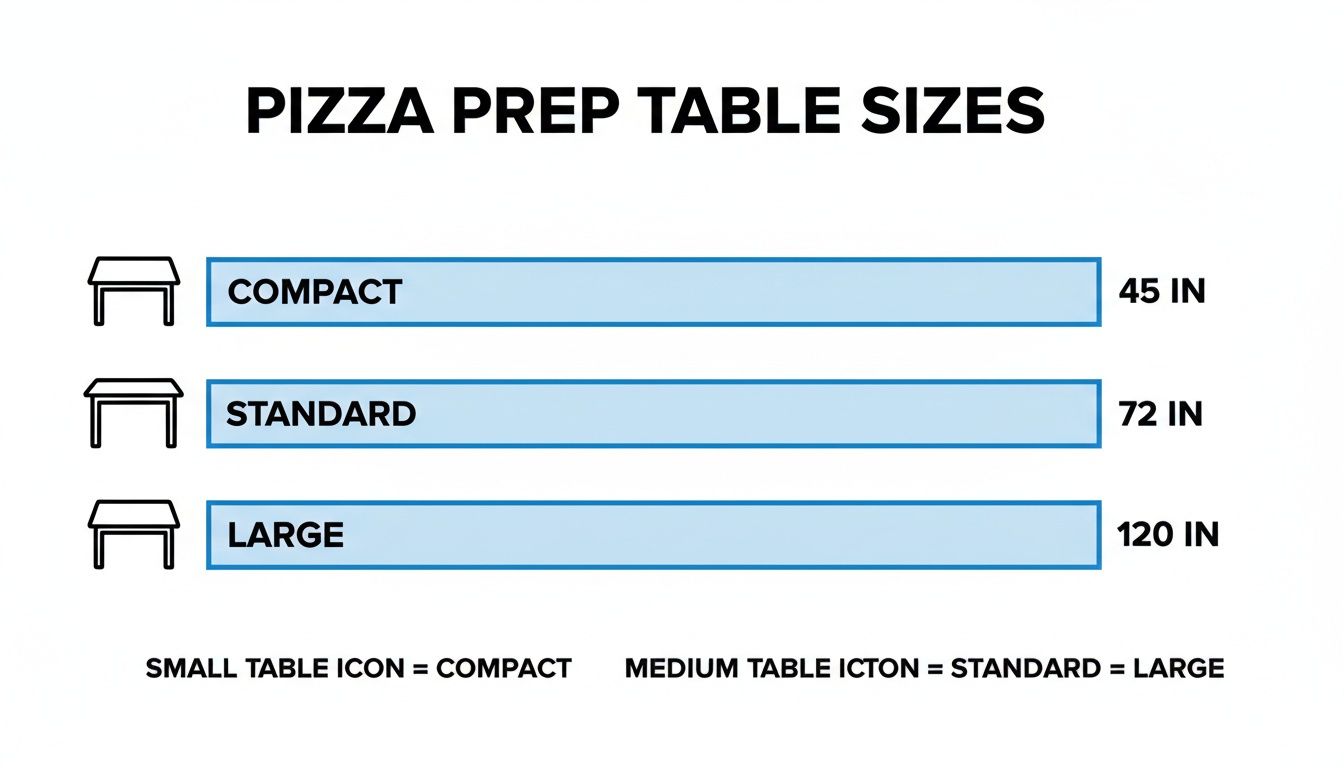
As you can see, a bigger table gives you more refrigerated topping wells and a larger workspace. For a high-volume pizza restaurant focused on speed and efficiency, that extra space is everything. For a complete look at all the gear you'll need, you might find our restaurant startup costs breakdown really helpful.
Building Your Financial Projections
Once you’ve tallied up all your costs, it's time to build the financial statements that investors will pick apart. You need to be realistic here. Base your numbers on solid market research, not just wishful thinking.
Key Insight: Lenders care less about your passion for pizza and more about your ability to pay back a loan. Your financial projections are the language they understand. Make them clear, conservative, and easy to defend.
These are the three non-negotiable financial statements for your business plan:
- Profit and Loss (P&L) Statement: This projects your revenue, costs, and profit over time—usually for the first three to five years. It answers the most basic question: will this pizza restaurant actually make money?
- Cash Flow Statement: This tracks the real cash moving in and out of your business. It's crucial for proving you'll have enough money on hand to pay your bills and handle any surprises.
- Break-Even Analysis: This calculation shows you the exact point where your revenue equals your total costs. It tells an investor how many pizzas you need to sell each month just to cover your expenses and start turning a profit.
Let's be honest, creating these can be a headache. You might want to consider the benefits of outsourcing accounting services to get it right. An expert can make sure your projections are sound and professionally presented, which adds a ton of credibility to your plan.
Weaving Your Marketing and Sales Strategy Into the Plan
Even the world's best pizza won't sell itself. A smart go-to-market strategy is what separates a flash-in-the-pan pizza joint from a beloved neighborhood institution. This is the part of your business plan for a pizza shop where you show investors you’ve got a rock-solid plan to get butts in seats and delivery orders flying out the door from day one.
This isn't just about placing a few ads. It’s about building a brand that people in your community actually connect with. We'll walk through everything from making sure your pizza restaurant is the first result when someone searches "pizza near me" to throwing a grand opening that gets the whole town talking.
Building Your Digital Pizzeria Footprint
These days, your online storefront is just as critical as your physical one. Think about it: when a pizza craving hits, the first move for most people is pulling out their phone. Your mission is to be at the top of that search list.
Getting your digital house in order is non-negotiable. Your first step should be to claim and meticulously fill out your Google Business Profile. I'm talking high-quality, drool-worthy photos of your pizzas, your full menu, hours, and your exact address. Nudge those first happy customers to leave reviews—that positive social proof is one of the most powerful and free marketing tools you'll ever have.
A Social Media Strategy That Actually Sells Pizza
Social media is a visual playground, and what's more visual than a perfect, cheese-pulling slice of pizza? Don't just post randomly. Your strategy should be a deliberate plan to build a local following and drive real orders. For a pizzeria, Instagram and Facebook are your best friends.
- Mouth-watering content: Post crisp photos and short, satisfying videos of pizzas fresh out of the oven.
- A peek behind the curtain: Show your team in action, from tossing dough to arranging fresh toppings on a spacious pizza prep table. This kind of content feels authentic and builds a real connection with your audience.
- Hyper-local ads: Use Facebook and Instagram's targeting tools to run promotions for people within a five-mile radius of your pizza restaurant. You'd be surprised how effective a small budget can be.
To really dial in your approach, it's worth digging into some proven restaurant marketing tips that can boost foot traffic and sales without breaking the bank.
Key Takeaway: Think of social media as your direct line to the community. It's where you build your pizzeria's personality and turn casual followers into loyal, paying customers.
Planning a Grand Opening People Won't Forget
Your grand opening is your one big shot to make a huge first impression. A well-planned launch event can create a wave of local buzz that brings in a flood of customers and kicks off that all-important word-of-mouth marketing.
Don't just unlock the doors and hope for the best. Make it an event. Team up with a local food blogger, offer an irresistible one-day-only deal ("First 100 people get a free slice!"), or host a giveaway. The goal is to create an experience people will be talking about for weeks. A strong opening sets the tone and can give your new pizza restaurant a critical early revenue boost. For more ideas on creating a memorable space, check out our guide on creative pizza shop design ideas.
Mastering Online Ordering and Delivery
In the pizza world, convenience is king. That means getting your online ordering and delivery strategy right from the start. Delivery and takeout aren't just trends anymore; they're how a huge chunk of your customers will want to get your food.
In fact, Mordor Intelligence data projects that carry-out will make up 46.85% of the massive USD 295.92 billion pizza market in 2025. This is a huge opportunity, especially as delivery-only "ghost kitchens" and food trucks—which often rely on compact pizza prep tables—are set to grow.
You have two main paths you can take:
- In-House Delivery: This gives you total control over the customer experience and lets you keep 100% of the revenue. The trade-off? You're responsible for hiring drivers, insurance, and managing all the logistics.
- Third-Party Apps: Services like DoorDash and Uber Eats plug you into their massive customer base instantly. But that convenience comes at a steep price, with commission fees often running between 15-30%.
Many pizza restaurants find a hybrid approach works best, using their own drivers for a small radius and third-party apps to reach a wider area. Your business plan needs to spell out which path you're taking and account for the costs—whether that's a driver's salary or commission fees. It shows investors you understand how modern customers operate and have a profitable plan to serve them.
Answering the Tough Questions About Your Pizza Shop Business Plan
Even with the best guide, you're going to hit some tricky questions when writing your pizza shop business plan. It happens to everyone. This last section is all about tackling those common hurdles head-on.
Getting these details right can be the difference between a plan that gets a green light from lenders and one that ends up in the "maybe later" pile. Let's dig into the big questions, from startup costs to what investors really care about.
How Much Does It Cost to Start a Pizza Shop?
This is the million-dollar question, and the honest-to-goodness answer is: it really depends. Startup costs can swing wildly based on where you are, the size of your space, and the kind of pizzeria you're dreaming of.
A small, delivery-only spot in a town with lower rent might get rolling for as little as $75,000. But if you're picturing a large, full-service pizza restaurant with a bar in a hot downtown neighborhood, you could easily be looking at $500,000 or more.
The trick is to be brutally honest and detailed in your financial projections. You need to account for everything. Major costs always include:
- Rent and Security Deposits: This is often your first big check to write, covering first month's rent and a hefty security deposit.
- Kitchen Equipment: This will be your biggest single expense. We're talking ovens, mixers, and of course, your workhorse pizza prep tables.
- Initial Inventory: All the flour, cheese, sauce, and toppings you need to get through those first few crucial weeks.
- Licenses and Permits: Think business license, health permits, and a liquor license if you're serving alcohol—that last one can be a big-ticket item.
- Marketing Budget: You need cash set aside to make a splash for your grand opening and get the word out.
To make that initial cash burn a little less painful, a lot of new pizzeria owners look at lease-to-own options for their big equipment. It can make getting a high-quality, super-efficient pizza prep table much more manageable right from day one.
What Sections Do Lenders Scrutinize Most?
Every piece of your business plan matters, but from my experience, lenders and investors always zoom in on three specific areas. If you want to get funded, these sections have to be absolutely rock-solid.
First, they will go over your Financial Projections with a fine-toothed comb. Your profit and loss statements, cash flow forecasts, and break-even analysis have to be realistic. They need to be backed by solid research and believable assumptions. Wild guesses about sales are a huge red flag that tells them you haven't done your homework.
Next up is the Executive Summary. This is your elevator pitch on paper. It has to be powerful, tight, and compelling, giving them a snapshot of your pizzeria concept, what makes you different, and why you're going to be profitable. If this section doesn't hook them, they might not even bother reading the rest.
Finally, they’ll dig deep into your Market Analysis. This is where you prove you have an intimate understanding of the local landscape. You need to show who your competition is and lay out a clear, actionable plan for how your pizza restaurant is going to win customers away from them.
Investor Insight: Lenders want to see more than just a great pizza recipe; they want to see a profitable business model. Your financial projections are the proof they need that your passion can translate into a sound investment.
How Do I Choose the Right Pizza Prep Table?
Picking the right pizza prep table isn't just about finding one that fits; it’s a strategic decision. This piece of equipment is the heart of your production line, and your choice should be driven by three things: your menu, your sales goals, and your kitchen layout.
- Menu Complexity: The more toppings you offer, the more refrigerated pan space you'll need. A simple pizzeria menu with 6-8 classic toppings can get by with a smaller, more compact unit.
- Sales Volume: If you're planning to crank out hundreds of pizzas during a Friday night rush, you need a bigger table (think 72 to 93 inches). This gives multiple cooks room to work without creating a bottleneck.
- Kitchen Layout: Measure your space, then measure it again. The table has to fit into your pizzeria kitchen’s natural workflow, allowing for a smooth trip from the fridge to the prep station to the oven.
Always, always prioritize models that are NSF-compliant. This is non-negotiable for meeting health codes and ensuring food safety. In your business plan, you should frame this decision as a key investment in your pizzeria’s speed, consistency, and quality.
At Pizza Prep Table, we understand that the right equipment is the foundation of a successful pizzeria. From compact units for tight spaces to large workstations for high-volume kitchens, we provide the durable, reliable pizza prep tables you need to bring your business plan to life. Explore our selection and find the perfect fit for your vision at https://pizzapreptable.com.