

Profitable Concession Stand Ideas for Pizza Restaurants
So, you're thinking about jumping into the concession business. It's easy to get overwhelmed, but a laser-focused strategy centered on pizza is what will make you stand out from the crowd. This isn't just another list of generic concession stand ideas; this is a real-world blueprint for building a profitable pizza operation. We're going to dig into why specializing in this high-demand food is such a powerful business model for any aspiring pizza restaurant owner.
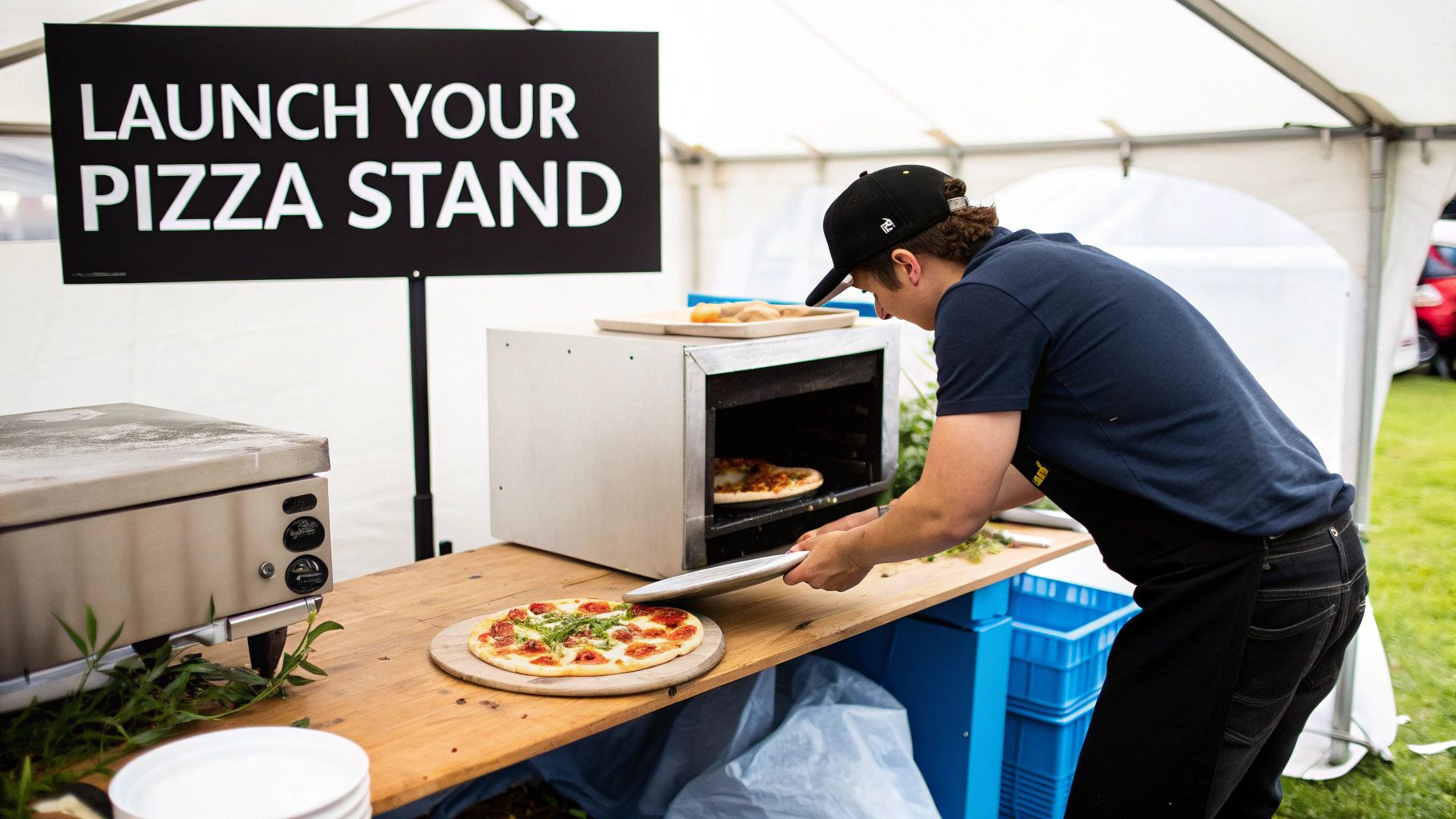
Launching Your Pizza-Focused Concession Stand
To win in the crowded food vendor space, you need a specialized concept. Sure, classics like popcorn and hot dogs have their place, but zeroing in on a high-value item like pizza lets you build a brand people remember and charge what you're worth. It simplifies your inventory, streamlines operations, and positions you as the go-to spot for a real meal, not just another snack.
Think of it this way: instead of trying to be everything to everyone, you become the absolute best at one thing—making incredible pizza. This guide is your roadmap to building that business from the ground up, with the pizza prep table as its heart.
Why Pizza is a Perfect Fit for Concession-Style Restaurants
Pizza is a match made in heaven for the concession world. Everybody loves it, it's super customizable, and you can serve it fast—which is everything when you've got a long line at an event. But the real genius is how efficiently it can be produced with the right equipment. Many of its core ingredients—dough, cheese, meats, and veggies—can be shared across your entire menu. This overlap dramatically cuts down on food waste and makes your supply chain a whole lot simpler.
This shared-ingredient strategy is your secret weapon for profitability. A well-organized pizza prep table becomes the command center for your entire menu, ensuring every single ingredient is optimized for speed and profit.
A focused menu isn't about limitation; it's about optimization. By centering your restaurant operation on a core product like pizza, you create efficiencies in every aspect of the business, from ingredient sourcing to workflow design around the pizza prep table.
Building Your Foundation for Success
Before you even think about firing up the oven, you need to map out your game plan. A well-thought-out operation is what separates a fun hobby from a business that actually makes money. We'll walk you through the essential pillars for launching your stand, making sure you have a solid plan from day one.
Here are the fundamentals we're going to cover:
- Menu Engineering: How to design a small but mighty pizza menu that maximizes profit and keeps prep time to a minimum.
- Compact Equipment: We'll help you pick the right tools for the job, with a special focus on the pizza prep table as the heart of your operation.
- Workflow Design: You'll learn how to create a logical layout that pumps out food with speed, safety, and quality, even when you're working in a tight space.
This strategic approach proves that a focused concept, executed flawlessly, is the most powerful of all concession stand ideas. By mastering the fundamentals of a pizza-centric operation, you can build a business that not only survives but thrives.
Crafting a Menu That Sells Itself
Your menu is the engine driving your entire pizza business. A smart menu does more than just list what's for sale—it actively guides what your customers order, boosts your profit on every transaction, and slashes waste by making every single ingredient work overtime. The goal here is to be strategic, not exhaustive.
Forget offering a dozen different pizzas. That just complicates your inventory, slows down your line, and confuses customers. The sweet spot is a focused menu built around 3-5 signature pizzas. This lets you absolutely nail each recipe, delivering a consistently awesome product that keeps people coming back.
Building Your Core Pizza Offerings
Think of your signature pizzas as a small, curated collection where every item has a job to do. You want to cover a range of tastes to make it easy for the widest possible audience to find their perfect slice. A balanced lineup means there's a quick "yes" for almost everyone who walks up to your window.
A great starting point for any pizza restaurant looks something like this:
- The Classic: A simple, high-quality Margherita or a fantastic cheese pizza. This is your guaranteed bestseller. It appeals to kids and adults alike, and the profit margin is unbeatable.
- The Meat Lover's: This is your premium, hearty option. Load it up with pepperoni, sausage, and bacon to justify a higher price and satisfy those with big appetites.
- The Gourmet Veggie: You need something for your health-conscious crowd. Think roasted red peppers, artichoke hearts, fresh spinach, and a sprinkle of feta. It’s an easy way to elevate your menu beyond the basics.
With a focused menu, your operation becomes incredibly efficient. Your team only has to master a handful of recipes, which dramatically increases their speed and consistency, especially when you get slammed with a rush.
The Power of Shared Ingredients
The real magic behind a profitable concession menu is cross-utilizing your ingredients. This is where your pizza concept expands beautifully into other items like calzones or pizza-style subs, essentially doubling your offerings without doubling your food orders. Your pizza prep table is the command center for this whole strategy.
The exact same pepperoni, mozzarella, bell peppers, and onions you stock in the refrigerated rails of your prep table can be repurposed for incredible, high-margin side items. A "Pizza Sub" using your marinara, mozzarella, and pepperoni on a toasted roll is a no-brainer. A "Veggie Delight" calzone can use the same ingredients as your gourmet veggie pizza.
By designing your menu around shared components stored in your pizza prep table, you drastically reduce food spoilage and simplify your ordering process. Every ingredient becomes an asset that pulls double-duty, directly boosting your bottom line.
Calculating Costs for Maximum Profit
Guesswork has absolutely no place in your pricing strategy. To guarantee you're making money, you have to calculate the precise food cost for every single item you sell. This means breaking down each pizza into its core components—from the dough and sauce right down to the last slice of pepperoni and the paper plate it’s served on.
Add up the cost of every ingredient that goes into a single pizza, then divide by the number of slices to get your cost-per-slice. The industry benchmark you should aim for is a food cost of 25-35% of your menu price.
For example, if your cost-per-slice comes out to $0.75, pricing it at $3.00 puts you at a very healthy 25% food cost. This data-driven approach is the only way to ensure every sale is a profitable one for your pizza restaurant.
Standing Out with a Unique Selling Point
What makes your pizza stand different from the one down the street? It could be a signature garlic-butter crust, a spicy house-made marinara, or a commitment to using only locally sourced toppings. This unique selling point is what you'll build your marketing around.
As people's tastes get more sophisticated, offering something special is more important than ever. Industry reports show a huge shift toward premium and gourmet options at concession venues. Pizza restaurants that lean into this trend are seeing a big jump in their average transaction values.
A simple, modern touch can also make a huge difference. Consider creating a restaurant menu QR code to enhance the customer experience and streamline your service. It's a low-cost way to cut down wait times and makes it incredibly easy to update your menu with seasonal specials.
Designing an Efficient Workspace Around Your Pizza Prep Table
In a concession stand, space isn't just a commodity; it's your most valuable asset. A smart layout directly translates to faster service, better food, and ultimately, more money in your pocket. For any pizza-focused restaurant, the absolute centerpiece is the pizza prep table. This isn't just a stainless steel surface—it's your command center. It combines refrigerated storage, organized ingredient rails, and a durable workspace into one hyper-efficient unit.
Building your entire workflow around this single piece of equipment is the secret to creating a logical, station-based system that just works. A well-thought-out layout gets rid of wasted steps, stops your team from bumping into each other, and creates a clear path from raw ingredients to a happy customer holding a hot slice. Honestly, getting this design right is one of the most impactful things you can do for your stand.
The Pizza Prep Table as Your Operational Core
Choosing the right pizza prep table is the first—and most critical—decision you'll make when designing your workspace. A standard folding table isn't going to cut it. You need a refrigerated unit that keeps your cheese, sauce, and toppings perfectly chilled and literally within arm's reach. Models typically range from a compact 44 inches up to a more expansive 93 inches, but the 48-inch and 60-inch units tend to be the sweet spot for most concession stands.
The ideal table has a few non-negotiable features:
- Refrigerated Base: This undercounter storage is a lifesaver for holding backup ingredients, dough boxes, and extra cheese. It dramatically cuts down on trips to a separate fridge.
- Top Ingredient Rail: This is where the magic happens. It's a series of cold pans holding all your prepped toppings, allowing for lightning-fast pizza assembly.
- Durable Cutting Board: A full-length cutting board gives you plenty of real estate for stretching dough and building your pies.
Many operators find that these features are also perfectly suited for assembling sandwiches. If your menu includes both, it's worth exploring the nuances of a prep table for both pizza and sandwiches to make sure one unit can handle everything you throw at it.
Creating a Logical Station-Based Workflow
Once you've picked your prep table, you can start mapping out a logical A-to-B-to-C workflow. The goal is simple: create distinct zones for each stage of the process to avoid turning your small space into pure chaos during a rush. A proven layout for a pizza restaurant always follows the natural progression of making a pizza.
This visual breaks down the simple, effective process of creating a menu that actually supports an efficient workflow, not fights against it.
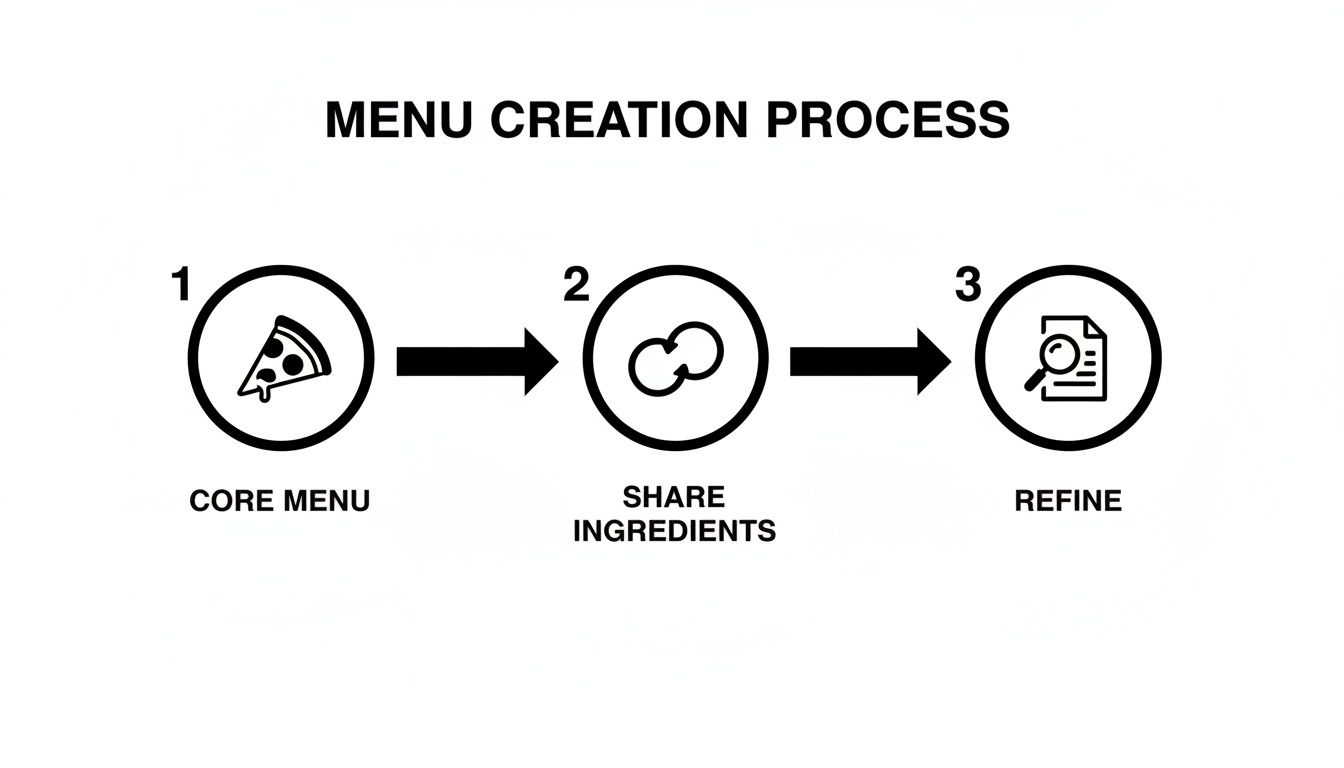
This process forces you to think about how your layout will support your menu, linking your core offerings to shared ingredients for maximum efficiency.
Here’s a sample station-based flow that works great in a typical 10x10 foot tent or small trailer:
- Prep Station: This is your pizza prep table, period. All dough stretching, saucing, and topping happens here. Your primary pizza maker should have everything they need without taking more than a step or two in any direction.
- Cooking Station: Position a compact, high-temperature countertop pizza oven directly next to the prep station. This setup is crucial. It lets the pizza maker slide a finished pizza into the oven with a simple turn, keeping the whole line moving.
- Cutting & Service Station: Create a totally separate counter for cutting cooked pizzas, boxing them up, and serving customers. This is key for food safety—it prevents the person handling money from cross-contaminating the prep area and keeps the customer line moving smoothly away from the hot zone.
A well-organized workflow is your secret weapon against long wait times. By designing your space so that each task has a dedicated home, you empower your team to work faster, safer, and with less stress, even during the peak dinner rush.
Maximizing Every Inch of Your Space
When you're working in a tight concession space, you have to think vertically. Wall-mounted shelving above your prep and service counters is non-negotiable. Use it to store pizza boxes, paper plates, napkins, and other dry goods. This simple trick frees up priceless counter space.
Before you finalize your layout, let's create a quick checklist of the essential equipment you'll need. This will help you visualize the footprint and ensure everything has a place.
Essential Equipment for a Pizza Concession Stand
| Equipment Category | Essential Items | Key Considerations |
|---|---|---|
| Preparation | Pizza Prep Table | The centerpiece; size it based on your menu and volume. |
| Dough Mixer/Press | A small countertop model can save significant time and effort. | |
| Cooking | Countertop Pizza Oven | Look for high-heat, fast-recovery models. Gas or electric. |
| Pizza Peels & Turner | Have multiple peels for raw and cooked pizzas. | |
| Service | Cutting Counter | A separate, dedicated surface for finishing and boxing. |
| Pizza Cutters/Rockers | Rockers are often faster and safer for high volume. | |
| Refrigeration | Undercounter Refrigerator | For drinks and extra backup ingredients not in the prep table. |
| Storage & Sanitation | Wall-Mounted Shelving | Go vertical to store boxes, disposables, and dry goods. |
| Handwashing Sink | A health code requirement. Don't forget it. | |
| Slim Trash Bins | Tall, narrow bins fit into corners and out of walkways. |
This table covers the big-ticket items, but don't forget the small stuff. Magnetic knife strips mounted on a wall are a fantastic way to keep your cutters and knives safely stored and easy to grab.
By combining a central pizza prep table with a logical workflow and smart use of vertical space, you can build a small but mighty pizza kitchen. This efficient design ensures you can serve hundreds of customers quickly and safely, making your pizza operation one of the most profitable ideas at any event.
Sourcing Equipment and Smart Financing Options
Once you've mapped out your layout, it's time to tackle the next big step: getting the actual equipment that will bring your pizza restaurant to life. I know the financial side of things can feel daunting, but a smart approach to sourcing and funding can seriously lower your initial cash outlay and get you on the fast track to making money. This is where your great idea starts to feel real.
And it’s a great idea to have. Concession stands are a booming part of the global food and beverage market, which was valued at a cool USD 52.3 billion in 2023. It’s projected to climb to around USD 75.4 billion by 2032, which just goes to show you're tapping into a market with real, sustained demand. You can find more insights on this growth over at dataintelo.com.
New vs. Used Equipment: A Practical Breakdown
Let’s be honest, your pizza prep table and compact oven are going to be the biggest line items on your equipment list. The decision to buy new or used has major financial ripple effects, and the right call really boils down to your starting capital and how much risk you’re comfortable with.
-
New Equipment: Going new gets you a full manufacturer's warranty, the latest energy-efficient tech, and invaluable peace of mind. The catch? It requires the biggest upfront investment. This is usually the best path for restaurant operators who have already secured a small business loan and are prioritizing long-term reliability.
-
Used Equipment: You can absolutely slash your initial costs—often by 40-60%—by hitting up restaurant auctions or reputable used equipment dealers. The trade-off is a lack of warranty and the potential for maintenance issues to pop up sooner than you'd like. My advice? Always inspect used refrigeration equipment in person. You need to see with your own eyes that the compressors and seals are in good shape.
No matter which way you go, stick to quality brands known for their durability in tough commercial kitchens. Your pizza prep table, especially, is not the place to cut corners. It's the heart of your entire operation.
Smart Financing: Lease-to-Own Programs
Here's a tip that has saved countless new businesses: you don't need to buy every single piece of equipment outright. Lease-to-own programs are one of the most powerful tools in a new restaurant owner's arsenal. This strategy lets you get your hands on high-quality, brand-new equipment for a manageable monthly payment instead of a massive one-time hit.
Leasing frees up your cash for other critical startup costs like your first big inventory order, permits, and marketing. It's a strategic way to manage cash flow and get your business off the ground without draining your bank account on day one.
A typical lease agreement runs anywhere from 12 to 60 months. When the term is up, you usually have the option to purchase the equipment for a predetermined price—sometimes for as little as a single dollar. This is how an expensive piece like a $4,000 pizza prep table becomes completely accessible. To really get into the weeds on how this works, take a look at our complete guide on financing restaurant equipment.
It's crucial to analyze any lease agreement before you sign. Pay close attention to the interest rate, the total cost over the life of the lease, and the final buyout terms. And don't be afraid to negotiate. Suppliers often have some wiggle room and want to work with you to find a plan that fits your budget. Building a good relationship with a reliable equipment provider can pay off for years to come.
Mastering Pricing and Daily Operations for Profitability
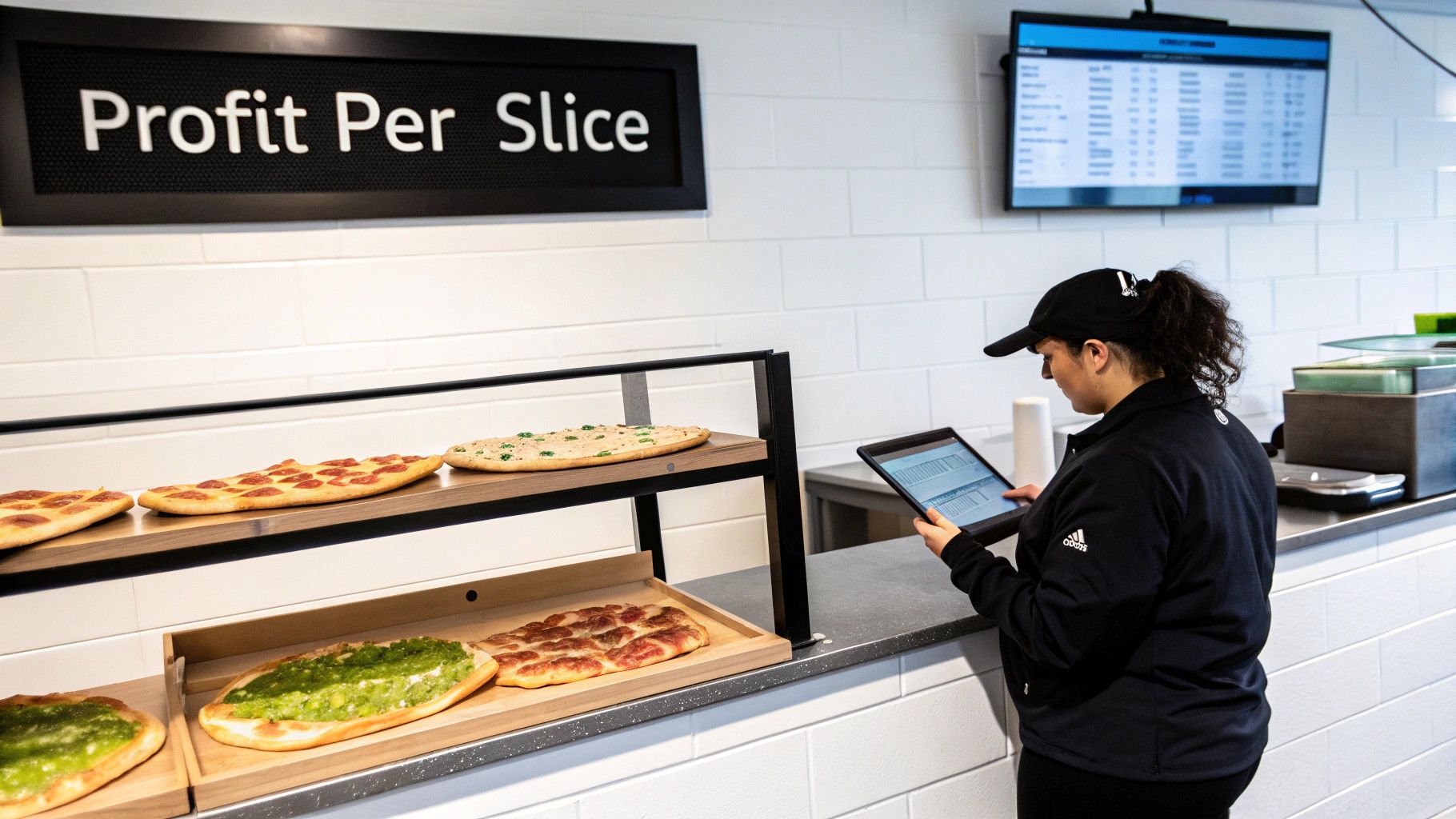
A slick setup and a killer menu are fantastic, but the real money is made in the daily grind. This is where you turn that initial investment into a consistent, predictable profit stream for your pizza restaurant.
It all comes down to mastering the details—from smart staffing and ironclad food safety to pricing every single slice with surgical precision. This is what separates a fun hobby from a seriously high-performing business. Your daily workflow is the heartbeat of your concession stand; an efficient process means you can crush the biggest rushes without ever sacrificing quality or safety.
Dialing in Daily Workflows and Food Safety
Even if your team is just you and one other person, everyone needs a clearly defined role. Think like a pizza assembly line. One person is dedicated to dough prep and building pizzas at the prep table, while the other handles the oven, cutting, and customer transactions.
This station-based approach is a game-changer. It minimizes unnecessary movement, prevents cross-contamination, and dramatically boosts your service speed when a line starts to form.
Of course, food safety has to be built right into that routine—it's completely non-negotiable. This isn't just about passing inspections; it's about building trust.
- Temperature Logs: Get in the habit of regularly checking and logging the temperatures of your pizza prep table and any other refrigerators. It takes seconds.
- Glove Changes: Have a strict policy. Change gloves between handling raw ingredients and cooked food, and always after handling money.
- Sanitation Buckets: Keep properly mixed sanitation solution ready to go for wiping down surfaces throughout the day.
A visibly clean and organized stand is one of your most powerful, and free, marketing tools. It tells customers you care about their health.
Calculating Your True Cost Per Pizza
Guessing at your prices is one of the fastest ways to go out of business. To set profitable menu prices, you absolutely must know your exact Cost of Goods Sold (COGS) for every single item you sell.
This means breaking down the cost of every component in one pizza—from the dough and sauce to the last sprinkle of cheese and even the box or plate it goes on.
Let's walk through a quick example for a pepperoni pizza slice:
- Tally ingredient costs: Add up the cost of the dough ball, sauce, cheese, and pepperoni needed for one large pizza.
- Add paper goods: Don't forget to factor in the cost of a paper plate or a slice tray.
- Find your cost-per-slice: Add everything up and divide by the number of slices (let's say 8).
- Set your price: A healthy industry target for food cost is 25-35% of your menu price. So, if your true cost-per-slice is $1.00, pricing it at $4.00 lands you at a perfect 25% food cost.
Knowing your exact cost-per-slice is empowering. It lets you price with confidence, run specials that are still profitable, and make smart menu decisions instead of just hoping you're making money at the end of the day.
This level of detail is critical. To really get your numbers dialed in, check out our guide with a restaurant profit margin calculator that does the heavy lifting for you.
Smart Inventory and Sales Tracking
Good inventory management is really just about minimizing waste. Use a simple "First-In, First-Out" (FIFO) system for all your ingredients, especially the perishables in your pizza prep table. At the end of each day or event, do a quick count of what you used.
This data is gold.
When you compare your inventory usage against the sales data from your POS system, you'll immediately see your bestsellers and which items are just taking up space. This lets you adjust your ordering, tweak your menu, and focus on the most profitable items for your specific crowd.
To keep those happy customers coming back, it's worth exploring the best loyalty programs for restaurants to turn one-time buyers into regulars. This kind of operational discipline is what builds a resilient business that can grow and adapt.
Got Questions About Starting a Pizza Concession Stand?
Jumping into any new business is going to bring up a ton of questions, and launching a pizza concession stand is no different. Getting solid, straight-up answers can be the difference between a smooth launch and a stressful one. Let's tackle some of the most common hurdles you'll face so you can move from the idea stage to your grand opening with real confidence.
How Much Space Do I Really Need for a Pizza Concession Stand?
You’d be surprised how much you can accomplish in a tight space. A killer pizza stand can easily operate within a 10x10 or 10x20 foot footprint. The real secret isn't about having tons of square footage; it's about having a smart layout centered on your pizza prep table.
Everything should revolve around a multi-functional pizza prep table. For most concession setups, a 48- or 60-inch model is the sweet spot. This one piece of gear is your command center—it handles your refrigerated ingredient storage and gives you a dedicated prep surface, cutting down on wasted movement.
Pair that with a compact, high-temp countertop pizza oven and some clever vertical shelving. This creates a natural workflow: from cold storage, to prep, to the oven, and finally to a separate spot for cutting and serving. This setup not only prevents bottlenecks but also keeps the health inspector happy. Just be sure to check with event organizers about any specific size limits beforehand.
What Are the Most Important Permits for a Food Concession Stand?
Navigating the world of permits can feel like a maze, but it's usually pretty straightforward once you know who to call. While the specific rules change from city to city, there are a few key documents that are almost always required for food vendors.
You're going to need these to operate legally:
- Local Business License: This is the basic green light to do business in your town or county.
- Health Department Permit: This is the big one. It involves an official inspection of your stand and equipment to make sure you're up to code on all things food safety.
- Food Handler's Permit: Anyone on your team who touches food—prepping or serving—will need to pass a certified food safety course.
If you’re working out of a trailer or food truck, you'll have an extra layer of mobile food vendor permits. On top of that, every festival or fair will likely require you to get a temporary event permit specific to that location.
Your very first phone call should be to your local health department. They have the final say and can give you a complete checklist for your area. Seriously, start this process months ahead of time—government approvals are not known for their speed.
What Is a Realistic Startup Budget for a Small Pizza Concession Stand?
Costs can swing quite a bit depending on your location and whether you're buying new or used gear, but a realistic startup budget for a solid pizza concession stand is typically somewhere between $10,000 and $25,000. Your equipment will be the biggest chunk of that by far.
A brand-new pizza prep table can set you back $2,000 to $5,000, and a professional countertop pizza oven could be another $1,000 to $4,000. Hunting for quality used equipment can slash these numbers significantly.
Other major costs to plan for include your tent or trailer, your first big food order ($500-$1,500), permits and licenses ($300-$1,000), and a point-of-sale (POS) system. It is absolutely crucial to build in a contingency fund of at least 15-20% of your total budget. Unexpected costs always pop up. And remember, leasing your equipment is a fantastic way to lower that initial cash outlay and keep your working capital free.
How Can I Market My New Concession Stand on a Tight Budget?
You don't need a huge marketing budget to get people excited about your pizza. Smart, low-cost marketing is all about being clever and consistent. Your best marketing weapon is your physical setup, so start there. Invest in professional, easy-to-read signage and keep your stand looking clean and inviting. A great presentation naturally draws people in.
Next, get active on social media. Use a platform like Instagram to post drool-worthy photos and videos of your pizza in action. Post your event schedule, tag the event organizers in your posts, and run simple giveaways to build a local following. Building real relationships with event coordinators and fellow vendors is another powerful, zero-cost marketing tactic.
Finally, get people coming back for more with a simple loyalty program. A "buy 5 slices, get one free" punch card is a classic for a reason—it just works. Never underestimate the power of an amazing product and friendly, fast service. That creates the kind of word-of-mouth buzz that no amount of money can buy.
Ready to build the foundation of your new pizza business? A high-quality pizza prep table is the most important investment you'll make. Explore a wide selection of top-tier models and find smart financing options at Pizza Prep Table. Visit https://pizzapreptable.com to find the perfect command center for your concession stand.