

Undercounter Fridge Dimensions: Sizes for Your Pizza Prep Station
When you're looking at spec sheets for commercial undercounter fridges, you'll see a few numbers pop up again and again: 32 to 34.5 inches high, 24 to 30 inches deep, and common widths like 48, 60, or 72 inches. For a pizzeria owner, these aren't just numbers—they're the building blocks of a fast, efficient, and profitable prep line.
Why Fridge Dimensions Are Crucial for Your Pizzeria
Getting your undercounter fridge dimensions right isn’t just about making a box fit into a space. It's about designing your kitchen's entire workflow for maximum speed and minimum chaos. The right size, tucked perfectly under a pizza prep table, can be the difference between a smooth Friday night rush and a bottlenecked nightmare.
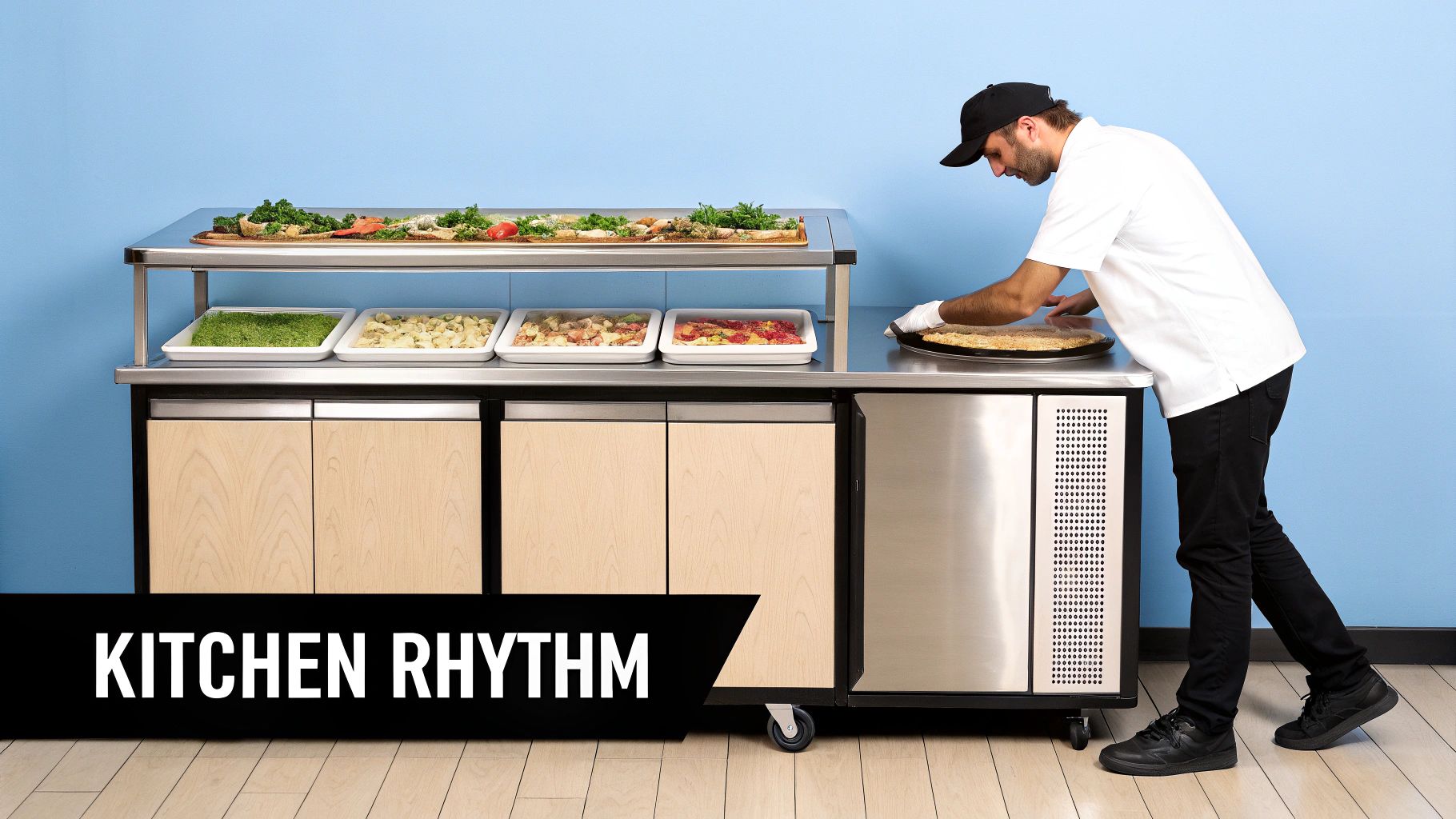
Think of your pizza prep station as the command center of your whole operation. Every single ingredient—from dough balls and sauce to shredded mozzarella and pepperoni—has to be within arm's reach. A perfectly sized undercounter fridge makes this a reality, turning your prep table into a highly organized and incredibly efficient workstation.
The Foundation of Kitchen Rhythm
In the fast-paced world of a pizzeria, every single second counts. Your crew shouldn't have to walk across the kitchen to grab more cheese or bend down awkwardly to wrestle the last dough box out of a poorly-sized unit. An undercounter fridge with the correct dimensions brings everything they need right to their fingertips.
This seamless access directly impacts your bottom line by:
- Boosting Prep Speed: When toppings, dough, and cheese are organized and right there, your team can assemble pizzas faster. That means more pies out the door during your busiest hours.
- Ensuring Food Safety: Proper refrigeration keeps ingredients within that critical food-safe temperature zone, even with doors constantly opening and closing. A well-chosen commercial unit is built to handle that kind of abuse.
- Improving Staff Ergonomics: A fridge that fits perfectly under the counter creates a comfortable, continuous workspace. This reduces physical strain and fatigue for your kitchen staff, which is huge for morale and long-term performance.
An undercounter fridge isn’t just an appliance; it's a strategic tool. The right dimensions are the blueprint for a kitchen that flows, where every movement is efficient and every ingredient is exactly where it needs to be.
Avoiding Common Kitchen Bottlenecks
On the flip side, the wrong dimensions can cause serious headaches. A unit that’s too small will force you to restock constantly during a busy service, completely derailing your workflow. But one that's too large might eat into precious aisle space, creating traffic jams and safety hazards for your team.
For instance, a 72-inch wide refrigerator might sound great for storage, but if it forces your pizza maker to take two extra steps to get from the sauce to the toppings, you've just added seconds to every single order. Over the course of a night, those seconds add up to lost revenue. This guide will break down how to pick the perfect undercounter fridge dimensions to prevent these issues and set your pizzeria up for success from day one.
To help you get started, here’s a quick-glance table of the most common dimensions and how they typically fit into a pizzeria setting.
Standard Undercounter Fridge Dimensions at a Glance
| Dimension Type | Common Range | Best For Pizzeria Context |
|---|---|---|
| Height | 32" – 34.5" | Designed to fit under standard 36-inch countertops, creating a seamless and ergonomic prep surface. |
| Depth | 24" – 30" | A 24-inch depth aligns with standard cabinets, while 30-inch depth offers more storage for bulkier items. |
| Width | 24", 48", 60", 72" | 48-inch is great for tight spaces. 60-inch and 72-inch models are the workhorses for high-volume prep lines. |
These ranges provide a solid starting point for planning your kitchen layout. Keep them in mind as we dive deeper into making the right choice for your specific needs.
Choosing the Right Width for Your Pizza Prep Line
The width of your undercounter fridge is way more than just a measurement—it dictates the entire rhythm and flow of your pizza prep station. Think of it as the foundation of your cook's "reach zone." Get the width right, and every core ingredient is within an easy arm's length, eliminating wasted steps and shaving precious seconds off every single order.
For a pizzeria cranking out pies on a Friday night, that kind of efficiency isn't just a nice-to-have; it's absolutely essential.
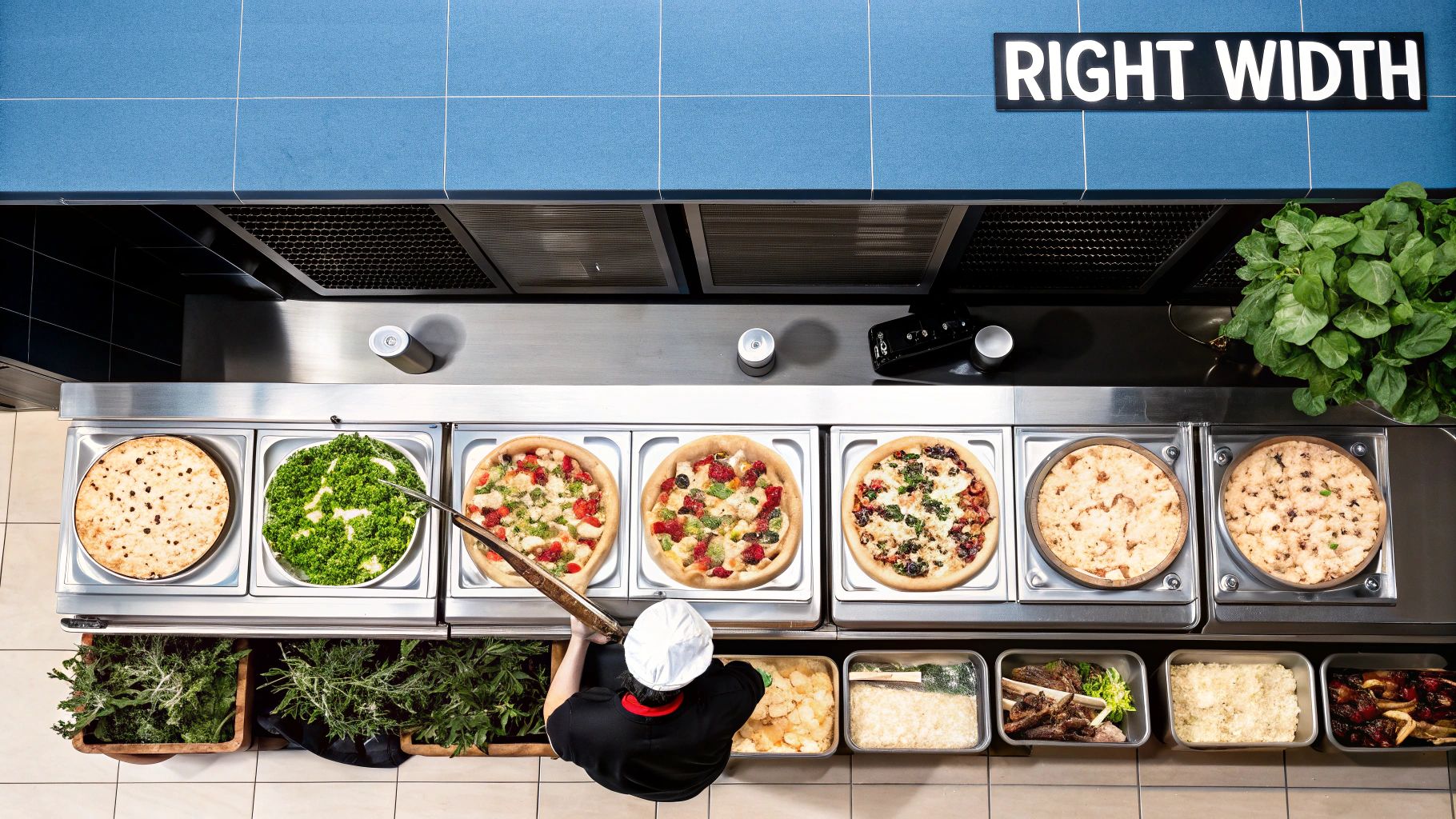
Picking the right undercounter fridge dimensions has a direct impact on your output. A well-planned width simplifies your kitchen layout, boosts speed, and creates a logical, less chaotic workspace for your team.
From Niche Stations to Mainline Workhorses
Standard widths like 24, 48, 60, and 72 inches aren't just arbitrary sizes. Each one plays a specific, strategic role in a pizzeria's prep line. Think of them as specialized tools for different jobs. Understanding these roles helps you build a much more effective kitchen.
A smaller, 24-inch unit is perfect for creating dedicated, specialized stations. You might set one up exclusively for gluten-free ingredients to completely eliminate cross-contamination, or use it to hold specialty toppings for your gourmet pies. This approach isolates ingredients, keeping your main prep area uncluttered and focused on the high-volume stuff.
These compact units are popular in pizzerias for their energy efficiency and versatility. They hit the sweet spot between providing useful storage and fitting snugly under pizza prep tables. Given that North America holds a significant 38% global market share in refrigeration, it's clear that pizzeria owners prioritize these efficient, space-saving solutions.
The Power of 48 and 60 Inch Models
Once you move up in size, you get into the true workhorses of the pizza world. The 48-inch and 60-inch undercounter fridge dimensions are the backbone of most prep lines for good reason. They’re built to hold multiple full-size food pans, keeping your core ingredients—mountains of shredded mozzarella, pans of pepperoni, and buckets of sauce—chilled and right where you need them.
The right fridge width transforms your prep table from a simple counter into an optimized cockpit. When everything is within a simple pivot or reach, your pizza makers can build pies with muscle memory, drastically reducing thought and movement.
This kind of setup is crucial for maintaining speed during the dinner rush. A 60-inch model lets a chef stand in one spot and access everything needed for the top five pizzas on your menu without taking a single step.
Optimizing Your Pizza Prep Table Layout
The real magic happens when you strategically combine different undercounter fridge dimensions to create a highly effective assembly line. For instance, a common and incredibly powerful layout involves:
- A 24-inch unit at the start: This is perfect for holding prepped dough balls, keeping them at the ideal temperature for stretching.
- A 60-inch unit in the middle: This becomes your primary topping station, loaded with all the essentials from cheese and sauce to meats and veggies.
- Another 24-inch unit at the end: This one can hold finishing ingredients like fresh basil, specialty cheeses, or drizzles that get added right after the pizza comes out of the oven.
This modular approach ensures that each step of the pizza-making process has its own dedicated, refrigerated zone. It supports a logical workflow and keeps your ingredients perfectly organized. For more ideas on how to set up your station, check out our guide on selecting a commercial pizza prep table.
This kind of strategic placement is exactly how top-tier pizzerias maintain both incredible quality and unbelievable speed, night after night.
How Height and Depth Impact a Seamless Kitchen Fit
Everyone obsesses over the width of an undercounter fridge, but I've seen firsthand how height and depth are the real game-changers for a functional pizza prep line. Get these two dimensions right, and your kitchen clicks into place like a puzzle piece. It's the secret to that clean, professional look that also eliminates dangerous gaps and tripping hazards for your crew.
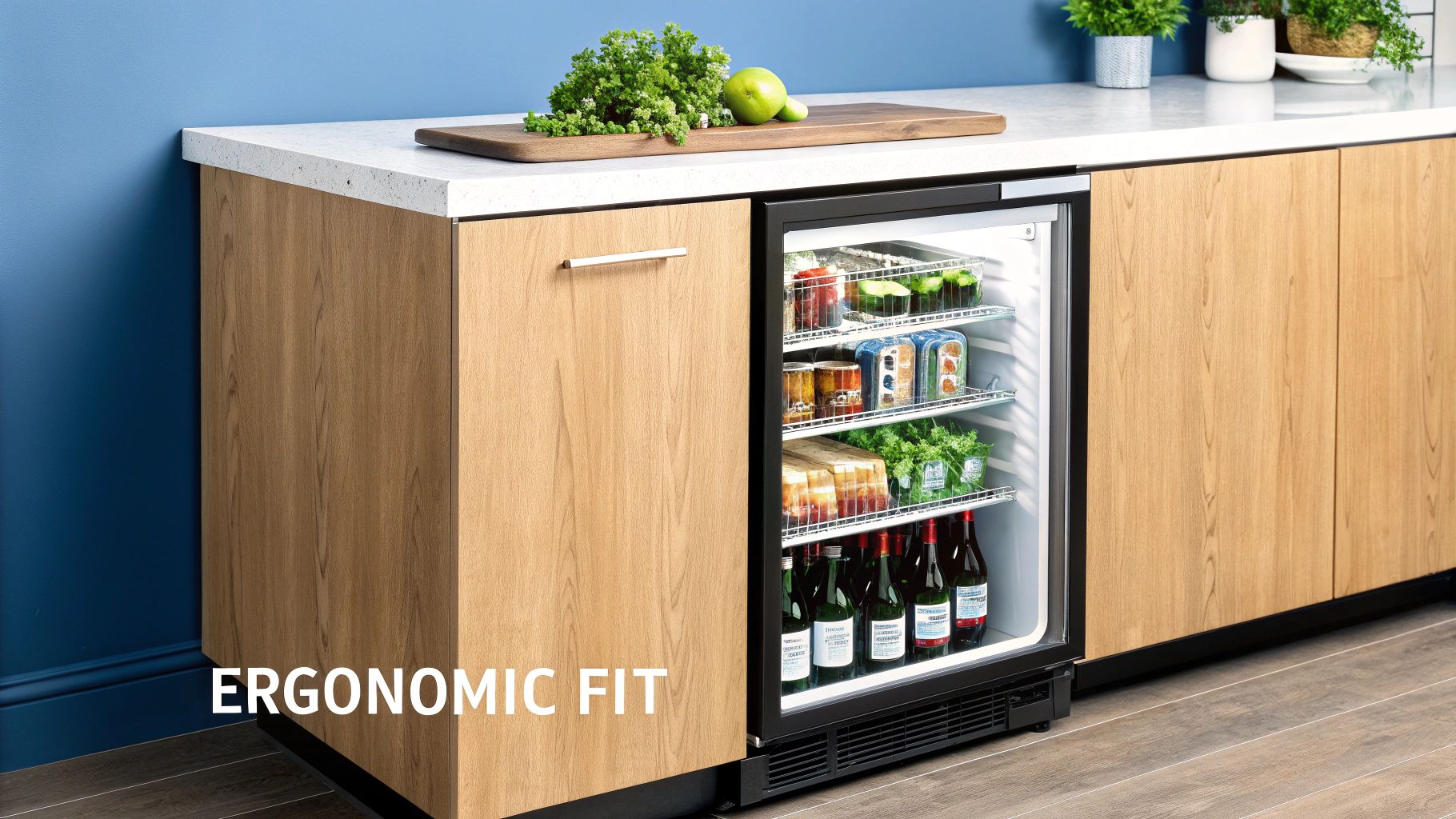
These two measurements are what give you that slick, truly built-in look under a pizza prep table. A unit that fits perfectly isn't just about appearances; it’s a cornerstone of smart, ergonomic kitchen design.
The Perfect Height for Ergonomic Workflow
Ever noticed that most commercial undercounter fridges clock in between 32 to 34.5 inches high? That’s not a random number. This specific range is engineered to slide perfectly under a standard 36-inch countertop—a height that also happens to be compliant with the Americans with Disabilities Act (ADA).
This alignment is crucial for a pizzeria's workflow. When your fridge sits flush with the prep table's underside, it creates a single, uninterrupted work surface. Your pizza makers can slide dough, pans, and topping bins across the counter without snagging an edge or dealing with an awkward drop-off.
A correctly heightened undercounter fridge creates more than just a clean line; it builds an ergonomic powerhouse. This seamless surface reduces physical strain on your staff's backs and shoulders, allowing them to work faster and more comfortably during long, demanding shifts.
That small ergonomic detail translates directly into higher productivity and happier staff. In the grand scheme of undercounter fridge dimensions, it's a detail that has a massive impact on the daily grind of a busy kitchen.
Depth: The Choice Between Storage and Space
When it comes to depth, you’re making a strategic decision for your pizzeria: do you want maximum storage capacity, or do you need a more streamlined, spacious kitchen? It really boils down to two options:
- Standard-Depth (25-27 inches): These units give you more internal cubic footage, plain and simple. That extra space is invaluable for storing bulky items like large dough boxes, full-size ingredient bins, or backup sauce containers. If you have plenty of aisle space and high-volume needs, a standard-depth model is a fantastic choice.
- Counter-Depth (24 inches): This is the magic number for achieving that true, built-in look. A 24-inch deep fridge will sit perfectly flush with your surrounding cabinetry and pizza prep tables. This creates a sleek, professional appearance and, more importantly, can save you several inches of precious aisle space.
In a crowded, high-traffic pizzeria kitchen, those extra inches are a lifesaver. A counter-depth unit prevents the fridge from jutting out, which means staff are less likely to bump into it and create dangerous traffic jams during a busy service. It just makes the whole kitchen feel more open and easier to navigate.
Ultimately, choosing between standard and counter-depth is a balancing act. You have to weigh your need for bulk ingredient storage against the layout and flow of your kitchen to find the perfect fit.
Measuring Your Space to Guarantee a Perfect Fit
Picking out the right undercounter fridge is the fun part. Making sure it actually fits? That's where things get serious. An inch off here or there can turn an exciting delivery day into a nightmare of costly returns, project delays, and a pizza prep line that’s dead before it even starts.
Getting your measurements right is your best—and first—line of defense. This isn't just about a quick check of the opening's width and height. A successful installation is more like a blueprint, ensuring the fridge not only slides into place but also works efficiently and safely for years. Think of it as mapping out the unit's entire journey, from the truck to its final home.
The Three-Part Measurement Plan
To dodge the most common installation headaches, you have to think beyond the final destination. A smart measurement plan covers the entire process, from delivery to daily operation. We break it down into three key phases.
- The Final Home: This is the most obvious one—measuring the actual cabinet opening or the spot under your prep table where the fridge will live.
- The Delivery Gauntlet: You have to measure every doorway, hallway, and tight corner the fridge must navigate to get from the delivery truck into your kitchen.
- The Breathing Room: This is the essential clearance the unit needs on all sides to prevent it from overheating. It’s absolutely critical for a long, healthy lifespan.
Skipping any one of these is just asking for trouble. A fridge that can't squeeze through the back door is just as useless as one that’s a half-inch too tall for the counter.
Give Your Fridge Some Breathing Room
One of the most overlooked details in measuring is planning for ventilation. Every fridge, especially a commercial-grade unit working hard in a hot pizzeria kitchen, creates heat to stay cold. That heat has to go somewhere. If it can't escape, the compressor works overtime, driving up your energy bills and leading to a much shorter lifespan.
Think of it as giving your equipment some personal space. Most manufacturers recommend leaving 1-2 inches of open space around the sides and back of the unit. For front-breathing models designed for built-in applications, that front grille must remain completely clear and unobstructed.
Proper air circulation is non-negotiable. That small gap around your fridge is like an insurance policy for its motor, ensuring it can efficiently dissipate heat and operate without burning itself out.
This breathing room lets air move freely, pulling heat away from the sensitive components. Forgetting to account for this is one of the fastest ways to kill a brand-new piece of equipment.
Your Step-by-Step Measurement Checklist
Ready to grab the tape measure? Follow this checklist to make sure you catch every little detail for a smooth, headache-free installation. This is your game plan for getting it right the first time.
- Measure Everything in Threes: Floors and countertops are almost never perfectly level or straight. Measure the height of the opening on the left, in the middle, and on the right—and use the smallest number. Do the same for the width (top, middle, bottom) and again, use the narrowest measurement.
- Mind the Trim and Baseboards: Don't just measure from the back wall to the front of the cabinet face. Account for any baseboards, chair rails, or trim that might stick out and steal a crucial inch of depth.
- Check for Level Floors: Grab a level and see if your floor has a major slope. An unlevel floor can mess with the door seal, causing temperature swings and making the fridge work harder than it needs to.
- Locate Your Power Source: Make sure there’s a grounded electrical outlet within easy reach of the fridge’s power cord. Never use an extension cord for a major commercial appliance—it’s a fire hazard and often a health code violation.
- Map the Delivery Route: Measure the width and height of every single doorway and corridor on the path from the truck to the kitchen. Don't forget to account for tight corners where the fridge's depth suddenly becomes the most important dimension.
To ensure your undercounter fridge integrates perfectly, it helps to understand the world it's moving into. A remodeler's guide on typical cabinet sizes can give you a better feel for planning your space. For a much deeper look at laying out your entire kitchen for maximum efficiency, our guide on how to design a restaurant kitchen offers insights that go way beyond just one appliance.
Solving Unique Challenges with Specialty Dimensions
Standard undercounter fridges are the workhorses of most pizzerias, but what happens when your kitchen throws you a curveball? Maybe it's a tight corner, a specialized menu item, or a new outdoor patio. These situations demand a refrigeration solution that standard sizes just can't handle.
This is where specialty dimensions come into play. These units aren't just oddly shaped; they're genuine problem-solvers. Whether you're designing a compact food truck layout or creating a dedicated station to prevent allergen cross-contamination, the right specialty fridge can turn an awkward space into a highly productive part of your pizza line.
Before you buy anything, though, you have to measure. This simple guide breaks down the three essential steps to make sure any unit—standard or specialty—fits perfectly from the delivery truck to its final home.
As you can see, a successful installation is about more than just the final opening. You have to plan for the unit's entire journey, including its delivery path and critical ventilation needs.
The Rise of Narrow and Drawer Models
Think of a narrow, 15-inch undercounter fridge as your secret weapon for efficiency. Its slim profile lets you add refrigeration to spots you might have written off as unusable. Tuck one next to the oven to hold finishing cheeses or create a totally isolated station for gluten-free ingredients, practically eliminating the risk of cross-contact without a major kitchen overhaul.
These slim models are heroes in tight spaces, allowing you to add refrigerated storage exactly where it's needed on the pizza line. Their height is almost always standardized between 32-34.5 inches, letting them slip under any pizza prep table. For a deeper look at market trends, you can explore more insights on residential undercounter refrigerators at databridgemarketresearch.com.
Undercounter drawer units offer a completely different kind of advantage over traditional swing-door models. Instead of opening a door and pulling out a pan, your crew can access ingredients with a single, quick pull.
For a high-volume pizza topping station, drawers are a game-changer. They provide instant, top-down visibility and access, allowing cooks to grab pre-portioned toppings like pepperoni or mushrooms without fumbling with multiple containers. This can shave seconds off every single order.
This organized, ergonomic access not only boosts speed but also helps with portion control and cuts down on ingredient spillage, making your entire prep line cleaner and more efficient.
Adapting to Unique Environments
Sometimes, your pizzeria’s needs extend beyond the four walls of the kitchen. A patio or outdoor dining space is a huge draw for customers, but it requires its own unique set of equipment.
- Outdoor-Rated Units: These refrigerators are built tough. They use corrosion-resistant stainless steel and feature beefed-up insulation to handle fluctuating temperatures and humidity. An outdoor-rated unit ensures your drinks and ingredients stay safely chilled, even on a blazing hot summer day.
- Food Truck and Mobile Setups: On a food truck, every inch is gold. Compact and narrow undercounter fridges are non-negotiable. Look for models with heavy-duty casters and secure door latches designed to handle the vibrations and constant movement of a mobile kitchen.
By choosing a specialty unit designed for a specific environment, you're protecting both your food and your investment. It’s smart planning that pays off in equipment longevity and customer safety.
Specialty Undercounter Fridge Comparison
Navigating the world of specialty undercounter fridges can feel overwhelming, but breaking them down by their intended job makes it much simpler. Each type is engineered to solve a specific problem in a busy pizzeria, from maximizing tiny spaces to speeding up the makeline.
The table below compares some of the most common specialty units and shows where they shine in a pizza operation.
| Unit Type | Typical Dimensions (W x D x H) | Primary Benefit | Ideal Pizzeria Application |
|---|---|---|---|
| Narrow Fridge | 15" x 24" x 34" | Fits in previously unusable small spaces. | Creating a dedicated gluten-free or allergen station; adding a beverage fridge to a tight bar area. |
| Drawer Fridge | 24"-48" x 24" x 34" | Quick, ergonomic, top-down ingredient access. | High-volume pizza makelines; sandwich or salad prep stations where speed is critical. |
| Outdoor-Rated | 24" x 24" x 34" | Withstands weather, humidity, and temperature swings. | Storing cold drinks and bar garnishes on an outdoor patio or service bar. |
| Glass Door Merchandiser | 24"-48" x 24" x 34" | Displays products to encourage impulse buys. | Front-of-house for bottled drinks, grab-and-go salads, or desserts. |
Ultimately, choosing the right specialty unit is about identifying a bottleneck or an opportunity in your workflow and finding the perfect tool for the job. Matching the unit to the task ensures you get the most value out of every square inch of your restaurant.
Matching Internal Capacity to Your Pizzeria's Menu
A fridge that fits perfectly under your pizza prep table but can't hold your ingredients is just an expensive, cold box. The outside measurements are only half the story. For a busy pizzeria, what really counts is the usable internal capacity and how it’s laid out for your specific menu.
You'd be surprised how two fridges with the exact same exterior dimensions can have wildly different interior space. This often comes down to things the spec sheet won't tell you, like how thick the insulation is or where the compressor is located. A unit with a top-mounted compressor, for instance, might give you more clean, uninterrupted shelf space than one with a bottom-mount design.
Translating Cubic Feet into Pizza Toppings
Thinking in "cubic feet" feels abstract. Let's get practical. The real question for a pizzeria owner is: how many food pans can I cram in there? This is where you connect the dots between the fridge's layout and your actual workflow on the prep line.
Before you even look at models, map out your core ingredients and the standard food pan sizes you use all day, every day:
- 1/3-Size Pans: Perfect for your heavy hitters like pepperoni, mushrooms, and onions. A typical 48-inch fridge should easily hold 8 to 10 of these on a single shelf.
- 1/6-Size Pans: Ideal for those lower-volume but essential toppings—think jalapeños, anchovies, or Kalamata olives.
- Full-Size Pans: You'll need these for bulk items like shredded mozzarella or your pre-portioned dough balls.
The best undercounter fridge doesn't just store ingredients—it organizes your workflow. Its interior should be a physical map of your menu, keeping the most-used items right where you can grab them to shave seconds off every order.
Shelving Flexibility for a Dynamic Menu
Your storage needs are never static. One day you're chilling bulky dough boxes, and the next you need to stack short sauce containers. This is exactly why adjustable shelving is a non-negotiable feature for any pizzeria worth its salt.
Fixed shelves lock you into a single configuration, and that almost always leads to wasted vertical space. With adjustable shelves, you can customize the interior on the fly. Lower a shelf to make room for tall proofing boxes, or raise one to double-stack shallow containers of prepped veggies. This flexibility ensures that no matter how your menu changes, your fridge can adapt.
It's also worth noting that better insulation doesn't just protect your ingredients; it can save you real money. To dig deeper into this, check out our guide on energy-efficient commercial refrigeration.
This kind of adaptability is the key to maximizing every last square inch of cold storage. By thinking through your pan sizes and demanding flexible shelving, you'll end up with a unit that doesn't just fit your kitchen's space—it fits the way your pizzeria actually runs.
Common Questions About Undercounter Fridge Dimensions
Even when you think you have the perfect plan, a few nagging questions always pop up before you pull the trigger on new equipment. I get it. Investing in the right undercounter fridge for your pizza prep table is a big deal, so you want to be absolutely sure.
Let's tackle some of the most common questions I hear from pizzeria owners, so you can make that final call with total confidence.
What’s the Best Dimension for a Small Pizzeria?
For most small pizzerias or anyone just starting out, the 48-inch wide undercounter refrigerator is the perfect sweet spot. It brilliantly balances having enough cold storage to get you through a service without taking up your entire kitchen.
A unit this size will typically hold 6 to 8 full-size food pans. That’s enough real estate for all your essential toppings and sauces for a decent dinner rush, meaning your team isn't constantly running back to the walk-in. It’s the ideal starting point that won’t overwhelm a compact kitchen layout.
Do I Really Need Clearance Space Around My Undercounter Fridge?
Yes, and this is non-negotiable. Giving your fridge some breathing room is critical for its health and efficiency. Proper ventilation stops the compressor from overheating—a ridiculously common problem in hot, hectic pizza kitchens.
Pretty much every commercial manufacturer, including big names like True and Atosa, recommends leaving at least 1 to 2 inches of clearance on the sides and back. If you get a front-breathing model designed to be built in, you have to make sure that front grille is never, ever blocked by mats, boxes, or anything else. That little gap is the key to saving on your energy bill and making your refrigerator last for years.
Think of that clearance gap as your fridge's personal breathing room. Suffocating it by pushing it flush against a wall is the fastest way to burn out the motor and cause a costly breakdown during your busiest service.
Can I Just Use a Residential Undercounter Fridge?
Absolutely not. You should never, ever use a residential undercounter fridge in a commercial pizzeria. Health codes are very clear: you must use a commercial-grade, NSF-certified unit. There are a few rock-solid reasons for this rule.
- Built for Battle: Commercial refrigerators are workhorses. They have powerful compressors and heavy-duty parts designed to handle the chaos of a kitchen—constant door openings and high ambient heat. A home unit would die a quick death.
- Temperature Recovery: When your line cook is grabbing pepperoni every 30 seconds during a rush, a commercial unit can bounce back to a safe temperature almost instantly. A residential fridge will struggle, letting your food creep into the temperature danger zone.
- Health Code Compliance: Using non-commercial equipment is a direct violation that can get you fined or even shut down by the health department. It’s just not worth the risk.
Investing in a proper commercial unit isn't just a suggestion; it’s essential for food safety, keeping your kitchen running smoothly, and staying on the right side of the law.
Ready to find the perfect undercounter refrigeration for your pizza prep station? The experts at Pizza Prep Table can help you select the right dimensions and model to optimize your kitchen's workflow. https://pizzapreptable.com