

Finding the Best Deli Meat Slicer for Your Pizzeria
For any pizzeria owner, the hunt for the best deli meat slicer isn't just about adding another piece of equipment to the line. It's a strategic move—an investment in the consistency, speed, and quality that define your pies. A great commercial slicer is the secret weapon that can take a chaotic pizza prep station and turn it into a powerhouse of efficiency, directly impacting your bottom line.
Why the Right Slicer Is Your Pizzeria's Secret Weapon
Picture the Friday night rush. The ticket printer is spitting out orders, but your pizza prep table is grinding to a halt. The problem? Your pepperoni is sliced inconsistently. Some pieces are too thick and come out undercooked and greasy, while the thin ones are burnt to a crisp.
This might seem like a small detail, but it undermines the quality of every pie that leaves your kitchen and drives your staff crazy. A high-quality commercial meat slicer turns that chaos into a smooth, predictable process. It’s not just a tool; it’s a core asset for your pizzeria's food prep.
The biggest win here is uniformity. A solid slicer gives you perfectly consistent slices every single time, whether you're working with paper-thin prosciutto or thick-cut salami. This precision means every topping on your pizza cooks at the same rate. No more burnt edges or raw centers—just perfectly balanced flavor and texture on every pizza.
From Cost Control to Streamlined Pizza Prep
Beyond making a better pizza, a good slicer is your best friend when it comes to portion control. When you can dial in the exact thickness you want, you can calculate precisely how much meat goes onto every single pizza. This takes the expensive guesswork out of the equation, stopping over-portioning and inventory waste in its tracks. Saving just a few slices of pepperoni per pizza can easily add up to thousands of dollars in food cost savings over a year.
A commercial slicer is the cornerstone of an efficient pizza prep workflow. It guarantees that the journey from the walk-in cooler to the pizza prep table is as quick and safe as possible, minimizing handling and maximizing output.
Bringing the right slicer into your workflow also has a huge impact on speed and labor costs. Think about the time you'll save:
- Bulk Preparation: Your staff can slice entire logs of pepperoni, ham, or capicola in just a few minutes, building up a ready-to-use inventory for the pizza prep table before the rush hits.
- Reduced Labor: A task that used to take an employee a solid chunk of time to do by hand can now be done much faster. That frees them up for other crucial jobs like stretching dough or managing the oven.
- Ergonomic Benefits: Let's be honest, slicing meat by hand all day is tough on the body. A good slicer reduces the physical strain and risk of injury from repetitive motion, creating a safer kitchen for everyone.
At the end of the day, this single piece of equipment is central to running a successful pizzeria. It directly supports your kitchen’s ability to handle high volume without ever sacrificing the quality that keeps your customers coming back for more. By tightening up your prep process, you ensure every pizza is built on a foundation of speed, consistency, and smart financial control.
Decoding Slicer Types for Pizzeria Meats
Picking the right deli meat slicer for your pizzeria starts with a simple question: how does it work? This isn't just a technical detail; it's a choice that shapes your kitchen's speed, precision, and daily workflow on the pizza line. The two big categories are manual and electric, and each has a very different job in a commercial kitchen.
Think of a manual slicer like a high-end, hand-crank coffee grinder. It gives the operator absolute control over every single pass. This is perfect for incredibly delicate meats like prosciutto, where you need that paper-thin, perfect slice every time. But that level of control is slow, making manual slicers a poor fit for the high-volume reality of a busy pizza prep station.
An electric slicer, on the other hand, is the commercial espresso machine of the kitchen—it’s all about power, speed, and consistency. It’s built to chew through pounds of pepperoni, salami, and ham for your pizza prep table without breaking a sweat. For almost any pizzeria, an electric model isn't just a suggestion; it's the only real option for keeping the prep line moving.
Gravity Feed vs Vertical Feed Slicers
Once you’ve locked in on an electric slicer, the next choice is about how the meat actually meets the blade. This is where you decide between a gravity-feed design or a vertical-feed (sometimes called a right-angle) design.
The gravity-feed slicer is the undisputed workhorse in most pizzerias. Its carriage is tilted at an angle, usually around 30 to 45 degrees, which lets gravity do some of the work for you by helping push the product against the spinning blade.
- Less Operator Effort: That angle means your staff doesn't have to push as hard, which cuts down on fatigue during long prep sessions for the pizza station.
- Faster Slicing: The natural assist makes it way faster for processing high volumes of standard pizzeria toppings like pepperoni and deli ham.
- Ideal for Firm Meats: It absolutely crushes it with firm, cylindrical meats that don’t need kid-glove handling, which covers most pizza toppings.
In contrast, a vertical-feed slicer holds the meat on a carriage that’s perfectly perpendicular (90 degrees) to the blade. This setup forces the operator to manually push the meat forward for every single slice. It’s more work, sure, but it gives you unmatched precision for specialty items. This is the tool you'd grab for slicing delicate, high-cost cured meats for a gourmet pizza where every slice has to be flawless.
This decision tree shows how investing in the right slicer directly impacts your pizzeria's quality, speed, and profit.
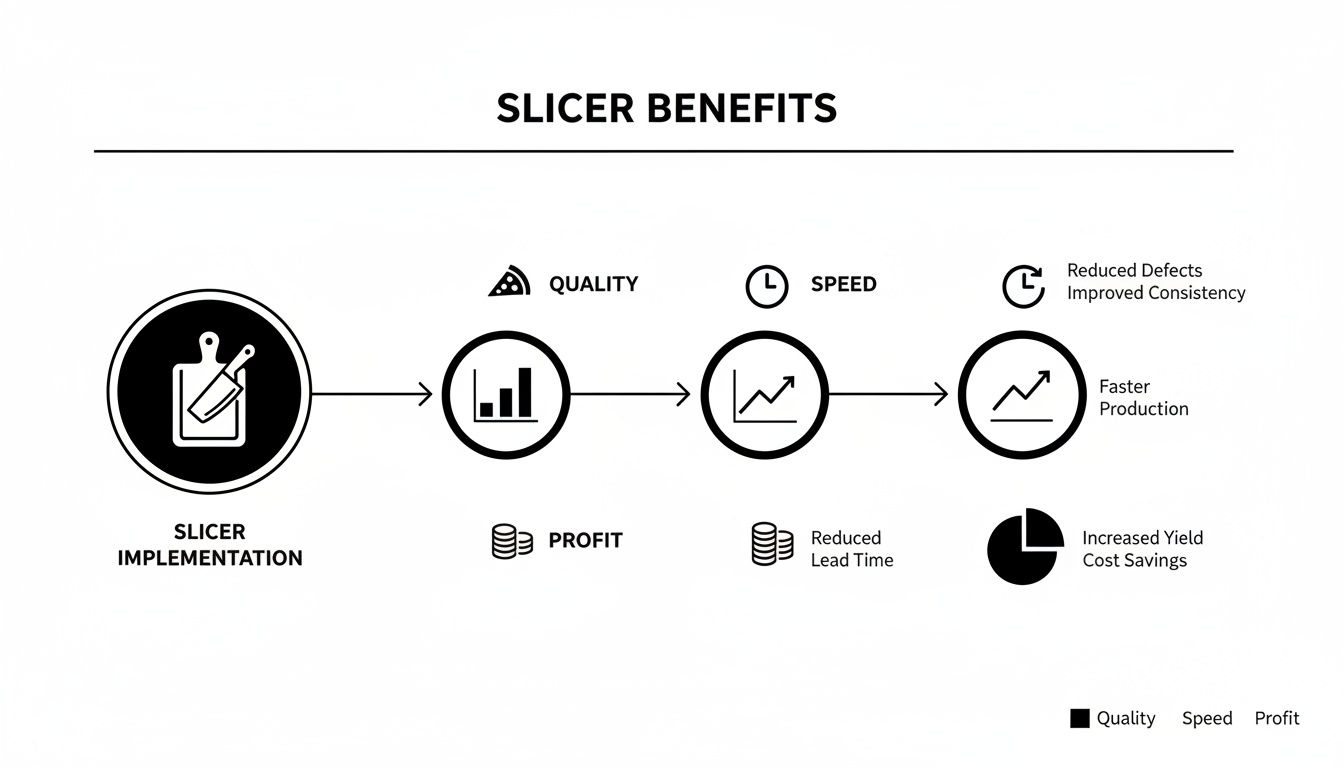
The image makes it clear: a good slicer isn't just about making nice slices. It’s a tool that drives speed and portion control, which leads straight to better profits for your pizza restaurant.
Making the Right Choice for Your Pizza Prep Table
For the vast majority of pizzerias, an electric, gravity-feed slicer is the way to go. It’s the perfect blend of speed, efficiency, and ease of use you need to keep a pizza prep table stocked and running without a hitch. And kitchens everywhere are catching on. The US meat slicer market has been climbing steadily, growing from USD 378.4 to 380.2 million in just the last year, with the food service sector accounting for 51.9% of that demand. Experts expect the market to hit nearly USD 649.4 million by 2034, showing just how essential this piece of equipment has become.
For a pizzeria, the goal is rapid, consistent slicing of your core toppings. A gravity-feed model automates some of that work, letting your crew focus on volume and keep the pizza prep table full.
While a powerful slicer is a must-have, it's also smart to have a solid understanding of all your cutting tools, including the different types of knives and their uses, to build a truly efficient kitchen.
Ultimately, your menu should guide your decision. If you're an artisan pizza shop specializing in pies with high-end charcuterie, maybe a secondary vertical-feed slicer makes sense. But for cranking out hundreds of pepperoni pizzas a night? Gravity is your best friend on the pizza line.
Choosing the Right Blade Size for Perfect Slices
The blade is the heart of your deli slicer. Think of it like the engine in a car—its size and quality dictate the machine's true power and what it can actually accomplish in your pizza restaurant. Just like you wouldn’t grab a paring knife to carve a turkey, you have to match the blade diameter to what you’re slicing and how much of it you’re slicing every day.
For most pizzerias, this decision is surprisingly simple. The sweet spot, the one size that really nails the balance between power, versatility, and footprint, is the 10-12 inch blade.
That’s not just an opinion; it’s a market reality. Slicers in the 10-12 inch range dominate the industry, accounting for a massive 50.2% of the total meat slicer market. Why? Because this size offers the perfect blend of processing muscle and physical size, which is a huge deal when you're trying to manage a tight kitchen layout, especially around a busy pizza prep table. You can read more about these market trends and dig into the research to see why this size has become the industry standard.
This popularity means you'll have a much easier time finding replacement parts, getting service, and training your team. It's the practical, reliable choice for any pizzeria owner.
Matching Blade Size to Pizzeria Toppings
A 10-inch blade is a fantastic workhorse. It’s compact, fits neatly into smaller prep areas, and has no problem handling smaller diameter products like classic pepperoni or cooked salami. For a pizzeria with a standard, straightforward menu, it’s often more than enough to keep the pizza prep table stocked.
But upgrading to a 12-inch blade is where you unlock some serious versatility. This size can power through wider products like large-format deli ham, capicola, or those beautiful, oversized logs of soppressata without breaking a sweat.
Even better, a 12-inch blade gives you the clearance to slice through large blocks of low-moisture mozzarella. For any pizzeria that shreds its own cheese for that superior melt and flavor, this is an absolute game-changer for the pizza prep station.
Key Takeaway: While a 10-inch blade handles the basics, a 12-inch model is a strategic investment for a pizza restaurant. It gives you the flexibility to slice a wider variety of meats and cheeses, essentially future-proofing your kitchen for any menu changes down the road.
Here's a quick guide to help you visualize which blade size fits your operation.
Pizzeria Meat Slicer Blade Size Guide
Use this table to match blade size to your pizzeria's daily volume and the specific products you need to slice for your pizza prep table.
| Blade Diameter | Duty Level | Ideal For | Common Pizzeria Toppings |
|---|---|---|---|
| 9-10 inches | Light-Duty | Pizzerias slicing for 1-2 hours per day. Great for smaller kitchens with limited space. | Standard pepperoni, salami, Canadian bacon. |
| 12 inches | Medium-Duty | The versatile workhorse for most pizzerias, running 2-4 hours per day. Balances power and footprint. | Large-format pepperoni, deli ham, capicola, prosciutto, and large blocks of cheese. |
| 13-14 inches | Heavy-Duty | High-volume pizzerias or commissary kitchens slicing for 4+ hours per day. Requires more space and power. | Oversized meats, continuous cheese slicing, frozen products. |
For the vast majority of pizzerias, that 12-inch slicer hits the sweet spot, providing the power you need today with the flexibility you’ll want tomorrow for your pizza prep table.
The Impact of Blade Material and Construction
Beyond the diameter, the blade's material directly impacts its sharpness, durability, and how much time you'll spend maintaining it. Your two main options are carbon steel and stainless steel.
-
Carbon Steel Blades: These are the choice of old-school purists. A carbon steel blade can be sharpened to an incredibly fine, razor-like edge that produces exceptionally clean cuts with almost zero tearing. The trade-off? They're high-maintenance and will rust if you don't meticulously clean and oil them after every single use.
-
Stainless Steel Blades: This is, by far, the more common choice in a busy pizzeria kitchen. Stainless steel blades offer fantastic corrosion resistance. They might not hold a razor-sharp edge quite as long as high-carbon steel, but they are far more forgiving and easier to maintain—a massive advantage in a high-speed pizza prep environment.
Many of the best commercial slicers today use a hardened, high-quality stainless steel alloy. This gives you the best of both worlds: strong edge retention with the rust resistance and simple cleaning you need in a fast-paced kitchen.
One last thing to look for is a hollow ground edge, where the blade thins out as it approaches the cutting edge. This design reduces friction, allowing slices of pepperoni or prosciutto to fall away cleanly instead of sticking, tearing, and slowing down your pizza prep line. For consistent, efficient slicing, a high-quality, 12-inch stainless steel blade is the clear winner for most pizzerias.
Designing Your Ultimate Pizza Prep Workflow
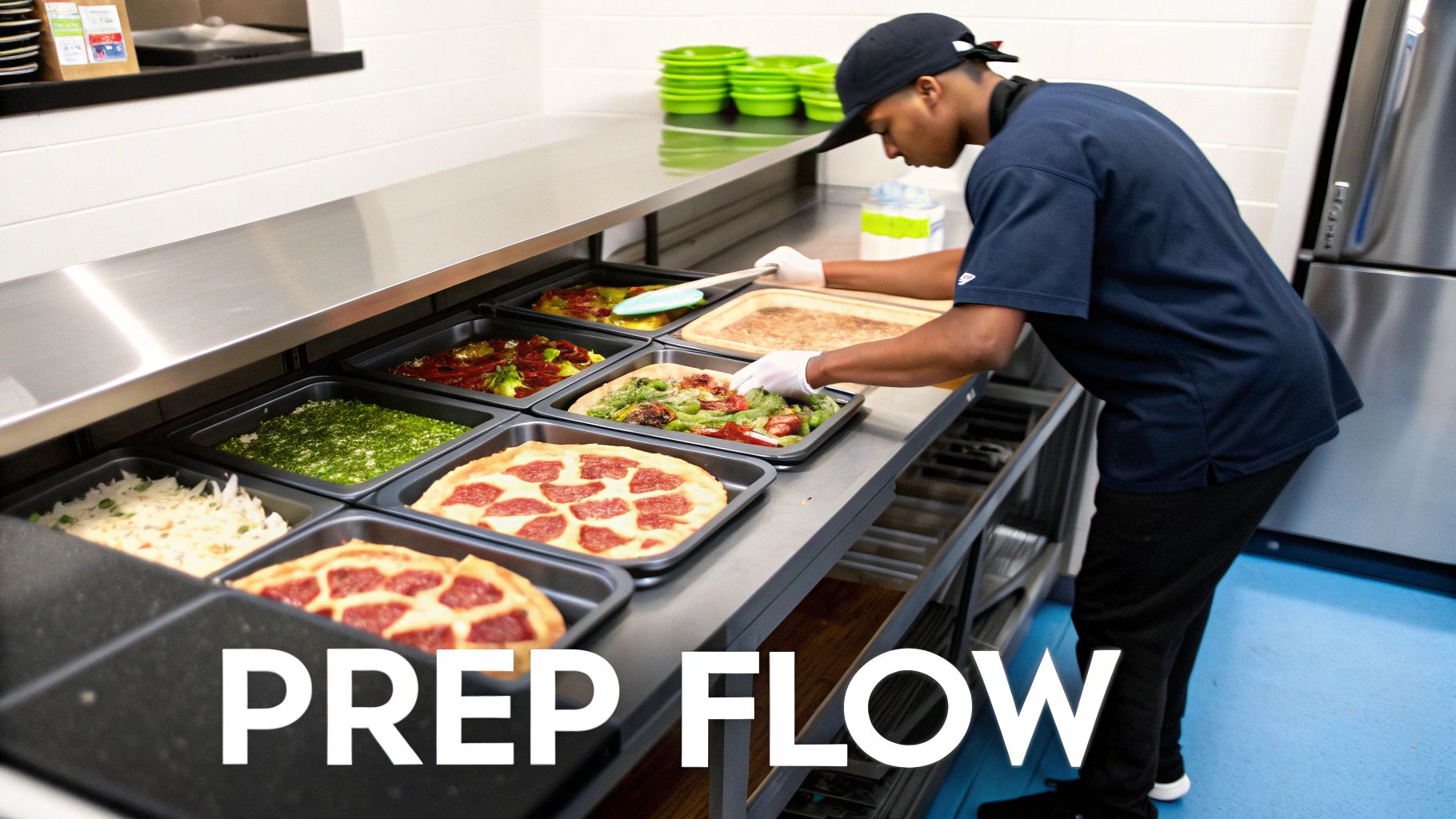
Buying the best deli meat slicer is a great first step, but where you put it in your kitchen is what unlocks its real value. An efficient pizzeria runs like a finely tuned machine, where every second and every step is deliberate. A smart layout can transform your prep area from a bunch of separate stations into a single, cohesive system built for speed and safety, centered around the pizza prep table.
The whole point is to create a seamless "slice-to-prep" flow. Think about it: your employee grabs a log of pepperoni, slices it, and places it directly into a chilled ingredient bin on the pizza prep table—all without taking more than a couple of steps. That’s the kind of ergonomic workflow that shaves valuable time off every single pizza order.
This isn't just about moving faster. A poorly positioned slicer can quickly become a bottleneck, a serious safety hazard, and a sanitation nightmare. When you think through the layout, you turn that new piece of equipment into a true asset that boosts your entire pizzeria's performance.
The Golden Triangle of Pizza Prep
For peak efficiency, your slicer needs to be part of a "golden triangle" with your under-counter refrigerator and your pizza prep table. This layout shrinks the distance your ingredients have to travel, which is critical for both speed and food safety. Keeping the slicer right next to the refrigerator means meats spend less time in the temperature danger zone (40°F to 140°F).
Here’s how this simple setup completely streamlines your pizza prep:
- Step 1: An employee pulls a whole log of pepperoni from the under-counter refrigerator.
- Step 2: They take one step over to the slicer, portioning it into perfect, consistent slices.
- Step 3: The freshly sliced pepperoni immediately goes into a chilled food pan on the pizza prep table, ready for topping.
This simple, three-step dance is incredibly effective. It cuts down on physical strain for your staff, keeps ingredients fresh and safe, and makes sure your pizza prep table is always stocked and ready for the next rush. For a deeper dive into optimizing your station, checking out guides on the secret sauce behind efficient pizza prep stations can offer some fantastic insights.
Positioning Your Slicer for Safety and Longevity
Strategic placement is also about respecting the machine's needs and the safety of your pizzeria. Commercial slicers are powerful pieces of equipment, and they have specific requirements for ventilation and sanitation that you can't ignore.
First off, give the motor room to breathe. The slicer's motor throws off a surprising amount of heat, and blocking its air vents is a surefire way to cause overheating and premature failure. You always want to leave at least four to six inches of clear space around the motor housing for proper airflow. Never, ever push the slicer flush against a wall or your pizza prep table.
The most ergonomic kitchen layout is also the safest. By designing a workflow that minimizes unnecessary movement, you reduce the risk of slips, collisions, and cross-contamination, creating a better environment for your entire pizzeria team.
Next, you have to get serious about preventing cross-contamination. Your slicer should have its own dedicated zone, physically separated from areas where you’re handling raw ingredients like chicken or ground beef. That separation is a cornerstone of food safety. It's also smart to position it away from sinks or dishwashing areas to prevent water from splashing onto the motor or blade, which can lead to electrical shorts and rust.
Creating an Organized and Effective Workspace
A well-organized prep station is a fast prep station. Period. The area around your slicer should always be kept clean, dry, and completely uncluttered. You should have designated storage for all the slicer accessories—the blade sharpener, cleaning tools, and food-grade lubricant all need a home.
Consider these practical tips for keeping your slicer station in top form:
- Non-Slip Mat: Place the slicer on a heavy-duty, non-slip mat. This keeps it rock-solid and stable during operation.
- Designated Landing Zone: Have a clean, sanitized surface or a stack of sheet pans ready to receive the freshly sliced product. No scrambling to find a place for your sliced pepperoni.
- Tool Accessibility: Keep your cleaning brushes, sanitizer spray bottles, and cut-resistant gloves in a designated drawer or a wall-mounted holder right next to the slicer.
By thoughtfully integrating your deli meat slicer into your pizza prep workflow, you're doing more than just making space for a new machine. You’re building a faster, safer, and more profitable production line that can handle the busiest of rushes with total confidence.
Mastering Slicer Safety and Sanitation
In a busy pizzeria, that commercial meat slicer is an absolute workhorse. It churns out perfectly consistent pepperoni and prosciutto faster than any human could. But let's be honest—it's also one of the most dangerous pieces of equipment in your kitchen.
Treating your slicer with the same respect you'd give a high-performance sports car is non-negotiable. You wouldn't drive without seatbelts, and you shouldn't run a slicer without a deep understanding of its safety features and a rock-solid sanitation plan. This isn't just about passing a health inspection; it's about protecting your team and your customers.
The best slicers come loaded with safety features designed to prevent the kind of horrific injuries that can happen in a split second. Proper training is what makes those features effective. Every single person who might touch that machine needs to know the why behind the rules, not just the how.
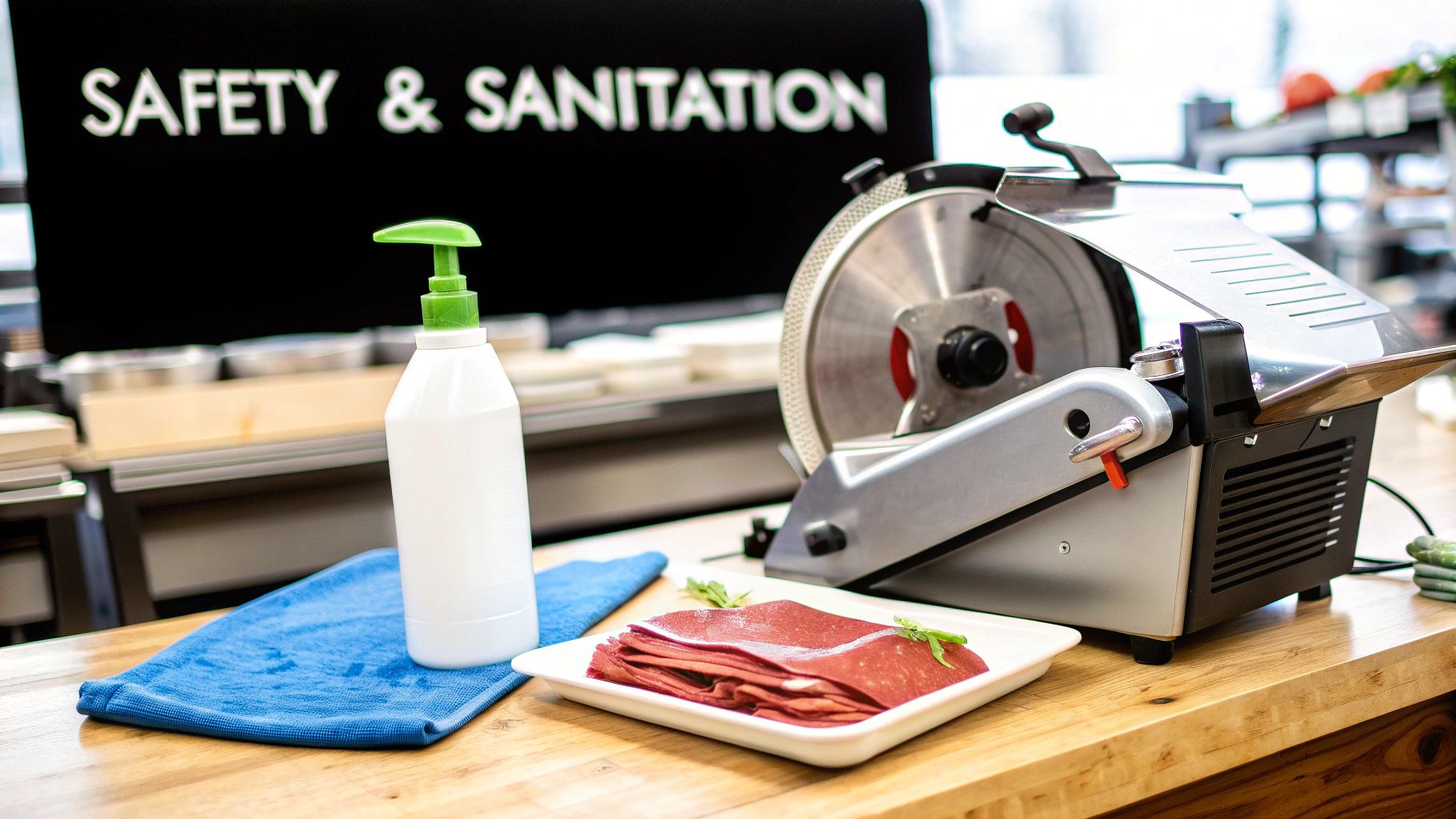
Key Safety Features to Demand
When you're shopping for a slicer to pair with your pizza prep table, don't even consider a model without these critical components. They are the difference between a reliable tool and a ticking time bomb.
- Permanent Blade Guard: This is the ring or cover that shields the part of the blade you're not actively using. It absolutely must be permanently attached. If a guard can be removed, someone will remove it for "easier" cleaning, and that's when accidents happen.
- Carriage Interlocks: This is a brilliant feature that prevents the blade from spinning unless the carriage—the part that holds the meat—is locked safely in the "home" position. It makes it impossible to accidentally start the motor while you're loading a log of pepperoni.
- No-Volt Release: If the power flickers or goes out completely, this system ensures the slicer will not automatically roar back to life when the power is restored. Someone has to physically and intentionally turn it back on, preventing a very nasty surprise during a busy shift.
These features are your first line of defense. They build predictability and control into a powerful machine, making it a much safer part of your daily pizza prep.
The Importance of NSF Certification
Beyond keeping fingers safe, you have to keep your food safe. This is where NSF (National Sanitation Foundation) certification is an absolute must-have for any piece of equipment in a pizza restaurant, especially your slicer. An NSF-certified slicer isn't just a nice-to-have; it's your proof that the machine was designed from the ground up to be cleaned properly and thoroughly.
An NSF certification tells you the slicer can be fully broken down without needing a special toolkit. It means the surfaces are smooth and non-porous, so bacteria have nowhere to hide. It guarantees there are no hidden cracks or crevices for food particles to get stuck in. Simply put, it's your assurance that you can actually get the machine hygienically clean.
This is your best weapon against cross-contamination and foodborne illness. A slicer that's a pain to clean is a slicer that won't get cleaned right, and that puts your entire pizzeria at risk.
Your Step-by-Step Cleaning and Sanitizing Guide
This isn't a once-a-week task. A full breakdown and cleaning should happen at the end of every single day, or any time you switch between different types of meat.
- Safety First: Unplug the slicer from the wall. Turn the blade thickness dial to zero. Make sure all guards are in place and, most importantly, put on a pair of cut-resistant gloves.
- Disassemble Components: Following the manufacturer's guide, carefully remove the product carriage, blade cover, and any other removable parts.
- Wash and Rinse: Carry the parts over to your three-compartment sink. Wash them with hot, soapy water, give them a thorough rinse with clean water, and let them air dry completely on a sanitized drainboard.
- Clean the Body: Grab a clean cloth and a good degreaser. Wipe down the entire body of the slicer, getting into all the seams, handles, and nooks and crannies.
- Clean the Blade: This is the most critical step. With your cut-resistant gloves still on, use a dedicated brush and soapy water. Always wipe from the center of the blade outward, away from the sharp edge. Never, ever wipe toward the blade.
- Sanitize Everything: Once all the parts are clean and dry, reassemble the slicer. Spray every food-contact surface with a food-safe sanitizer, making sure it stays wet for the required contact time. You can learn about the 3 types of sanitizer solutions to see which one works best for your kitchen.
- Final Air Dry: Let the sanitizer air dry completely. Don't wipe it off. Once it's dry, your slicer is ready for the next shift at the pizza prep station.
By making this process an automatic part of your closing routine, you'll blow past health code standards and build a reputation for quality and safety that your customers can taste in every pizza.
Making a Smart Investment in Your Slicer
Alright, let's talk money. This is where we connect all those technical specs to your pizzeria's bottom line. I know the initial price tag on a quality slicer can make you gulp, but looking at it as a long-term investment is the key to making a smart decision that actually saves you money down the road.
A slicer isn't just another line item on your equipment list; it's a core part of your pizzeria's engine. Going cheap with a light-duty model might feel like a win at first, but those "savings" evaporate fast. Think about the hidden costs: constant repairs, a machine that dies mid-shift on a Friday night, and sloppy, inconsistent slices that hurt your food cost and pizza quality.
Understanding Slicer Price Ranges
Commercial slicers really break down into three main categories. The price climbs with the machine's durability, motor power, and ability to handle the grind of a real pizza restaurant.
- Light-Duty Slicers ($300 - $1,000): These are for very occasional use, maybe an hour a day, tops. The motors are smaller, and the parts just aren't built for a commercial pizza workload.
- Medium-Duty Slicers ($1,500 - $4,000): This is the sweet spot for most pizzerias. These machines are engineered to run for hours every day. They have beefier motors and a more solid build that can live happily next to your pizza prep table.
- Heavy-Duty Slicers ($5,000 - $12,000+): These are the absolute tanks. They're designed to slice all day, every day without breaking a sweat, perfect for high-volume pizzerias or central commissary kitchens.
When you're shopping, it helps to see your slicer as part of your kitchen's bigger picture. Considering it alongside other kitchen appliances and gadgets helps you build a cohesive and efficient equipment lineup for your pizza restaurant.
Exploring Lease-to-Own Options
For a new pizzeria just starting out or any shop trying to manage cash flow, dropping thousands on a slicer upfront can be a tough pill to swallow. This is where financing can be a total game-changer.
A lease-to-own plan gets a high-quality, dependable slicer into your kitchen without wiping out your cash reserves. You make predictable monthly payments, and at the end of the term, the machine is yours. It's how you get the performance you need for your pizza prep table today.
This approach lets you afford the workhorse slicer that won’t quit during the dinner rush. To get a better handle on what might work for you, it's worth digging into the different ways of handling restaurant equipment financing. By choosing a quality slicer, you’re not just buying a piece of steel; you're investing in consistency, safety, and the long-term health of your pizzeria.
Slicer Questions From the Pizza Trenches
When you're equipping your pizzeria, a commercial slicer is one of those core tools you just have to get right. Let's tackle some of the most common questions I hear from owners when they're picking out, using, and taking care of the workhorse on their pizza prep table.
How Often Should I Be Sharpening My Slicer Blade?
For a pizzeria that's seeing steady, daily action, a good rule of thumb is to sharpen the blade once or twice a week. But don't just follow the calendar—let the slicer tell you what it needs.
The real test is in the cut. If you start seeing your pepperoni tear instead of slicing cleanly, or if your team has to put more muscle into the push, it's sharpening time. Always stick to the manufacturer's guide for using that built-in sharpener; going rogue can wear down your blade way too fast. Remember, a sharp blade isn't just faster, it's a whole lot safer.
Can I Slice Cheese on My Meat Slicer?
Yes, you absolutely can, and for many pizza restaurants, it's a huge time-saver. But you have to go into it with the right machine and a smart process. Softer cheeses are notorious for creating drag and gunking up the blade, which puts a ton of strain on the motor. If cheese is a big part of your pizza prep, you'll want a slicer with a beefier motor—think at least 1/2 HP—and a non-stick blade coating if you can get one.
Here's the critical part: you must clean the slicer immediately after running cheese through it. If that residue hardens, it's a nightmare for both sanitation and your slicer's performance. Many pizzerias buy a separate, dedicated slicer for cheese to sidestep any flavor transfer or cross-contamination issues with their meats.
It's a simple split in your workflow that pays off big in food safety and keeping your pizza prep table running smoothly.
What’s the Real Difference Between a Belt-Driven and Gear-Driven Slicer?
This is all about how power gets from the motor to the blade, and it’s a huge factor in the slicer's muscle and longevity at your pizza restaurant.
-
Belt-Driven Slicers: These machines use a heavy-duty belt, kind of like a fan belt in a car, to spin the blade. They tend to be quieter and a bit easier on the wallet upfront. The trade-off is that the belt will eventually stretch out and need to be replaced as part of your regular maintenance schedule.
-
Gear-Driven Slicers: Think of these as the heavy-duty trucks of the slicer world. They use tough, interlocking metal gears to turn the blade. This setup delivers more consistent power, which is a lifesaver for slicing through dense cheese or tougher cured meats. They're built to last and need less maintenance on the drive system, but they usually make more noise and cost more to buy.
Honestly, for most pizzerias that are mainly slicing pepperoni, ham, and other standard deli meats, a good-quality belt-driven slicer is the perfect, cost-effective choice. It’s got more than enough power to keep your pizza prep table loaded and ready for the rush.
Ready to build a faster, safer, and more efficient pizza line? At Pizza Prep Table, we live and breathe this stuff. We specialize in high-quality, reliable equipment that can handle the heat of a busy pizzeria. Check out our lineup of commercial slicers and pizza prep tables built for pros. Find the perfect slicer for your kitchen today!