

A Guide to Commercial Walk In Refrigerators for Pizzerias
It’s Friday night, and the order screen is a blur of tickets. Your pizza prep table, once the command center of your operation, has become a traffic jam. You're constantly shuffling ingredient pans, trying to make room for more cheese, while your team yells for the dough balls buried somewhere in the back. This is the moment every pizzeria owner hits when they're growing: the realization that the reach-in cooler under the prep table just can’t keep up.
Moving Beyond the Pizza Prep Table
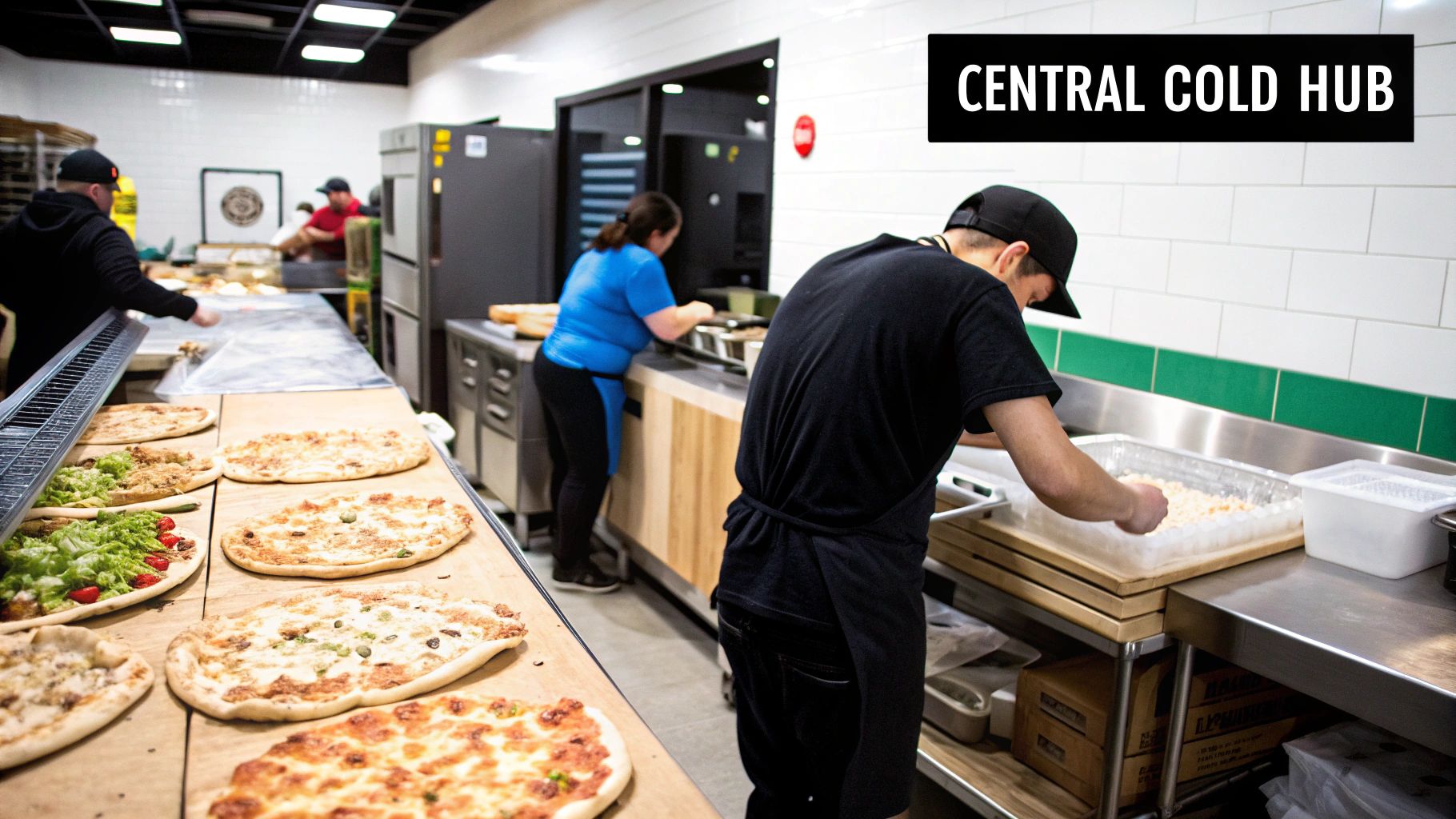
That cramped space under a standard pizza prep table is a familiar headache for any pizzeria that’s doing well. It’s essential for the make-line, sure, but its limited cold storage quickly becomes the biggest obstacle to getting pizzas out the door faster. When your crew is trying to manage dough proofing, topping storage, and sauce rotation from a small, overstuffed cooler, you're creating friction right where you need speed.
This is where a commercial walk-in refrigerator completely changes the game. It isn't just a bigger fridge; it's the new central hub for your entire cold chain, connecting your delivery door to your pizza prep table. Don't think of a walk-in as just an appliance—think of it as the command center for your pizzeria's entire inventory.
A Foundation for Growth and Efficiency
Making the jump to a walk-in unit solves several massive operational problems all at once. It immediately fixes the space crunch under your pizza prep table, but its real power is in how it unlocks your pizzeria's potential.
- Bulk Purchasing Power: All of a sudden, you can buy cheese in 50-pound blocks, dough by the pallet, and produce in bulk. This drastically lowers your food cost on every single pizza you sell.
- Streamlined Prep Workflow: Your team can now prep huge batches of toppings, sauces, and portioned dough, storing them on organized rolling racks that are ready for the rush. No more mid-service scrambles to restock the pizza prep table.
- Enhanced Food Safety: A dedicated walk-in means your ingredients are stored at consistent, optimal temperatures. This cuts down on the spoilage risk that comes from a prep table cooler door that's being opened every 30 seconds.
- Scalability for the Future: It gives you the storage capacity to finally say "yes" to big catering orders, add new items to the menu, or just handle a growing customer base without your quality taking a nosedive.
A commercial walk-in refrigerator isn't an expense; it's a strategic investment in your operational capacity. It empowers a pizzeria to shift from just surviving the rush to actually mastering it, laying the groundwork for real, long-term success.
Ultimately, this one piece of equipment bridges the gap between a small-shop operation and a high-volume professional kitchen. It lets you organize your cold storage with logic, separating bulk ingredients from the ready-to-use items on the pizza prep table. This simple change creates a seamless flow from the delivery truck, to the prep table, and finally to the oven, setting your pizzeria up for maximum efficiency.
How to Size Your Walk In Refrigerator
Picking the right size for your walk-in refrigerator is probably the single biggest equipment decision you'll make for your pizzeria. It’s a choice that ripples through everything—your food costs, your kitchen's workflow, and even your ability to grow down the road. You have to think of it less like buying an appliance and more like building a custom pantry that has to be perfectly in sync with your pizzeria's unique rhythm.
Sizing isn't just about the physical footprint; it's about figuring out your real operational capacity. A cooler that's too small will create daily headaches, forcing you into smaller, more frequent deliveries and killing any chance of saving money with bulk buys. On the flip side, a unit that’s way too big is just a waste of energy and money that could be put to better use somewhere else, like a new pizza prep table.
Calculating Your Pizzeria's Storage Needs
To nail down the right size, you need to get a clear picture of your inventory flow. Start by digging into your weekly sales numbers and delivery schedules. How many pizzas are you slinging during your busiest week of the year? That number is the bedrock of your calculation because it tells you exactly how much dough, cheese, and toppings you need to have on hand at all times.
Next, think about the specific ingredients that are the real space hogs in a pizzeria. These are your "bulk items," and they have a much bigger storage footprint than the stuff you can cram into a standard pizza prep table.
- Dough Trays: How many stacks of dough trays do you need proofing at once to survive a Friday night rush? They’re wide and demand a serious amount of shelf real estate.
- Cheese Blocks: Buying cheese in 50-pound blocks is a huge money-saver, but these things are bulky and require deep, heavy-duty shelving to support them.
- Sauce and Toppings: Those big buckets of pizza sauce, large bags of pepperoni, and cases of fresh produce all add up fast. You need enough space to keep it all organized and easy to grab.
- Kegs and Beverages: If you're serving draft beer or selling bottled drinks, you’ll need to carve out dedicated floor space for kegs and cases.
By mapping out the space you need for these core items, you can stop guessing and start working with a real estimate of the cubic footage you require. For a more detailed walkthrough on calculating specific dimensions, you can check out our guide on walk-in cooler sizing.
Here’s a quick guide to help you visualize what different volumes might require:
Pizzeria Walk In Refrigerator Sizing Guide
This table gives you a rough idea of how weekly pizza sales translate into walk-in cooler sizes, helping you connect your sales volume to your physical storage needs.
| Pizzas Sold Per Week | Recommended Walk In Size (ft) | Primary Use Case | Typical Ingredients Stored |
|---|---|---|---|
| Up to 250 | 6'x6' | Small startup or carry-out only spot | Dough trays, cheese blocks, basic toppings, canned goods |
| 250 - 500 | 6'x8' or 8'x8' | Growing neighborhood pizzeria with some dine-in | Increased dough, multiple cheese types, produce, drinks |
| 500 - 1,000 | 8'x10' or 8'x12' | Busy pizzeria with significant dine-in and delivery | Bulk cheese, extensive produce, sauce buckets, kegs |
| 1,000+ | 10'x12' or larger | High-volume operation, multi-location commissary | Pallet-sized deliveries, full cases, multiple kegs, extensive menu items |
Remember, these are just starting points. Your specific menu and delivery frequency will play a big role in your final decision.
Planning for Future Growth
Once you have a handle on your current needs, the next critical step is to think about the future. Your pizzeria isn't going to stay the same size forever, and your walk-in is a long-term investment. The last thing you want is to outgrow your cooler in just a couple of years.
A smart rule of thumb is to add a 20-25% capacity buffer to your current calculations. This extra space acts as a safety net, allowing you to handle unexpectedly large catering orders, test new menu items, or simply absorb the demands of a growing customer base without stress.
This foresight prevents the costly and disruptive process of replacing your walk-in down the road. For example, a small startup pizzeria might find a 6'x6' unit is plenty for their initial volume. However, a high-traffic shop pushing hundreds of pizzas a night will likely need an 8'x12' unit just to keep operations running smoothly during peak hours.
Understanding Market Trends and Availability
The availability of specific sizes and features can also be shaped by what's happening in the regional market. In North America, where demand for commercial walk-in refrigerators is strong, indoor installations are the most common. In fact, one market study projects the U.S. walk-in market will grow from approximately USD 1.5 billion in 2025 to USD 2.2 billion by 2035.
That same study notes that indoor units make up about 63% of installations, mostly because they're more energy-efficient and better protected from the elements. This robust demand means pizzerias in this region often have a wider selection of sizes and refrigeration systems to choose from. You can discover more insights about the expanding walk-in refrigerator market to see how these industry trends can work in your favor.
Choosing the Right Refrigeration System
Once you've nailed down the right size for your walk-in, the next big decision is picking its engine—the refrigeration system. This isn't just a technical detail; it's a choice that directly shapes your kitchen's environment, your monthly energy bills, and how often you'll be calling a service tech. For a busy pizzeria, where the ambient heat from ovens is a constant battle, getting this right is non-negotiable.
Think of it like choosing an engine for a delivery car. You have different options for power and efficiency that fit specific needs. Keeping that simple analogy in mind makes it much easier to see which system is the right fit for your pizza operation.
Before you pick the engine, you need to know the size of the car. This handy decision tree is a great starting point for matching your pizzeria's output to a recommended walk-in size.

Use this visual guide to get a solid baseline for your kitchen's cold storage needs, which will then inform your choice of refrigeration system.
Self-Contained Systems: The "Window AC Unit"
A self-contained refrigeration system is the most straightforward of the bunch. All the guts of the system—the compressor, condenser, and evaporator—are bundled into a single, factory-built unit. This package typically sits right on top of or on the side of the walk-in box.
This is the "all-in-one" solution. It’s a breeze to install because there are no refrigerant lines to run through your building. You just mount the unit, plug it in, and you're good to go. It’s simple, and the upfront cost is usually lower.
But it has some real drawbacks for a pizzeria. It dumps heat and noise right back into the kitchen. In an already sweltering and loud pizza kitchen, this can make the work environment a real drag for your staff and force your HVAC system to work overtime, inflating your utility bills.
Remote Systems: The "Central Air Conditioner"
Now, let's talk about the remote refrigeration system. This one operates just like a central air conditioning unit in a house. The loud, heat-generating parts (the condensing unit) are installed outside the building, usually on the roof or a concrete slab out back. The evaporator coil, the part that actually gets cold, is the only piece left inside the walk-in.
For a pizzeria, the benefits are huge and immediate. By moving all that heat and noise outdoors, you instantly create a cooler, quieter, and much more comfortable kitchen. Your team can work more efficiently, especially when they're standing in front of hot ovens during the dinner rush.
The trade-off? A more complex and expensive installation. A certified technician has to run refrigerant lines between the indoor and outdoor units, which means more labor and materials. Despite the higher upfront cost, most high-volume pizzerias find the better kitchen environment and potential energy savings make it a smart long-term investment.
For many pizzeria owners, a remote system is the clear winner. It gets the heat-generating machinery away from the already-hot pizza prep table and oven line, which improves staff comfort and eases the load on the kitchen's main air conditioning.
Pre-Assembled Remote Systems: A Hybrid Solution
A pre-assembled remote system, often called a "drop-in," tries to give you the best of both worlds. The evaporator and condenser come pre-charged with refrigerant and are connected at the factory, but they are still two separate pieces. This makes the installation process much simpler than a traditional remote system, often cutting down on labor time and costs.
This hybrid approach still gets the condensing unit outside of the walk-in box itself, which helps cut down on the heat and noise issues you see with self-contained units. However, the condenser is usually located very close to the walk-in (often on top), so it can still contribute some heat to the kitchen, just not as directly. It's a solid compromise for pizzerias that want some of the perks of a remote system without the full installation headache.
The market for commercial walk-in refrigerators is growing fast, which is great news for pizzeria owners. This growth, driven by restaurants just like yours, means more competition and innovation from manufacturers. For you, that translates into more choices, better features like energy-saving compressors, and more flexible financing options. You can discover more insights about the expanding walk-in refrigerator market to see how these industry trends can work in your favor.
Optimizing Your Kitchen Workflow
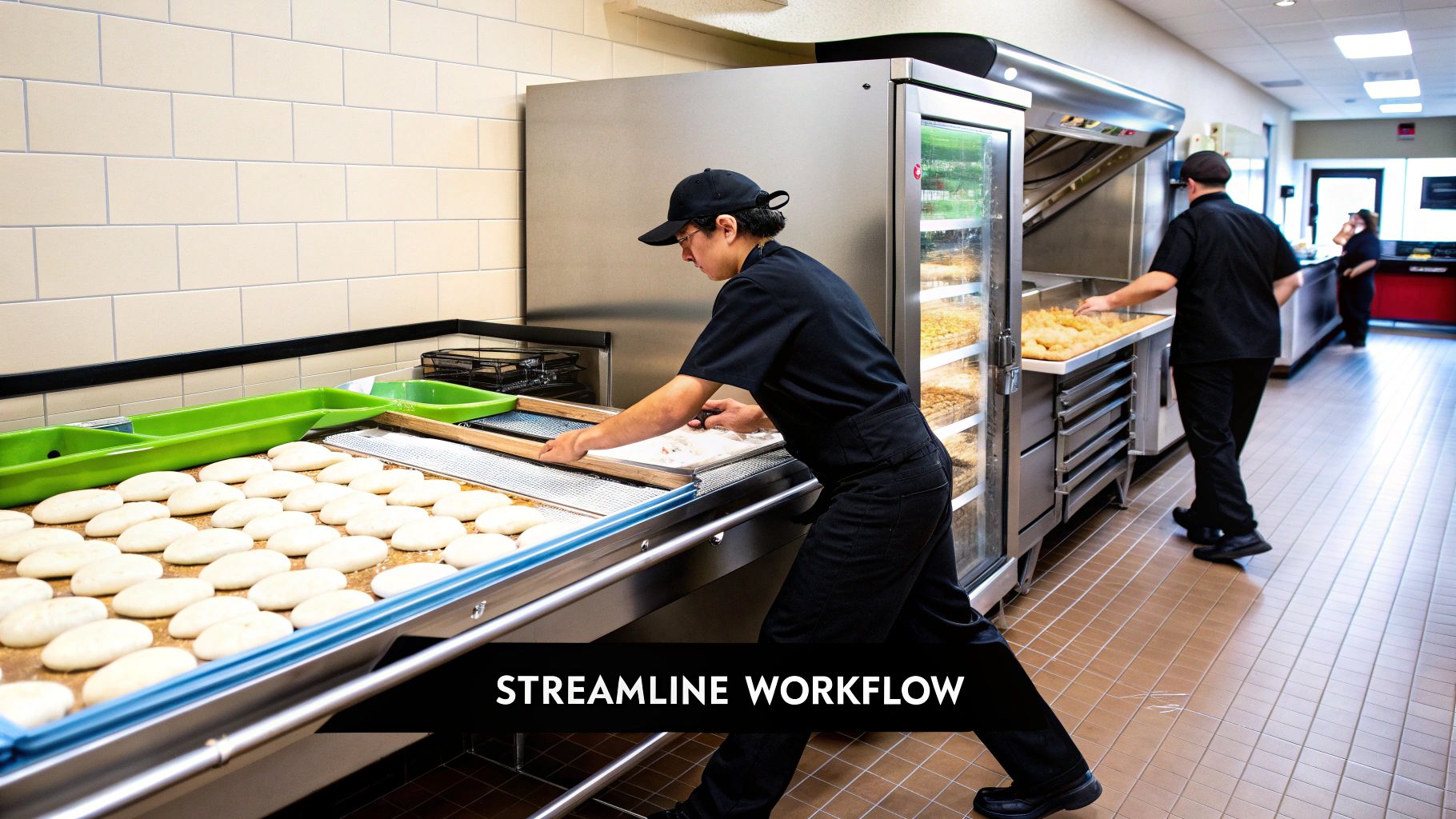
A commercial walk in refrigerator is so much more than a big cold box. When you get it right, it becomes the beating heart of an efficient pizzeria. Smart planning around its location and how you use it can slash wasted steps, ease the stress of a dinner rush, and get pizzas out the door faster.
The real goal here is to create a seamless cold chain—a straight, unbroken path for ingredients moving from bulk storage to the pizza prep table.
Imagine it’s a packed Friday night. Your pizzaiolo sees the lowboy cooler under the pizza prep table is running low on cheese. If your walk-in is stuck down a long hallway or in the basement, that restock mission is a time-consuming trek that pulls a key player off the line. That’s a classic bottleneck, and it slows the whole kitchen down.
Now, picture that same moment, but the walk-in is just a few steps from the prep area. Restocking becomes a quick, thirty-second job. This is the bedrock of an optimized workflow. It’s not just about convenience; it’s a direct investment in your kitchen’s speed and labor efficiency.
Designing a Seamless Cold Chain
The sharpest pizzeria owners I know treat their kitchen layout like a factory production line. The flow should be a straight shot: ingredients come in the back door, get organized in the walk-in, are prepped, get assembled on the pizza prep table, and then head to the ovens.
Placing your commercial walk in refrigerator as the bridge between receiving and prep is the key.
This setup means heavy hitters like 50-pound cheese blocks and huge sauce buckets can be unloaded and stored immediately, saving your staff’s backs. More importantly, it carves out a dedicated restocking path that doesn’t cross wires with finished pizzas heading out to customers.
Every step a pizzaiolo takes away from the pizza prep table is a moment they aren't making a pizza. A well-placed walk-in keeps your most skilled staff right where they need to be, focused on assembling orders and maintaining quality.
This isn’t just about saving a few seconds here and there. Over a week, those seconds turn into hours of reclaimed labor time, which hits your bottom line and boosts your kitchen’s total output.
Advanced Prep Inside Your Walk In
Your walk-in isn’t just for passive storage; it's an active prep station waiting to happen. By bringing in rolling racks, you can turn your cooler into a dynamic part of your workflow. This lets your team knock out crucial prep tasks during slower hours, setting you up for a smooth, controlled rush.
Here’s how to put your walk-in to work for your pizza line:
- Portioned Toppings: Use sheet pan racks to hold pre-portioned containers of pepperoni, mushrooms, and onions. When the rails on the pizza prep table run low, a cook just grabs a full tray instead of refilling a dozen tiny pans one by one.
- Proofing Dough: Rolling racks are perfect for holding and proofing stacks of dough trays. This method keeps the dough at a consistent, ideal temperature and makes it easy to wheel a whole new batch right over to the prep station.
- Organized Ingredient Stations: Set up dedicated zones inside your walk-in. All cheese lives on one set of shelves, produce on another, and sauces on a third. This "grab-and-go" system kills the time wasted hunting for ingredients.
This system creates a powerful feedback loop. The pizza prep table signals a need—more mozzarella, more dough balls—and the walk-in, organized for pure speed, provides the solution instantly. This turns your commercial walk in refrigerator from a simple storage box into a vital, integrated part of your pizza production line, saving precious time when it matters most.
Getting Through Installation and Past the Health Inspector
Your new walk-in cooler is a beast, but it’s not officially part of the team until it's installed correctly and gets the nod from the health inspector. This final stretch can feel a little daunting, but think of it less like a final exam and more like the last quality check before your pizzeria’s new cold storage MVP can get to work. A little prep work here saves you from massive headaches and costly delays down the road.
Getting the installation right is everything. I’ve seen brand-new units fail because they weren't perfectly level, causing the door to swing open on its own or fail to create a tight seal. That leads to a constantly running compressor, sky-high energy bills, and, worst of all, spoiled dough and cheese. The same goes for ventilation—especially for self-contained systems. If that hot air has nowhere to go, your unit is going to struggle, dramatically shortening its lifespan. These aren’t nit-picky details; they're the foundation of your investment.
Before the install crew even shows up, you need to walk through a quick pre-installation checklist. Trust me, this simple step can prevent a world of hurt.
Your Pre-Installation Checklist
A smooth installation day is all about having your space prepped and ready to go. Getting this right is just as important as picking out the unit itself.
- Level and Ready Flooring: Your floor has to be perfectly level. An uneven concrete slab can throw off the whole assembly, preventing the panels from locking together tightly. This compromises not just the structure but the insulation, too.
- Clearance and Ventilation: Make sure you’ve left plenty of space around the unit for air to circulate, especially above it. If you have a remote condenser, it needs a clear, unobstructed path to the outdoors. A self-contained unit just needs room to breathe so it can push heat away.
- Verified Electrical Supply: Get a certified electrician to confirm your electrical service matches the walk-in’s specs exactly. We’re talking voltage and amperage. Mismatched power is the fastest way to fry your new equipment.
Passing the Health Inspection
Once your walk-in is up and running, it has to meet the strict criteria set by your local health department. Most of these rules are based on NSF (National Sanitation Foundation) standards, and the inspector’s main focus is always on food safety and sanitation. They’re looking for a fortress—a unit that's sealed, pest-proof, and dead simple to clean.
The health inspector’s job is to prevent foodborne illness, period. They’re trained to spot anything that could be a problem: surfaces that aren't smooth and non-porous, seals that aren't airtight, and any missing temperature monitors that are essential for food safety.
The best way to prepare is to think like an inspector. They zero in on specific details that are easy to miss but are non-negotiable for passing. For a comprehensive look at what they'll be checking throughout your kitchen, our restaurant health inspection checklist is a fantastic resource that breaks down all the common focus points.
Here’s what they’ll be looking for inside your new commercial walk-in refrigerator:
- Coved Base Molding: That transition from the wall to the floor inside the walk-in can't be a sharp 90-degree angle. It needs a curved, or coved, base. This eliminates corners where dirt, flour, and bacteria love to hide, making mopping and sanitizing way more effective.
- Sealed and Sanitizable Surfaces: Every surface inside, from the walls to the shelving, must be smooth, non-porous, and free of any cracks or gaps. This is why you almost always see stainless steel or other NSF-approved coated metals.
- Airtight Door Seals: The inspector will run their hand along the door gasket to feel for any gaps. That seal needs to be perfect. Any little breach lets in warm, humid air and is an open invitation for pests.
- Accurate External Thermometer: The unit absolutely must have a thermometer that’s visible from the outside. This lets your staff—and the inspector—check the internal temperature at a glance without having to open the door and let all the cold air rush out.
- Proper Air Gaps: If you have any condensation or drain lines, they need a proper air gap. This is a simple plumbing requirement that prevents dirty water from backing up and contaminating your clean water supply. It's a small detail, but it's a critical one for food safety.
Protecting Your Investment and Your Bottom Line
Your walk-in refrigerator is one of the biggest and most critical assets in your pizzeria, right behind your pizza ovens. Protecting this investment isn’t just about dodging repair bills; it’s about protecting your entire inventory, guaranteeing food safety, and making sure your kitchen doesn't skip a beat during the dinner rush. Simple, consistent upkeep is the secret to getting the most value out of it for years to come and preventing a complete meltdown.
Preventative maintenance is your first and best defense against expensive breakdowns and carts full of spoiled food. Think of it like a routine oil change for your car—it’s a small, easy task that prevents major engine trouble down the road. For your walk-in, this means keeping the refrigeration system breathing easily and ensuring all that precious cold air stays locked inside.
A Simple Maintenance Schedule
Building a routine is the single best way to stay on top of maintenance. A consistent schedule stops minor issues from blowing up into full-blown emergencies that could shut down your entire pizzeria.
Here are the essential tasks you can't afford to skip:
- Monthly Coil Cleaning: The condenser coils are your cooler's lungs. In a pizzeria kitchen filled with flour dust and grease, they get clogged up fast. A quick monthly cleaning with a stiff brush or vacuum is all it takes to help the system release heat efficiently.
- Weekly Seal Inspection: Check the door gaskets for any cracks, tears, or gaps. A bad seal makes the compressor work overtime, which wastes energy and burns out expensive parts. This is a simple visual check that takes just a few seconds.
- Daily Temperature Log: Keep a simple log of the external thermometer reading. A sudden change is the very first warning sign that something is going wrong inside the refrigeration system.
Neglecting basic maintenance is a direct threat to your bottom line. A single day of downtime from a failed compressor or a cooler full of spoiled cheese can easily cost a pizzeria thousands of dollars in lost revenue and wasted inventory.
To really protect your investment and keep costs predictable, looking into commercial HVAC maintenance contracts is a smart move. These plans often bundle regular inspections and cleanings, making sure your system runs at its best and lasts a whole lot longer.
Smart Financing for a Major Asset
For an independent pizzeria, the upfront cost of a high-quality walk-in can feel like a huge hurdle. But with smart financing, this essential investment becomes completely manageable, freeing up your cash for other critical needs like ingredients, marketing, or a new pizza prep table.
Lease-to-own programs are a really popular solution. Instead of a massive initial payment, you make predictable monthly payments over a set term. At the end of the lease, you usually have the option to buy the equipment for a small amount. This approach turns a huge capital expense into a manageable operating cost, which makes budgeting so much easier.
Choosing an energy-efficient model from the get-go can also lead to huge savings on your utility bills over time. You can learn more about picking the right energy-efficient commercial refrigeration to slash long-term operating costs. Ultimately, financing makes getting a top-tier walk-in an achievable and intelligent financial move for any serious pizzeria looking to grow.
Got Questions? We’ve Got Answers.
When you're deep in the weeds running a busy pizzeria, you don't have time for guesswork. You need straight answers. Here are some of the most common questions we hear from pizza pros about walk-in coolers.
Can I Just Install a Walk-In Myself?
I get why you'd ask—saving money on installation is always tempting. But while some pre-fab units look like a simple weekend project, this is one area where you absolutely want to call in a pro.
A certified refrigeration technician doesn't just assemble the box; they ensure it's sealed perfectly, the refrigeration system is charged correctly, and everything is up to local health and building codes. One wrong move during a DIY install can void your warranty, lead to crazy high energy bills, or even cause you to fail a health inspection. Trust me, the cost of a professional installation is cheap insurance against much bigger headaches down the road.
What’s the Real Difference Between a Walk-In Cooler and a Freezer?
It all comes down to temperature. Think of it this way:
- A walk-in cooler is for your everyday essentials. It holds a steady temperature between 35°F and 41°F, which is the sweet spot for keeping dough, cheese, fresh produce, and sauces perfectly chilled and ready for the pizza prep table.
- A walk-in freezer is for your long-term storage, operating at a bone-chilling 0°F or below. This is where you'd keep bulk mozzarella, frozen meats, or anything else you're not using within a few days.
Most pizzerias start with a walk-in cooler. It's the workhorse of the kitchen. As you grow, you might add a freezer to take advantage of bulk purchasing on things like frozen toppings or cheese.
How Much Is This Going to Cost Me?
There’s no single price tag, as the cost depends heavily on size, the type of refrigeration system you choose, and any custom features you add.
For a ballpark idea, a smaller, self-contained 6'x6' unit might land in the $5,000 to $8,000 range. If you're looking at a larger 8'x12' model with a more powerful remote refrigeration system, you should budget for something closer to $12,000 to $20,000, which usually includes installation.
Be sure to get detailed quotes that break everything down: the unit itself, delivery fees, the all-important professional installation, and any site prep work needed. A complete quote is the only way to understand the true investment and avoid any nasty surprises.
Do I Really Need a Floor in My Walk-In?
This is a great question, and the answer depends entirely on the floor you already have in your pizzeria.
Floorless models are a fantastic, budget-friendly option if your pizzeria has a solid, level concrete slab. The big advantage here is accessibility—you can roll heavy dough racks and ingredient carts right in and out without dealing with a ramp or lip.
However, if your existing floor is made of wood, tile, or isn't properly insulated, then a walk-in with its own integrated, insulated floor is non-negotiable. It’s the only way to guarantee the unit holds its temperature efficiently and satisfies the health inspector.
At Pizza Prep Table, we live and breathe the kind of high-quality refrigeration solutions that help pizzerias succeed. From compact coolers to sprawling walk-in systems designed to mesh with your unique workflow, we've got the gear to help you grow. Check out our full lineup of commercial refrigeration options and let's build something great.