

Beat the Clock: Expert Tips to Drastically Reduce Dough Mixing Time
The Need for Speed: Why Mixing Time Matters in a Pizzeria
Reduce mixing time is critical for any pizzeria looking to maximize output without sacrificing quality. Here's what you need to know:
Quick Ways to Reduce Mixing Time:
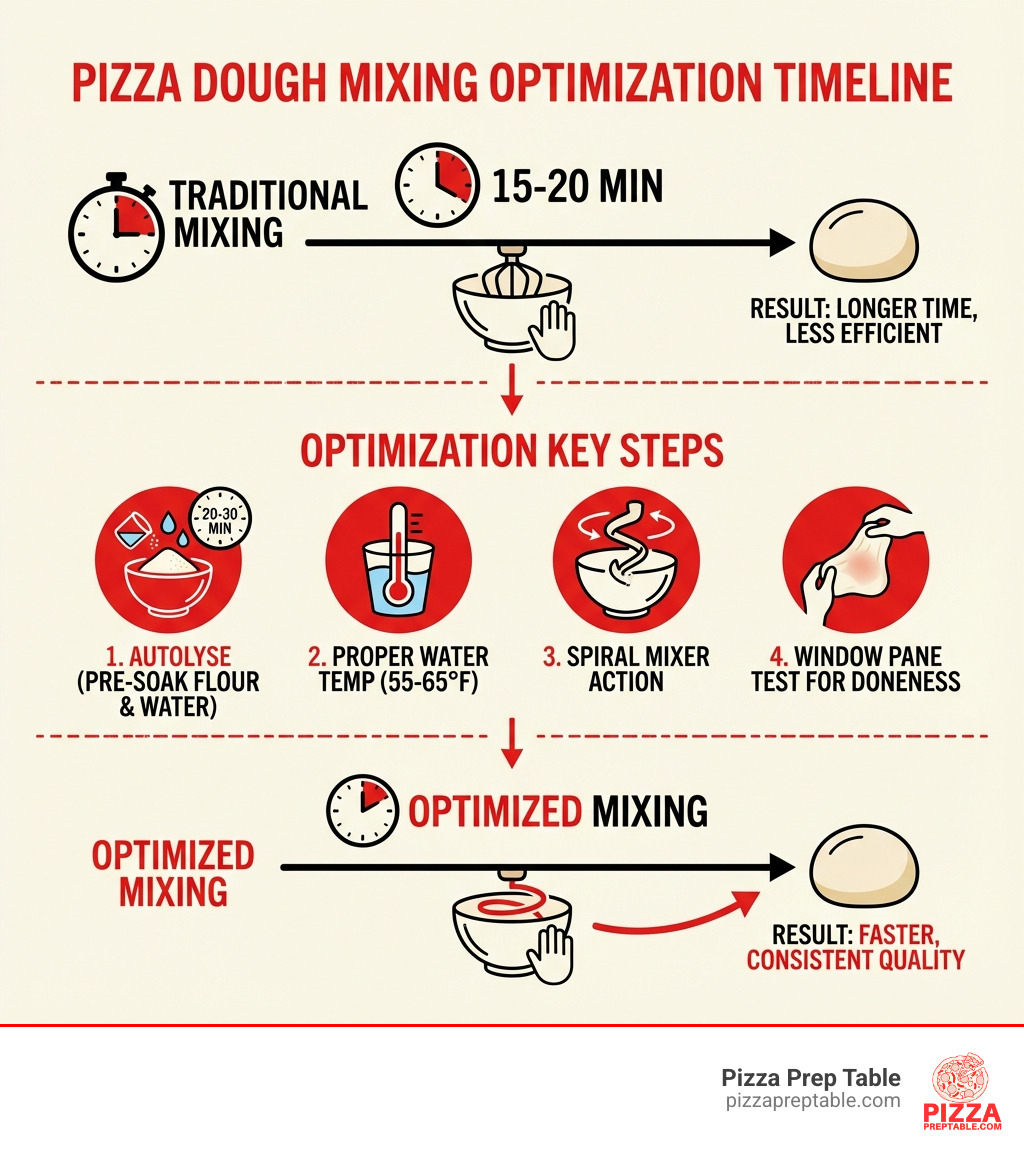
- Control your water temperature - Use 55-65°F water to achieve optimal dough temperature
- Try the autolyse technique - Pre-soak flour and water for 20-30 minutes before mixing
- Upgrade to a spiral mixer - Can cut mixing time by up to 50% compared to planetary mixers
- Add ingredients in the right order - Start with liquids, then add dry ingredients to prevent clumping
- Maintain your equipment - Clean blades and check for wear to prevent extended mixing cycles
If you're running a pizzeria, you know that mixing is a crucial step in production. It determines the texture and quality of your pizza crust. Traditional mixing can be time-consuming and expensive, creating bottlenecks that limit how many pizzas you can serve during your busiest hours.
Long mixing times mean more than just waiting around. They translate to higher labor costs, increased energy consumption, and equipment that wears out faster. When your mixer is running for 15-20 minutes per batch, you're burning money while your customers are waiting for their orders.
But there's good news. Research from industries ranging from bakeries to chemical manufacturing shows that mixing time can often be reduced by a factor of two with the right techniques and equipment. The key is understanding what's actually happening in your mixer bowl and optimizing every variable—from ingredient temperature to the type of mixing action your equipment provides.
I'm Sean Kearney, and I've spent years helping pizzeria owners maximize their kitchen efficiency through smart equipment choices. My experience in foodservice equipment has shown me that understanding how to reduce mixing time effectively can transform a struggling operation into a profitable one.
At Pizza Prep Table, we understand the relentless pace of a commercial kitchen. Every second counts, especially when you're crafting the perfect pizza. Dough mixing, while foundational, can often be the bottleneck that slows down your entire operation. The primary challenges associated with traditional dough mixing processes in pizzerias are multifaceted, impacting everything from labor costs to product consistency.
Inconsistent results are a common headache. Without precise control over mixing time and conditions, one batch of dough might be perfectly developed, while the next is either under-mixed and tough or over-mixed and soupy. This inconsistency directly affects the quality of your final product, potentially alienating customers.
Long mixing times tie up valuable equipment and staff. If your mixer is running for 15-20 minutes per batch, that's time your team could be spending on other critical tasks, and it limits your overall production capacity, especially during peak hours. This leads to increased labor costs and missed opportunities for sales.
The quality of your pizza, from its chewiness to its crust structure, hinges on proper gluten development and dough hydration. These are directly influenced by the mixing process. Achieving the ideal balance requires not just time, but effective time. If the mixing isn't efficient, you're either spending too long to get there or compromising on quality.
The Hidden Costs of Slow Mixing
Beyond the immediate impact on production, slow and inefficient mixing carries a host of hidden costs that can eat into your pizzeria's bottom line.
Traditional mixing challenges often stem from outdated equipment or a lack of understanding of mixing dynamics. For instance, in many industries, including bakeries, mixing is a crucial step that determines the texture and quality of the final product. If we're not optimizing this step, we're leaving money on the table.
- Energy Consumption: A mixer running longer consumes more electricity. Over months and years, these extra minutes per batch add up to significant energy bills. Imagine the impact across all our locations, from New York City to Los Angeles – those kilowatt-hours aren't free!
- Equipment Wear and Tear: The longer your mixer operates, the more stress it endures. This accelerates wear on motors, gears, and mixing attachments, leading to more frequent maintenance, costly repairs, and ultimately, a shorter lifespan for your valuable equipment.
- Production Bottlenecks: This is perhaps the most visible cost. During busy dinner rushes, if your dough isn't ready, your entire line grinds to a halt. This leads to frustrated staff, delayed orders, and potentially lost customers who simply can't wait.
- Reduced Slump and Strength (Concrete Analogy): While we're not mixing concrete, the principle of over-mixing applies. In concrete production, excessively long mixing can reduce the "slump" (workability) and strength of the mix. Similarly, for pizza dough, over-mixing can break down the gluten structure, leading to a dough that loses its elasticity and strength, becoming difficult to work with and resulting in a subpar crust.
- Over-oxidation: Prolonged exposure to air during mixing can lead to over-oxidation of the dough. This can negatively impact the flavor and color of the final product. Just like asphalt hardening during prolonged mixing, where quality diminishes after a certain point, dough can suffer from extended agitation.
The Science of Efficient Mixing
To truly reduce mixing time, we need to understand the science behind it. Mixing isn't just stirring; it's a complex interplay of forces designed to achieve homogeneity – a uniform distribution of ingredients – as quickly and effectively as possible.
At its core, mixing relies on fluid dynamics. This is the study of how liquids behave when forces are applied. In our case, the liquid is our dough, a viscoelastic fluid that changes properties as it's mixed.
- Turbulent Flow: While dough might not seem like a turbulent fluid in the same way water is, the action of the mixer creates localized turbulence. This helps distribute ingredients rapidly. In turbulent flow, the mixing time is closely related to the pumping capacity of the stirrer. Imagine the mixer creating little currents and eddies that pull and stretch the dough, incorporating ingredients more quickly. Studies show that even in complex systems, understanding and leveraging turbulent flow is key to efficient mixing.
- Homogeneity: The ultimate goal of mixing is a perfectly uniform dough where every ingredient is evenly distributed. This ensures consistent flavor, texture, and rise in every pizza.
- Shear Stress: This is the force exerted on the dough as it's being mixed. Too little shear, and ingredients won't incorporate properly. Too much, and you risk damaging the gluten structure. Efficient mixers are designed to apply optimal shear stress for dough development.
- Ingredient Incorporation: This is where the magic happens. Flour, water, yeast, salt, and oil need to be thoroughly combined. Modern mixing technologies, even those from chemical manufacturing, emphasize rapid and complete ingredient incorporation. For instance, advanced mixing strategies can improve mixing efficiency by using unsteady hydrodynamics and vortex-shedding features to create fluid filaments that rapidly diffuse into a homogeneous mixture. Mixing by stirring: Optimizing shapes and strategies.
Key Strategies to Reduce Mixing Time Without Sacrificing Quality
Now that we understand why efficient mixing matters, let's dive into the practical strategies we can implement in our pizzerias. This section will focus on process optimization before and during the mixing cycle.
Strategy 1: Master Your Ingredient Preparation
The journey to perfect pizza dough starts long before the mixer even turns on. Proper ingredient preparation is paramount to drastically reduce mixing time.
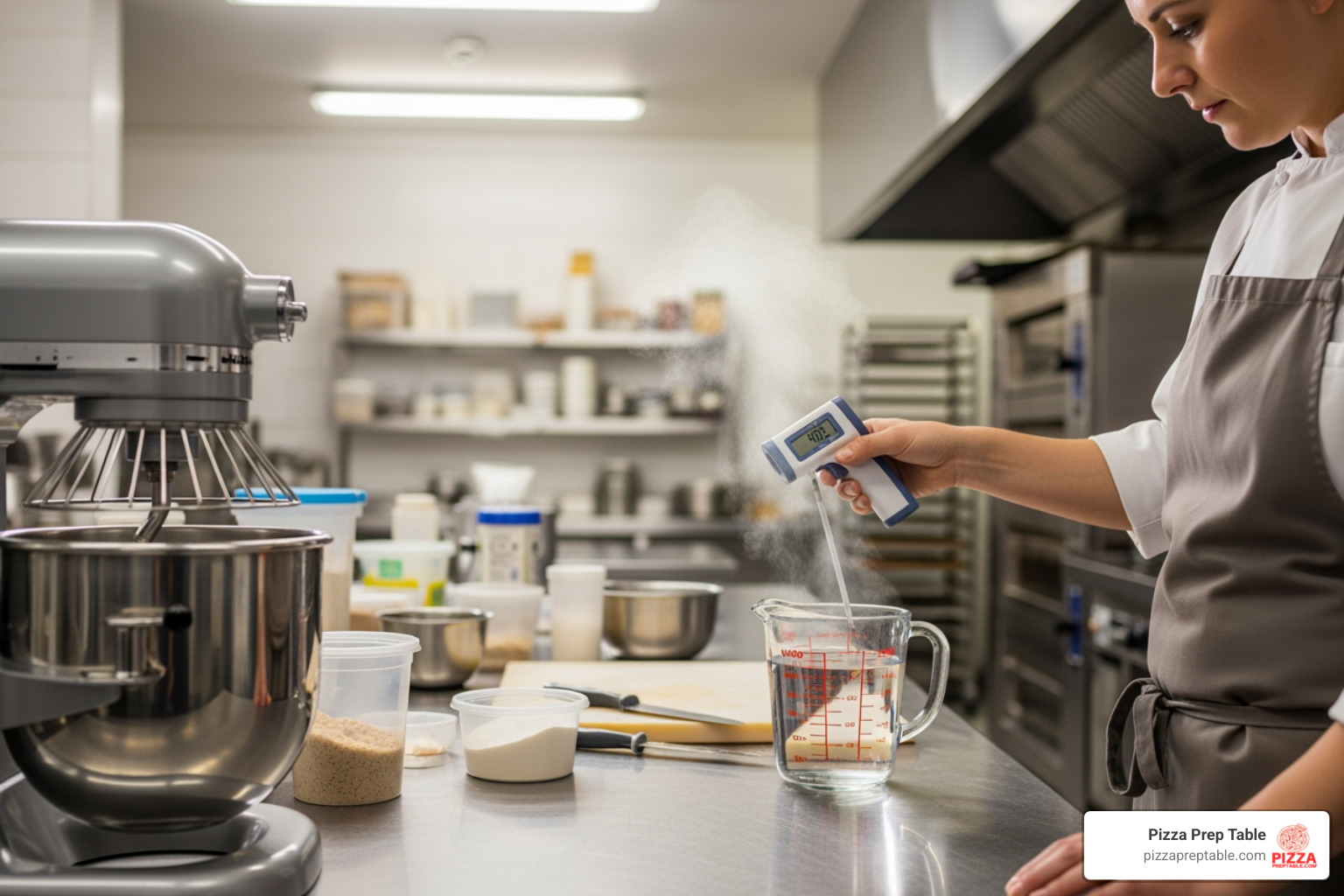
- Ingredient Temperature: This is a game-changer. The temperature of your ingredients, especially water, directly impacts the final dough temperature, which in turn affects yeast activity and gluten development speed. We aim for a final dough temperature of around 75-80°F (24-27°C). To achieve this, we need to carefully control our water temperature, typically targeting 55-65°F (13-18°C). This optimal range helps keep the dough cool during mixing, preventing premature yeast activation and allowing for better gluten development without overheating.
- Flour Particle Size & Accurate Grinding: While we typically buy pre-milled flour, the principle of uniform particle size is crucial. In feed mills, consistent grinding ensures all particles are coated efficiently. For us, this translates to using high-quality flour with consistent milling, ensuring even hydration. If ingredients aren't uniform, it takes longer to achieve a homogeneous mix.
- Proper Weighing: Precision is key. Accurately weighing all ingredients ensures the correct hydration ratio and overall balance, which directly influences how quickly and effectively the dough comes together. Even slight variations can extend mixing times as the mixer struggles to achieve the desired consistency.
- Pre-hydration (Autolyse Technique): This simple yet powerful technique can significantly reduce mixing time. Autolyse involves mixing just the flour and water until no dry spots remain, then letting it rest for 20-30 minutes before adding the remaining ingredients. During this rest, the flour fully hydrates, and enzymes naturally begin to break down starches and proteins, starting gluten development without any mechanical action. This makes the dough more extensible and less sticky, drastically shortening the subsequent kneading time.
Strategy 2: Perfect Your Ingredient Sequencing
The order in which you add ingredients to the mixer can dramatically impact efficiency and reduce mixing time. It's not just about getting everything into the bowl; it's about how they go in.
- Dry Ingredient Blending: Before adding any liquids, we recommend lightly blending your dry ingredients (flour, salt, yeast, sugar if used) together. This pre-mix ensures they are evenly distributed, preventing pockets of unmixed salt or yeast that would require longer mixing to disperse.
- Liquid Addition Methods: The most effective way to incorporate liquids is to add them gradually and continuously. Research from industries like chemical manufacturing, involving the dispersion of powders into liquids, highlights the benefits of continuous liquid addition. Technologies like Silverson's Flashmix Powder/Liquid mixer and Ross's SLIM system demonstrate that forcing powder into a liquid stream or adding liquid continuously to a running mixer drastically reduces agglomerate formation and mixing time. For us, this means starting with the bulk of our water, then slowly incorporating dry ingredients, and finally adding the remaining liquids like oil.
- Adding Liquids Continuously: Instead of dumping all the liquid at once, add it in a steady stream while the mixer is running. This allows the dry ingredients to hydrate progressively, preventing the formation of stubborn lumps (agglomerates) that would require aggressive and prolonged mixing to break down. This principle is mirrored in feed mills, where continuous liquid addition to a running mixer ensures all particles are coated quickly and efficiently.
- Fat and Oil Incorporation: Fats and oils can coat flour particles, hindering water absorption and gluten development if added too early. We typically add oil towards the end of the mixing process, after the initial gluten structure has started to form. This allows for proper hydration and gluten development before the oil lubricates the strands.
- Avoiding Agglomerates (Lumps): Lumps are the enemy of efficient mixing. They force your mixer to work harder and longer. By adding dry ingredients slowly to liquids and ensuring they are thoroughly dispersed from the start, we prevent these "dough balls" from forming. This is directly analogous to the challenges faced in powder-liquid mixing, where specialized equipment prevents agglomerates by ensuring intensive mixing at the point of powder introduction. For more insights on optimal mixer selection, explore The ultimate guide to choosing the best pizza dough mixers.
Strategy 3: Understand Optimal Mixing Duration
Knowing when your dough is perfectly mixed is an art, but it's backed by science. Over-mixing can be just as detrimental as under-mixing, and both will prevent you from achieving the perfect crust.
- Over-mixing Risks: While the goal is to reduce mixing time, blindly rushing can lead to disaster. Over-mixing generates excessive heat, which can prematurely activate yeast and degrade gluten. The gluten network, once overdeveloped, begins to break down, resulting in a sticky, slack, and often soupy dough that lacks structure and is difficult to handle. This is similar to how asphalt hardening occurs rapidly during the first 15 seconds of wet mixing, with little additional hardening from continued mixing; prolonged agitation beyond that point offers no benefit and can even be detrimental.
- Under-mixing Signs: Dough that is under-mixed will be shaggy, crumbly, and lack elasticity. It won't hold its shape well and will produce a dense, tough crust. It needs more time for gluten development and hydration.
- The Window Pane Test: This is our go-to method for assessing dough development. Take a small piece of dough, gently stretch it with your fingers. If you can stretch it thin enough to see light through it without it tearing, it's ready. The dough should be smooth, elastic, and pass this test before you move on. This visual and tactile assessment is crucial for confirming homogeneity.
- Asphalt Hardening Analogy & Ross Count Method Principle: In asphalt production, studies found that dry mixing time had little effect, but wet mixing time was critical for coating aggregates. However, asphalt hardening occurred during the first 15 seconds of mixing, with no additional hardening from continued mixing. Prolonged mixing was unnecessary and potentially detrimental. Similarly, for dough, there's an optimal window for gluten development. Once achieved, further mixing provides diminishing returns and can even cause damage. The "Ross Count Method" in asphalt, which assesses the percentage of coated aggregate particles, conceptually reminds us to verify the actual state of our mix (e.g., gluten development) rather than just relying on arbitrary timers.
- For more detailed insights on mastering dough kneading, check out Mixing it up: Mastering pizza dough kneading in your stand mixer.
The Right Tool for the Job: How Advanced Mixers Cut Down Time
Even with perfect ingredient prep and sequencing, the mixer itself plays a starring role in how effectively we can reduce mixing time. Modern equipment is engineered for speed and efficiency, drawing parallels from advanced industrial mixers.
High-Efficiency Spiral Mixers
For pizzerias, especially those dealing with large volumes of dough, spiral mixers are often the champions of speed and quality.
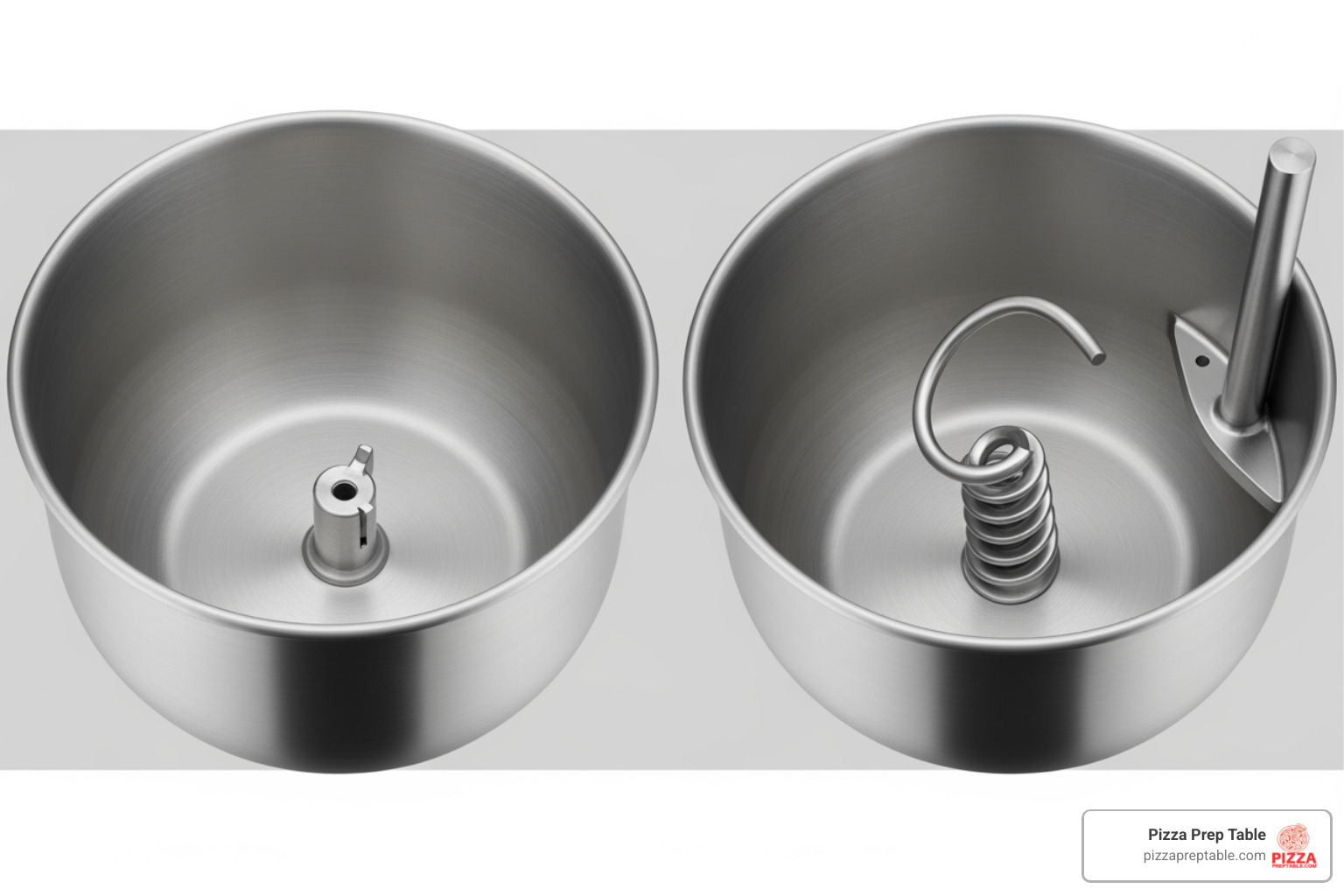
- Spiral Hook Design: The unique spiral hook works in conjunction with a rotating bowl. This dual-action system gently stretches and folds the dough, mimicking hand-kneading. Unlike planetary mixers, the dough remains relatively stationary around the central agitator, resulting in less friction and heat.
- Bowl Rotation: The rotating bowl ensures that the dough is constantly fed into the spiral hook, allowing for continuous and thorough mixing without overworking any single part of the dough.
- Gentle Kneading Action & Low Friction Heat: The gentle, yet effective, kneading action of a spiral mixer develops gluten efficiently without excessive friction. This keeps the dough cooler, which is vital for optimal yeast activity and preventing premature fermentation, ultimately contributing to a shorter, more controlled mixing time.
- Axial Flow Impeller Analogy: In large-scale bioprocessing, axial flow impellers are known to improve top-to-bottom mixing and can reduce mixing time by a factor of two compared to radial flow impellers. Similarly, the spiral mixer's action creates a highly efficient, consistent flow pattern within the dough mass, ensuring all ingredients are incorporated uniformly and quickly.
- Spiral mixers can often cut mixing time by up to 50% compared to planetary mixers for large batches of pizza dough. To find the ideal model for your establishment, explore Mix it up: Finding the perfect spiral dough mixer for your business.
Planetary Mixers: Versatility and Speed
Planetary mixers are the workhorses of many commercial kitchens, prized for their versatility. While they might not be as specialized for high-volume dough as spiral mixers, they still offer speed for a variety of tasks.
- Dough Hook Efficiency: Planetary mixers use a dough hook attachment that rotates on its axis while simultaneously orbiting the bowl - much like planets around the sun (hence the name!). This action ensures that the hook reaches all parts of the bowl, thoroughly mixing ingredients.
- Planetary Action: This movement is excellent for smaller to medium batches of dough, batters, sauces, and other mixtures. For dough, it can effectively develop gluten, though it tends to generate more friction heat than a spiral mixer, potentially requiring slightly longer rest times or closer temperature monitoring.
- Applications for Different Doughs: While pizza dough is a primary focus, planetary mixers excel at a wider range of tasks, from whipping cream to mixing cake batters. Their versatility makes them a staple in many kitchens in cities like Chicago, Houston, and Philadelphia. For a deeper dive into choosing the right planetary mixer, refer to The ultimate guide to comparing planetary mixers.
Comparing Mixer Types for Speed and Efficiency
| Mixer Type | Mixing Action | Best For | Avg. Mixing Time Reduction (vs. traditional) | Dough Temperature Control |
|---|---|---|---|---|
| Spiral Mixer | Rotating bowl, stationary spiral hook | Large batches of pizza dough, heavy doughs | Up to 50% (for dough) | Excellent (low friction) |
| Planetary Mixer | Hook orbits bowl while rotating on its axis | Small to medium batches, versatile for many mixes | Variable (depends on task), less for heavy doughs | Good (can generate more friction heat) |
Optimizing Your Current Setup for Faster Mixing
Even if a brand-new mixer isn't in the budget right now, there are still many actionable steps we can take to optimize our existing equipment and processes to significantly reduce mixing time.
Can You Retrofit Your System for Speed?
Sometimes, a few strategic upgrades or adjustments can breathe new life into your current mixer.
- Upgrading Dough Hooks: The design of your dough hook matters. Some older models might have less efficient designs. Research into impeller shapes in other industries consistently shows that optimized geometries can dramatically improve mixing efficiency and reduce energy consumption. For dough, a well-designed hook can improve the stretching and folding action, leading to faster gluten development.
- Variable Speed Drives: Many industrial mixers, from chemical reactors to feed mills, benefit from variable speed operation. Variable-speed stirring can improve mixing efficiency by disrupting periodic flow structures and generating multi-scale vortices, leading to faster reaction times and reduced energy consumption. If your mixer has multiple speeds, experiment with starting at a lower speed for initial ingredient incorporation and then increasing it for gluten development, or vice versa, to find the optimal sequence that works best for your specific dough and mixer. This allows for precise control over the dough development process.
- Bowl Scrapers: These simple attachments ensure that all ingredients are continuously incorporated into the main dough mass, preventing dry pockets from sticking to the sides of the bowl. This eliminates the need to stop the mixer and scrape manually, which not only saves time but also ensures a more homogeneous mix.
- Hydrobond Technology Principle: While Hydrobond technology is a specific system for bakery lines that rapidly circulates ingredients to create a homogeneous mixture in a fraction of the time, its underlying principle can inspire us. It emphasizes immediate and even distribution of dry and wet ingredients. We can apply this concept by ensuring our dry ingredients are well-distributed before liquids are added, and that liquids are introduced in a way that minimizes clumping, even in traditional mixers. This focus on rapid, even hydration from the start is key. For more on choosing the right large mixer for your operation, visit How to choose a large mixer that fits your kitchen and your needs.
The Role of Maintenance in Optimal Performance
A well-maintained mixer is an efficient mixer. Neglecting maintenance can lead to longer mixing times, inconsistent results, and costly breakdowns.
- Regular Cleaning Procedures: This might seem obvious, but thorough and regular cleaning is non-negotiable. Residue buildup on hooks and bowls can create friction, hinder proper dough development, and even affect dough temperature. In feed mills, regular cleaning prevents residue buildup and ensures smooth operation.
- Preventing Residue Buildup: Ensure all dough residue is removed after each batch. Dried dough can harden and become abrasive, increasing wear on moving parts and reducing mixing efficiency.
- Inspecting Moving Parts: Regularly check your mixer's motor, gears, belts, and bearings for any signs of wear or damage. A smoothly operating machine will mix more efficiently.
- Blade and Hook Maintenance: Ensure your dough hook or spiral arm is free from bends or damage. Even a slight deformation can impact its ability to effectively knead the dough, leading to longer mixing times.
- Reducing Downtime: Proactive maintenance prevents unexpected breakdowns, which are the ultimate time-wasters. A broken mixer means zero dough production, halting your entire pizzeria. By keeping our equipment in top shape, we ensure it's always ready to perform at its peak, helping us reduce mixing time consistently. The principle of optimizing mechanical mixing through mechanism analysis and characterization, as seen in chemical engineering research, underscores the importance of maintaining our equipment's operational integrity to improve efficiency. Learn more about such analyses here: Mechanism analysis and mixing characterization of variable-speed mechanical mixing enhancement.
Frequently Asked Questions about Reducing Dough Mixing Time
How does the autolyse technique help reduce mixing time?
Autolyse involves pre-soaking flour and water, which allows the flour to fully hydrate and gluten bonds to begin forming without mechanical action. This shortens the required kneading time, improves dough extensibility, and can lead to a better final product.
Is a spiral mixer always faster than a planetary mixer for pizza dough?
For large batches of pizza dough, a spiral mixer is typically faster and more efficient. Its design—a rotating bowl and a stationary spiral hook—kneads the dough with less friction, keeping it cooler and developing gluten more effectively, which helps to reduce mixing time. Planetary mixers are more versatile but may require longer mixing for large, stiff doughs.
Can I over-mix my dough by trying to mix it too fast?
Yes. Over-mixing is a significant risk, especially with powerful mixers. It breaks down the gluten network, leading to a sticky, soupy dough that won't hold its shape. It's crucial to monitor the dough's development (using methods like the window pane test) rather than just relying on a timer.
Conclusion: More Dough, Less Time
By implementing these strategies and leveraging the right equipment, we can significantly reduce mixing time in our pizzerias. The benefits are clear and impactful: increased efficiency means we can produce more dough in less time, meeting higher demand without stress. Improved product quality ensures every pizza we serve maintains the consistent, delicious crust our customers love. This all contributes to reduced energy consumption and lower production costs, boosting our profitability across all our locations, from Boston to San Diego.
At Pizza Prep Table, we're committed to helping you streamline your operations. The right equipment and techniques are key to optimizing your pizzeria's production, allowing you to serve more customers without compromising on the quality of your signature crust. Find the perfect spiral dough mixer for your business.