

Undercounter Refrigerator Sizes The Ultimate Pizzeria Prep Guide
When you're trying to figure out the right undercounter refrigerator sizes for a pizza prep line, you’re generally looking at units somewhere between 27 and 72 inches wide. In terms of space, that translates to a capacity of about 5 to 20 cubic feet. The perfect fit really comes down to your kitchen's unique layout, how many pizzas you're slinging, and exactly what ingredients you need to keep cold and ready to go.
Matching Refrigerator Size To Your Pizza Prep Workflow
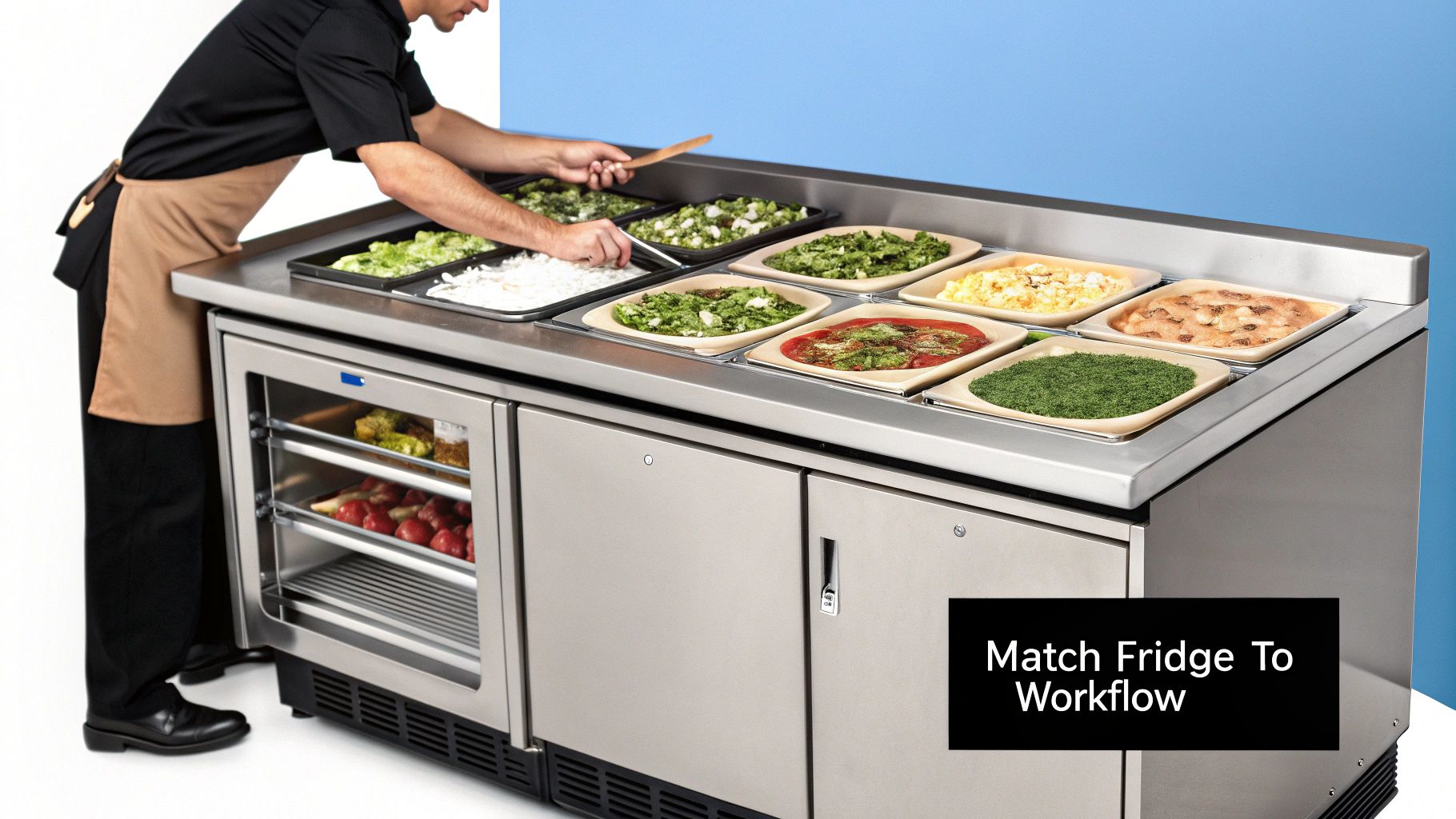
Picking out the right undercounter refrigerator is about more than just filling a gap in your kitchen line; it's a strategic move that has a real impact on your pizzeria's efficiency. The right unit is the backbone of a high-performance prep station, making sure every topping, cheese, and dough ball is right where your crew needs it. Getting this alignment between equipment and workflow is absolutely critical for cranking out orders faster, nailing food safety, and boosting your bottom line.
To get this right, it helps to think about the bigger picture of optimizing your restaurant's back of house. When you map out the entire journey from dough prep to the oven, it becomes much clearer what you actually need from your refrigeration.
Quick Guide to Pizzeria Undercounter Refrigerator Sizes
To make things a little easier, I've put together a quick reference table. Think of this as a starting point to help you match common unit sizes with how they'd actually be used in a real pizza kitchen.
| Unit Width (Inches) | Typical Capacity (Cu. Ft.) | Best For | Example Application |
|---|---|---|---|
| 27" - 36" | 5 - 8 | Small pizzerias, secondary prep stations | Holding just cheese and pepperoni next to the primary make-line. |
| 48" - 60" | 10 - 15 | Mid-volume operations, primary prep station | Storing the top 8-10 most popular toppings for a busy night. |
| 60" - 72" | 15 - 20 | High-volume kitchens, main make-line | Accommodating a wide variety of specialty toppings and sauces. |
This table gives you a solid baseline, but remember to always measure your space and consider your specific menu before making a final decision. The goal is to find that perfect balance of footprint and function for your pizza operation.
Aligning Dimensions with Operational Needs
The physical size of your refrigerator directly influences how your pizza-making team moves and operates. A unit that's too small will cause constant bottlenecks as your staff runs to the walk-in for restocks of mozzarella or dough. On the flip side, one that's too big is just a waste of valuable kitchen real estate you could be using for another prep surface or a dough sheeter.
Here are the key things I tell pizzeria owners to think about for their workflow:
- Width and Capacity: A wider unit, like a 60" or 72" model, can hold more ingredient pans, which means fewer interruptions and trips to the walk-in cooler. For a lot of independent pizzerias, that 5-10 cubic feet range is the sweet spot—it strikes a great balance between storage and footprint. This size bracket is a popular choice for pizza parlors and smaller commercial kitchens.
- Depth and Accessibility: Standard-depth units give you the most storage for dough boxes and bulk cheese, but if you're working in a tight space, a shallow-depth model might be the smarter choice. It can make a huge difference in preventing traffic jams behind the pizza line.
- Workflow Integration: The end goal is a seamless process. Your undercounter refrigerator should feel like a natural extension of your commercial pizza prep table, not an obstacle you have to work around.
When you frame your decision around these pizzeria-specific outcomes, you'll choose an undercounter refrigerator that doesn't just fit the space. You'll get a piece of equipment that actively supports your operation, from managing dough trays to keeping toppings perfectly organized for that Friday night rush.
Getting to Know Standard Undercounter Refrigerator Dimensions
When you're outfitting a pizza prep station, three numbers matter more than anything else: width, depth, and height. Honestly, getting these dimensions right is the difference between a smooth, seamless workflow and an installation nightmare that costs you time and money. Each measurement has a direct impact on how the unit slides under your prep table and how efficient your kitchen ultimately becomes.
These refrigerators are engineered from the ground up to fit under standard commercial countertops, which almost always stand at a height of 36 inches. It’s the industry benchmark, ensuring that most units can tuck neatly underneath, freeing up that precious counter space for what it’s meant for—making pizzas.
Core Dimensions for Pizza Prep Stations
In a busy pizzeria, every inch of space is prime real estate. If you get a handle on the standard dimension ranges for undercounter refrigerators, you can plan your layout like a pro and make sure you have enough cold storage exactly where it’s needed most—right on the make-line.
-
Height: Most of these units fall in the 34 to 35.5-inch range. That little bit of wiggle room leaves just enough clearance for proper ventilation under a 36-inch counter, which is absolutely critical for keeping the compressor from overheating during a dinner rush. You’ll also find ADA-compliant models out there, which are a bit shorter at around 32 inches high to fit under accessible counters.
-
Width: This is the big one that dictates your unit's footprint and how many topping pans you can cram in. The most popular widths I see in pizzerias are 24", 48", 60", and 72". A 24-inch unit is a great sidekick for a smaller, secondary station, while a beastly 72-inch model can anchor a high-volume make-line, holding all the pepperoni, cheese, and veggies you can throw at it.
-
Depth: The standard commercial depth is usually between 30 to 32 inches. This size is designed to line up perfectly with most pizza prep tables, giving you that clean, flush workspace. But if you’re working in a kitchen with tight aisles, you can find "shallow-depth" models that prevent traffic jams when the dinner rush hits.
Key Takeaway: Always, always measure your available space before you even think about buying. And don't just measure the spot for the fridge itself—factor in the clearance needed for ventilation. It's usually an extra 1-2 inches at the back and sides unless you've got a front-breathing model.
Nailing the right undercounter refrigerator size ensures your equipment doesn't just fit physically; it becomes a strategic part of your pizza-making machine. A well-chosen unit cuts down on wasted steps for your crew, keeping all your essential ingredients perfectly chilled and always within arm's reach.
Translating Capacity From Cubic Feet To Pizza Pans
When you’re looking at a manufacturer's spec sheet, seeing a capacity listed in cubic feet can feel a bit abstract. What does that number actually mean for a pizzeria owner? The real question is always a practical one: how many ingredient pans, dough boxes, and topping containers can I actually fit in there?
This is where the rubber meets the road. Translating undercounter refrigerator sizes into metrics you can actually use is the key to designing a pizza prep station that works for you, not against you.
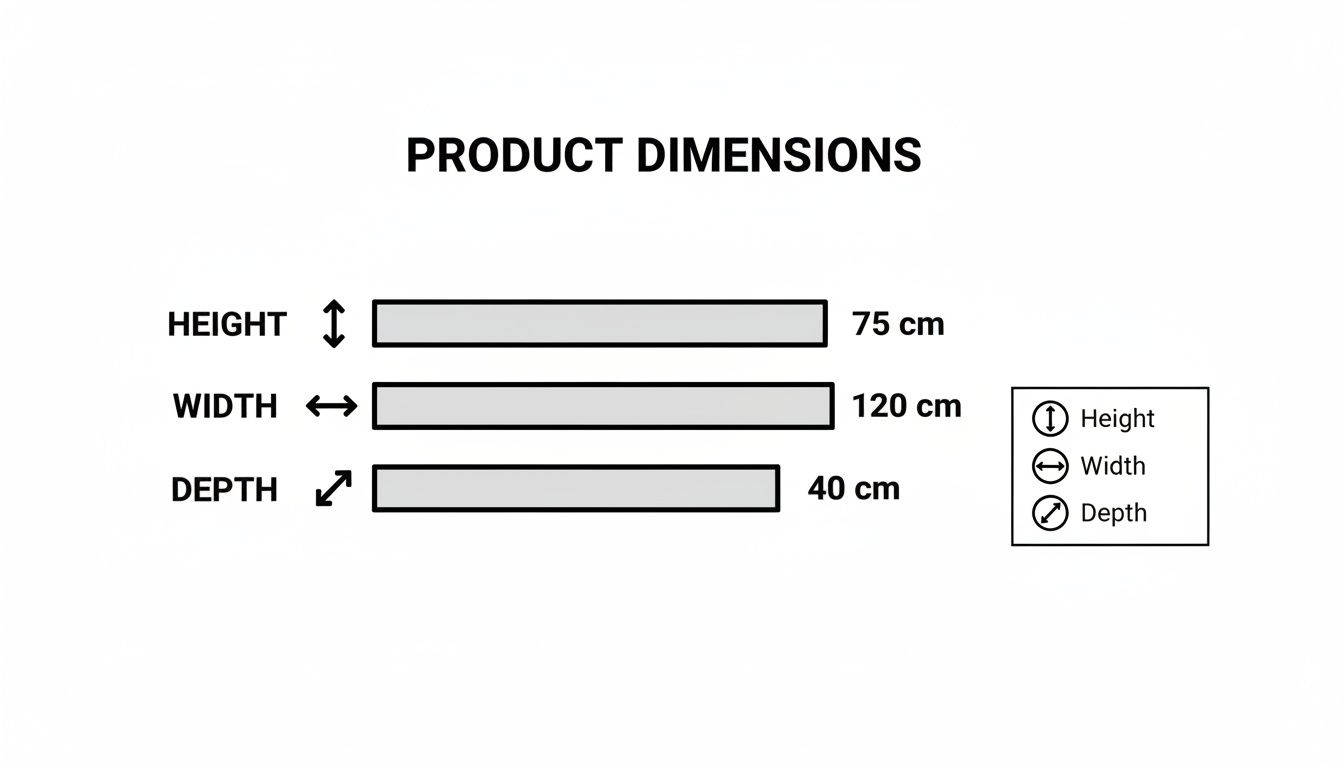
This isn’t just about raw volume; it’s about usable, organized space. A 12-cubic-foot refrigerator might sound roomy, but its real-world utility comes down to the internal layout. Things like shelf placement, where the compressor housing sits, and the door design all dictate whether you can neatly stack 1/6-size pans for toppings or slide in bulky dough trays.
From Volume To Pizza Toppings
To bridge that gap between the spec sheet and your actual pizza kitchen, start thinking in terms of the standard containers you use every day. A smart interior design can make a world of difference in how many topping pans you can cram in.
For instance, a standard 7-cubic-foot undercounter unit (usually around 27 inches wide) can typically hold between 12 to 16 of the standard 1/6-size, 6-inch deep food pans. That makes it a perfect fit for a secondary station holding just cheese, pepperoni, and sauce.
On the other hand, a larger 15-cubic-foot unit (often around 60 inches wide) might swallow 30 to 40 of those same 1/6-size pans. That’s the kind of capacity you need for a primary make-line, giving you immediate access to a whole arsenal of toppings during a chaotic service.
Pizza Ingredient Storage Capacity Conversion Chart
To make this even easier, I've put together a quick conversion chart. This helps translate those abstract cubic feet numbers into the real-world items you're juggling in the kitchen every single day.
| Capacity (Cu. Ft.) | Approx. 1/6 Size Pans | Approx. Full-Size Dough Boxes | Ideal for (Menu Size) |
|---|---|---|---|
| 5-7 Cu. Ft. | 10-16 | 0-1 | Small / Limited Topping Menu |
| 10-12 Cu. Ft. | 20-28 | 1-2 | Medium / Standard Topping Menu |
| 15-20 Cu. Ft. | 30-45 | 2-4 | Large / Extensive Topping Menu |
This chart is a great starting point, but always double-check the interior dimensions and shelf layout on the specific model you're considering. The location of the compressor hump can be a real game-changer for dough box storage.
Factoring In Dough Boxes And Bulk Items
Beyond just the small topping pans, you have to think about your bulk storage needs. Dough is picky and needs the right conditions, and trying to fit full-size dough boxes is a challenge every pizzeria operator faces. Most standard dough boxes measure about 18" x 26".
Here’s what that means for different units:
- Shallow Depth Units: These often struggle to fit a full-size dough box laying flat. You might have to get creative with smaller boxes, but it's not ideal for high-volume proofing.
- Standard Depth Units (30"+): These can usually accommodate one or two boxes per shelf without an issue, making them a better choice for most pizzerias.
Making the most of this space is what keeps your workflow from grinding to a halt. If you know you'll be storing a lot of prepped dough or large trays of cheese, you might even need a dedicated rack for trays inside your refrigeration to keep things organized and easy to grab. By visualizing the capacity in terms of the pans and boxes you handle daily, you can pick an undercounter refrigerator size that truly supports your pizza-making operation.
Choosing The Right Door And Drawer Configurations
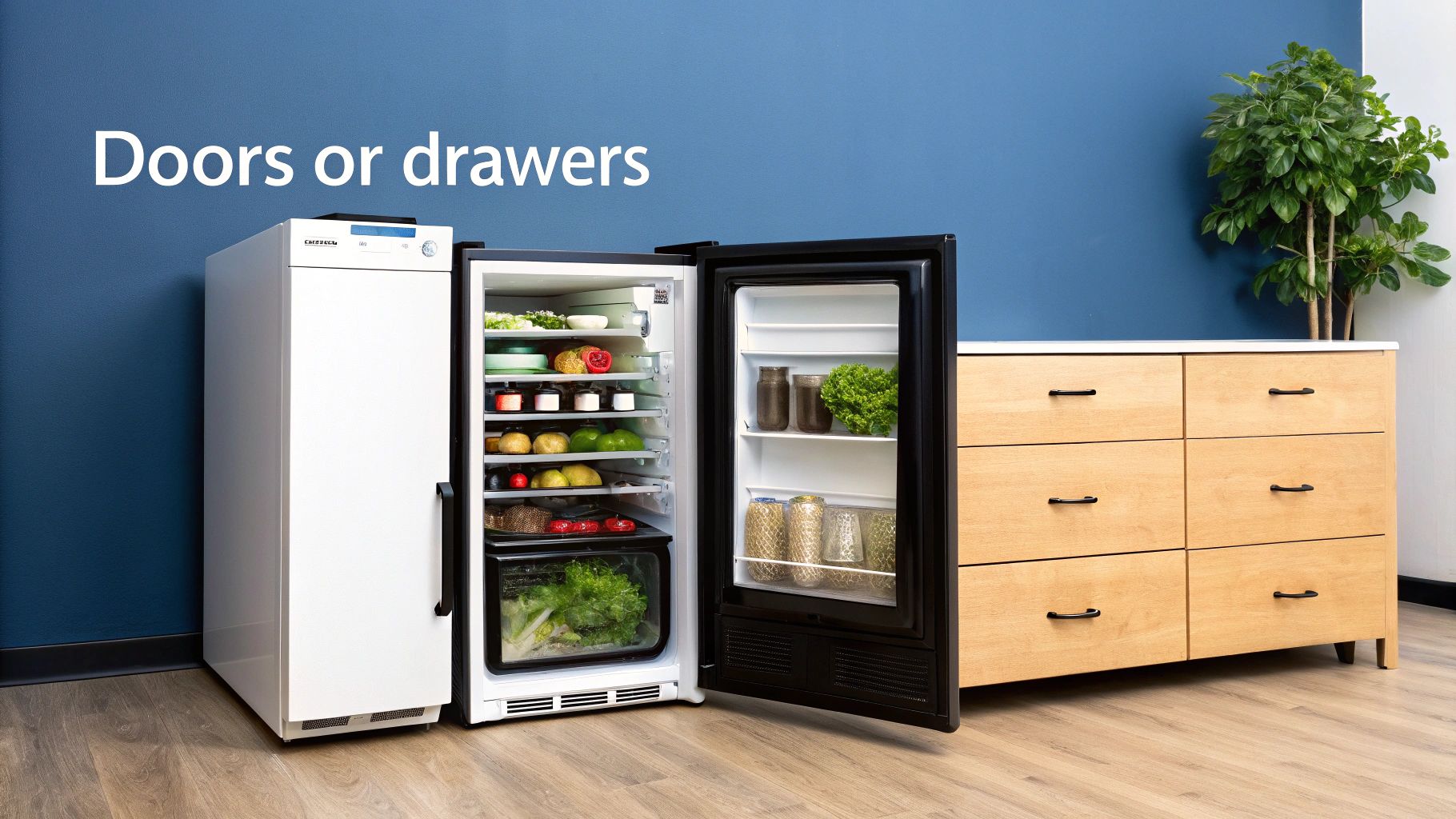
Once you've nailed down the right undercounter refrigerator size for your pizza prep table, the next big decision is the configuration. This isn't just about looks; the choice between doors and drawers is what makes or breaks the speed of your pizza prep line. How your staff grabs ingredients during a chaotic dinner rush directly impacts ticket times and organization.
Think about it this way: drawers are the undisputed champs for portioned toppings. A chef can pull one open and get immediate, top-down access to multiple pans of cheese, pepperoni, and prepped veggies. It completely eliminates the need to shuffle items around on a shelf, saving precious seconds on every single order.
Solid Doors Maximum Insulation
Solid-door refrigerators are the workhorses of any pizzeria, built for bulk storage and serious insulation. Because they don't have glass, they're more energy-efficient and rock-solid at maintaining consistent, cold temperatures. That's absolutely vital for preserving the integrity of sensitive items like pizza dough and bulk sauces.
These models are perfect for storing things that aren't needed for every single pizza but have to stay close to the prep line. Think of them as the ideal spot for backup containers of high-use ingredients or full dough boxes.
Glass Doors For Quick Inventory
Glass-door models offer one massive advantage for a pizza line: visibility. Your prep team can see stock levels at a glance without ever opening the door, which helps maintain internal temperatures and makes restocking way faster. This visual access is perfect for spotting when you're running low on cheese before it becomes a mid-service crisis.
The trade-off, of course, is slightly lower insulating efficiency compared to their solid-door cousins. They're best suited for moderate-volume stations where quick visual checks are more valuable than maximum thermal retention.
A common strategy I've seen in larger pizzerias is a hybrid approach that mixes undercounter refrigerator sizes and configurations. For example, a 72-inch unit might have two drawer sections for toppings and one solid door section for bulk dough boxes. This creates a highly specialized and efficient pizza prep station where every ingredient has a logical home, directly supporting a faster, more organized workflow.
Essential Features For Pizzeria Refrigeration
When you're outfitting a pizzeria, it’s about more than just finding an undercounter refrigerator that fits the space. Certain technical features are absolutely non-negotiable if you want a high-performance pizza kitchen. These specs directly impact food safety, how smoothly your line runs, and the long-term value of your investment, so getting them right from the start is crucial.
First up, and this one's a biggie, is NSF certification. This isn't just a fancy sticker; it’s a sanitation standard that health inspectors look for. It confirms the unit is designed for easy cleaning and safe food handling—something you absolutely need when you're dealing with raw dough and fresh cheese all day long.
Durability and Temperature Control
Next, let's talk about construction. Your refrigerator needs a durable stainless steel exterior and interior. Pizzerias are tough environments. You’ve got acidic tomato sauce splashing around and the constant hustle of a busy prep line. Stainless steel stands up to all of it without corroding or getting beat up.
Just as important is rock-solid temperature management. You need a reliable digital thermostat that holds a consistent temperature between 33°F and 41°F. This is the sweet spot for keeping cheese, dough, and fresh toppings in perfect condition. That kind of consistency is a cornerstone of any good plan for strategies for reducing food waste.
Investing in a unit with a robust cooling system and quality construction isn't just about meeting codes; it's about protecting your ingredients and your profits. A refrigerator that can't maintain temperature costs you money in spoiled food.
Finally, the heart of the unit is its compressor. A powerful and efficient compressor is what ensures the temperature bounces back quickly after the doors have been opened and closed a hundred times during a rush. This is also where you can find some serious long-term savings on your energy bills. For a deeper dive, check out our guide on energy-efficient commercial refrigeration. By focusing on these core features, you're not just buying a fridge; you're investing in quality, safety, and profitability for your pizzeria.
We Hear These Questions All The Time
When you're trying to dial in the perfect undercounter setup for a busy pizzeria, a few key questions always pop up. Getting these details right from the start is the difference between a smooth-running prep line and a constant source of frustration. Let's tackle the concerns we hear most often from pizzeria owners.
Honestly, thinking through the nitty-gritty of installation and workflow now will save you a world of headaches later. The right choice is about more than just cold storage; it’s about food safety, speed of service, and protecting your investment for years to come.
How Much Breathing Room Does My Undercounter Fridge Really Need?
Proper ventilation is non-negotiable. I can't stress this enough. Without enough airflow, the compressor will overheat, struggle to keep things cool, and eventually burn itself out. It’s one of the most common—and most preventable—causes of equipment failure in a hot pizza kitchen.
Most commercial undercounter refrigerators need at least 1-2 inches of clearance on the sides and back to breathe properly. However, if you're planning a tight, built-in installation, look for a front-breathing unit. These pull in and push out air through a grille on the bottom front, giving you a lot more flexibility.
Always, and I mean always, check the manufacturer's spec sheet for the exact clearance requirements. Sticking to those guidelines isn't just for performance; it's often a requirement to keep your warranty valid.
Can I Put My Oven Right Next to the Fridge?
Placing something hot, like a pizza oven or charbroiler, directly next to your undercounter refrigerator is a really bad idea. The constant heat radiating from the oven forces the fridge's compressor to work overtime just to maintain its internal temperature.
This constant strain sends your energy bills through the roof and dramatically shortens the life of the unit. You're basically guaranteeing an expensive, premature repair call. If your kitchen layout gives you absolutely no other choice, leave as much space as you possibly can between the two and seriously consider installing a stainless steel heat shield to act as a barrier.
For a Pizza Station, Are Drawers or Doors Better?
This is the classic debate, and the honest answer is: it depends entirely on your workflow. Each setup has clear advantages for different ingredients and how your pizza team works.
- Drawers are fantastic for organizing and grabbing portioned toppings on the fly. Chefs can pull one open and see multiple pans of cheese, pepperoni, and veggies all at once. It's a huge time-saver during a busy rush.
- Doors are much better for bulky items that just won't fit in a drawer. Think large containers of sauce, backup ingredient bins, or full-size dough boxes.
In my experience, many pizzerias land on a combination unit that has both drawers and doors. It really does offer the best of both worlds, giving you the most versatile and efficient setup for your pizza prep table.
Ready to spec out the perfect undercounter refrigerator for your pizzeria? You can browse a huge selection of top-quality units at Pizza Prep Table. We've helped countless owners optimize their kitchen's workflow, and we can do the same for you. Find your ideal fit today at https://pizzapreptable.com.