

what is haccp food safety? essential guide for pizzerias
Let's cut through the jargon. HACCP isn't just another regulation to memorize; it's your pizza kitchen's playbook for stopping food safety disasters before they ever happen. Think of it like a pilot's pre-flight checklist—a systematic process to ensure every critical step, from ingredients arriving at the back door to the final pizza sliding into a box, is safe and under control.
This shifts your mindset from reacting to problems to actively preventing them. Instead of just cleaning up messes, you’re engineering your workflow to avoid them entirely. This is what HACCP (Hazard Analysis and Critical Control Points) is all about. You identify potential dangers throughout your entire pizza-making process and create specific checkpoints, like your pizza prep table, to manage those risks before they can cause harm.
A Proven System for Safer Food
The power of HACCP isn't just theoretical; it has a long and successful history. The system actually got its start in the 1960s as a project for NASA to guarantee the food for astronauts was 100% safe. Since its widespread adoption in the food industry, some countries have reported up to a 50% reduction in contamination incidents from pathogens like Salmonella.
The idea is simple but incredibly effective: find out where things can go wrong and stop them in their tracks. For a pizzeria, this could mean anything from verifying that cheese is delivered at the proper temperature to making sure your oven cooks every single pizza to a safe internal temperature. We cover many of these practical steps in our complete guide to food safety guidelines for restaurants.
Key Takeaway: HACCP is a preventative food safety system. Its goal is to identify and control potential biological, chemical, and physical hazards at specific points in your food production process.
HACCP at a Glance for Pizzerias
To really bring this concept to life, let's break down the acronym and see what each part means in the day-to-day chaos of a busy pizza kitchen. This table gives you a quick snapshot.
| Acronym Component | Meaning | Pizza Kitchen Example |
|---|---|---|
| Hazard | A biological, chemical, or physical agent that could make food unsafe. | Salmonella bacteria on raw chicken toppings. |
| Analysis | The process of identifying where these hazards might occur. | Reviewing how your staff handles raw chicken near ready-to-eat vegetables on the pizza prep table. |
| Critical | A step that is absolutely essential to prevent or eliminate a food safety hazard. | The final cooking step in the pizza oven. |
| Control | The action of managing conditions to maintain safety standards. | Ensuring the pizza prep table's refrigerated rail holds toppings at or below 41°F. |
| Point | A specific step in the process, from receiving ingredients to serving. | The refrigerated rail on your pizza prep table where toppings are held. |
Seeing it broken down this way helps you understand that HACCP isn't about memorizing a textbook. It's about looking at your own kitchen with a fresh set of eyes and building a smarter, safer process from the ground up.
The Seven HACCP Principles in a Pizza Kitchen
Alright, we've established that HACCP is all about playing offense—preventing problems before they start. Now, let's turn that theory into a real-world game plan for your pizzeria. The globally recognized HACCP system is built on seven core principles. Think of them not as boring rules, but as a step-by-step guide to building a reliable, repeatable safety plan that protects your customers and your business.
This isn't just about good intentions. It's the structure that helps you tackle real pizzeria hazards, like Salmonella on raw chicken toppings, head-on. If you want to dive deeper into the global standards, you can learn more about what HACCP is and its core principles on fsns.com.
The process flows logically from identifying potential dangers to setting up controls and having a plan for when things go wrong, as you can see below.
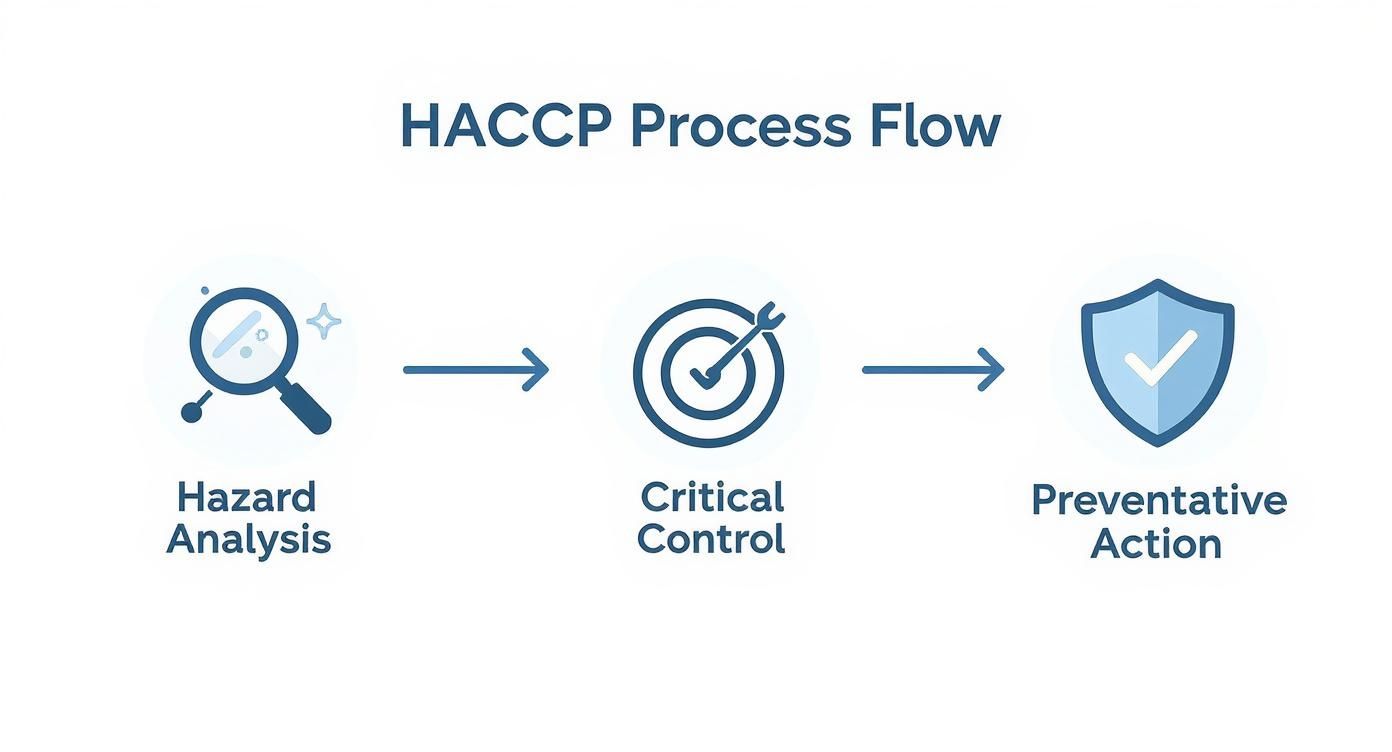
This visual makes it clear: finding the hazards is just the start. The real power of HACCP comes from controlling those specific points and knowing exactly what to do to prevent a problem.
1. Conduct a Hazard Analysis
This is the detective phase. Get your team together and brainstorm every single thing that could possibly go wrong with your food from a safety standpoint. We're talking about biological, chemical, and physical hazards.
Don't just think in general terms. For a pizzeria, that means getting specific. What's the risk of Salmonella on the raw chicken you use for a BBQ pizza? Or E. coli in uncooked ground beef? What about undeclared allergens like nuts hiding in a pesto sauce you buy from a supplier? Could cleaning chemicals from wiping down the pizza prep table mid-service get into the toppings?
This analysis is the bedrock of your entire plan. If you skimp here, you're building your safety system on a shaky foundation.
2. Determine Critical Control Points
Once you've got your list of potential hazards, you need to pinpoint the exact moments in your process where you can step in to prevent, eliminate, or reduce them to a safe level. These are your Critical Control Points (CCPs). A CCP is a kill-or-be-killed moment for a hazard; a step where control is absolutely essential.
Not every step is a CCP. Sprinkling oregano on a finished pizza is a quality step, not a safety one. But the final cook in the oven? That’s absolutely a CCP. It's your last and best chance to destroy harmful bacteria on raw toppings like sausage or chicken.
Other common CCPs you’ll find in a pizzeria include:
- Receiving: Taking the temperature of refrigerated deliveries like cheese and meats the moment they come through the door.
- Cold Holding: Making sure the refrigerated rail on your pizza prep table stays consistently cold.
- Cooking: Hitting that minimum internal temperature on every pizza, especially those with raw meat toppings.
3. Establish Critical Limits
For every CCP you identify, you need a clear, measurable target—a minimum or maximum value that separates safe food from dangerous food. This is your critical limit. These aren't just numbers you pull out of thin air; they must be based on food science.
Example in Action: If your pizza prep table's cold rail is a CCP for stopping bacterial growth, the critical limit isn’t just "keep it cold." It has to be specific, like "all toppings must be held at or below 41°F (5°C)."
This removes all the guesswork. Your team knows the exact number they need to hit, making the next step—monitoring—simple and consistent.
4. Establish Monitoring Procedures
So, how do you know if you're hitting your critical limits? This principle is all about creating a system for observing and measuring your CCPs. You need to define who checks what, and how often they do it.
Let's stick with our pizza prep table example. The monitoring procedure might be: "The shift lead will use a calibrated digital thermometer to check the temperature of the diced ham in the third pan from the left every two hours. They will write the temperature and time in the daily log." Simple, clear, and actionable.
5. Establish Corrective Actions
Things go wrong. It's inevitable. A delivery driver gets stuck in traffic and your cheese arrives too warm. A cooler door is accidentally left ajar. A corrective action is your pre-planned response for what to do the moment a critical limit is missed.
Having a plan ready prevents panic and ensures everyone takes the same safe, decisive action every time. If that ham on the pizza prep table measures 48°F, your corrective action might be: "Immediately discard the ham, notify the manager, and investigate why the prep table isn't cooling properly."
6. Establish Verification Procedures
This step is all about checking your own work. Verification procedures are the activities you perform to confirm your HACCP plan is actually working the way it's supposed to. It’s a layer of oversight beyond the daily monitoring.
Verification could include:
- The pizzeria manager reviewing all pizza prep table temperature logs at the end of the week.
- Calibrating all your kitchen thermometers on the first of every month.
- Observing a pizza maker follow the cooking CCP to ensure they use a thermometer on a meat-lover's pizza.
This proves your plan isn't just a document sitting in a binder—it’s a living, effective system.
7. Establish Record-Keeping Procedures
If it isn't written down, it didn't happen. This final principle requires you to document everything. You need to keep organized records for every part of your HACCP plan, from the initial hazard analysis to your daily temperature logs and any corrective actions you took.
These records are your proof. They show a health inspector you’re actively managing food safety, and they can be your best defense if a foodborne illness complaint ever comes your way. Think of it as your pizzeria's official safety diary.
Spotting the Usual Suspects: Common Hazards in Your Pizzeria
Every kitchen has its hidden dangers, but a solid HACCP plan is like turning on the lights—it helps you see the problems before they can actually hurt someone. To build a plan that works for your pizzeria, you first have to know exactly what you’re up against. In any pizzeria, these threats fall into three buckets: biological, chemical, and physical.
Getting specific makes these risks real. Forget generic warnings and start thinking about the actual dangers lurking in a bustling pizza kitchen—from the ingredients on your pizza prep table to the cleaning supplies under the sink. Naming these threats is the first, most critical step in building a system to shut them down for good.
Biological Hazards: The Invisible Threat
Biological hazards are the microscopic bugs—bacteria, viruses, and parasites—that cause foodborne illness. In a pizzeria, these are hands down the most common and dangerous threats you'll face, simply because they can multiply like crazy when you give them the chance.
Picture a slammed Friday night. A new pizza maker slices raw chicken for a BBQ pizza, then uses the same knife and cutting board to chop green peppers for a veggie order without washing them first. That’s a textbook example of cross-contamination, where nasty bacteria like Salmonella can hitch a ride from a raw ingredient to something that’s ready to eat.
Other common biological troublemakers in a pizzeria include:
- E. coli from undercooked ground beef toppings.
- Listeria, which can grow on deli meats or in soft cheeses if they aren’t kept cold enough on your pizza prep table.
- Viruses like Norovirus, easily spread by an employee who didn't wash their hands properly before stretching pizza dough.
These invisible enemies thrive in what we call the "Temperature Danger Zone"—that's anywhere between 41°F and 135°F (5°C and 57°C). This is exactly why temperature control, especially with a good refrigerated pizza prep table, is the absolute bedrock of food safety.
Chemical and Physical Hazards
While they don't pop up as often as biological threats, chemical and physical hazards are just as serious and need to be on your radar. These are the non-living things that have no business being in your pizza.
Chemical hazards are all about harmful substances accidentally getting into the mix. It's not hard to imagine how it could happen in a pizzeria. An employee might spray a powerful cleaning sanitizer near an open bin of shredded mozzarella on the pizza prep table, letting a fine mist settle right on the cheese. Other risks include pesticide residue on unwashed mushrooms or using dough additives the wrong way.
Physical hazards are any foreign objects that end up in the final product, and they’re often the most jarring for customers because they can actually see them. Think about a tiny piece of blue plastic wrap tearing off a bulk container of pepperoni and falling into the grated cheese. Other cringe-worthy examples include a stray piece of metal from a worn-out can opener, a shard of glass from a broken light fixture, or even a hair or fingernail in the pizza sauce.
By sorting out the potential problems in your pizzeria, you can start to see exactly where you need to build up your defenses. This process turns the vague idea of "food safety" into a concrete hit list of enemies to defeat.
Pizza Restaurant Hazard Identification Chart
To make this crystal clear, let's map out what these hazards look like in the real world of a pizza kitchen. The chart below breaks down a few common examples, showing how a simple preventative step, guided by HACCP, can stop a problem before it starts.
| Hazard Type | Specific Hazard Example | Common Source | Preventative Measure (HACCP) |
|---|---|---|---|
| Biological | Salmonella bacteria | Raw chicken toppings | Cooking pizza to a minimum internal temperature of 165°F. |
| Chemical | Sanitizer spray | Overspray during cleaning | Using sanitizers away from exposed food on the pizza prep table. |
| Physical | A small piece of plastic | Torn packaging for cheese or meat | Inspecting ingredients as they are placed into pizza prep table containers. |
Looking at it this way helps connect the dots between a potential danger and the practical, everyday actions your team can take to ensure every pizza you serve is safe.
Pinpointing Critical Control Points in Your Pizzeria
Alright, you’ve identified the hazards lurking in your pizza kitchen. Now for the fun part: figuring out exactly where you can stop them in their tracks. These are your Critical Control Points (CCPs), and they are the make-or-break moments in your food safety plan.
Think of it this way: a CCP is a point of no return. If you mess up here, there’s no fixing it later, and the risk to your customer goes way up. Not every step in making a pizza is a CCP. Portioning sauce or prepping dough balls is about consistency, not necessarily the last line of defense against a nasty bug.
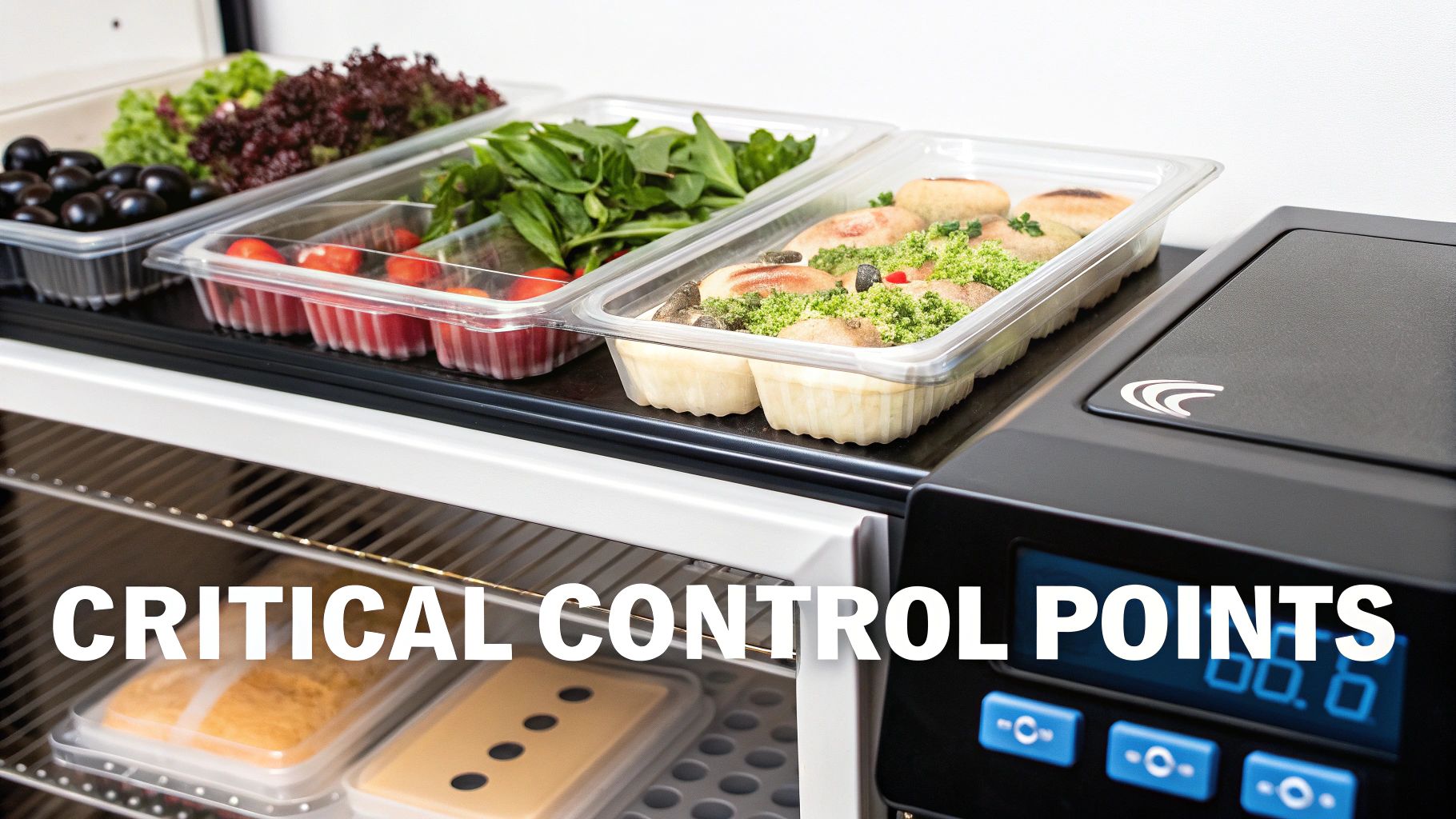
For any pizzeria, the real action happens in a few key places: when ingredients arrive at your back door, while they’re sitting in cold storage, and during the mad rush of assembly on the pizza prep table.
CCP 1: Receiving Ingredients
Your food safety responsibility starts the second that delivery truck pulls up. You have zero control over how that food was handled before it got to you, so this first checkpoint is your only chance to set the standard. For anything refrigerated or frozen, this is a non-negotiable CCP.
Imagine a case of shredded mozzarella shows up. If your thermometer reads 48°F instead of the required 41°F or below, that cheese has already been in the "Temperature Danger Zone." Bacteria have started to party, and you can't un-ring that bell.
Key Actions at This CCP:
- Temperature Checks: Get a calibrated thermometer and poke every perishable item—cheese, meats, pre-cut veggies—as it comes off the truck.
- Visual Inspection: Give everything a once-over. Look for busted packages, weird smells, signs of pests, and check those expiration dates.
- Rejecting Deliveries: Create a firm rule: if it doesn't meet your standards, it doesn't come in the door. Accepting that warm cheese means you’re accepting all the risk that comes with it.
CCP 2: Cold Storage and Cooling
Once you’ve accepted good, safe ingredients, the next critical job is to keep them that way. Your walk-in, reach-in fridges, and freezers are all CCPs. Their entire purpose is to keep biological hazards like Listeria and Salmonella asleep by holding food out of the danger zone.
This isn't just about the fridge itself. How you cool hot foods is also a CCP. If you make a huge batch of marinara, you absolutely have to cool it down fast before it goes into storage to prevent bacteria from blooming. Digging into the safety of placing hot food directly into a refrigerator can offer some great insights on doing this correctly.
That thermostat on your walk-in isn't just a dial—it's an active control measure. A failing compressor or a door propped open for five minutes can turn thousands of dollars of inventory into a massive liability.
CCP 3: The Pizza Prep Table
Now we get to the command center: the refrigerated pizza prep table. This is arguably one of the most dynamic and vital CCPs you’ll manage all day. During a service rush, toppings like pepperoni, mushrooms, and sausage come out of bulk storage and live in that refrigerated rail for hours.
This station is a hotbed for potential temperature abuse and cross-contamination. Keeping those toppings at or below 41°F is the only thing stopping bacteria from multiplying while they sit out. That pizza prep table’s cooling system is your main weapon for controlling this CCP. For a deeper dive, our guide on temperature control for food safety lays out more strategies for locking this area down.
Why the Pizza Prep Table is So Critical: This is where ready-to-eat items (like olives) hang out right next to raw ingredients that need a kill step (like sausage). Strict temperature control and preventing cross-contact are the only ways to manage the risks here.
CCP 4: The Final Cook
The pizza oven is your final, glorious CCP for obliterating biological hazards. It’s your last and best chance to destroy any harmful bacteria like E. coli or Salmonella that might be on raw meats or veggie toppings.
The critical limit here is a tag team of temperature and time. Just melting the cheese isn't good enough. For any pizza with a raw protein, you have to ensure its internal temperature hits a kill-step, which is typically 165°F (74°C). This final blast of heat wipes out the hazards you've been managing all along, making sure the pizza that lands on your customer's table is completely safe.
A Real-World HACCP Example: The Pizza Prep Table
All right, theory is one thing, but let's get our hands dirty. The best way to really wrap your head around HACCP is to build a simple plan for the busiest, most critical spot in your entire pizza kitchen: the pizza prep table.
This single piece of equipment is your command center. It's where countless food safety battles are won or lost every single shift.
So, let's walk through a real-world, step-by-step example using those seven principles we talked about. We'll zero in on one common, high-stakes hazard—bacterial growth in your toppings rail—to show you exactly how this system works in practice. This will give you a blueprint you can adapt for your own pizza shop right away.
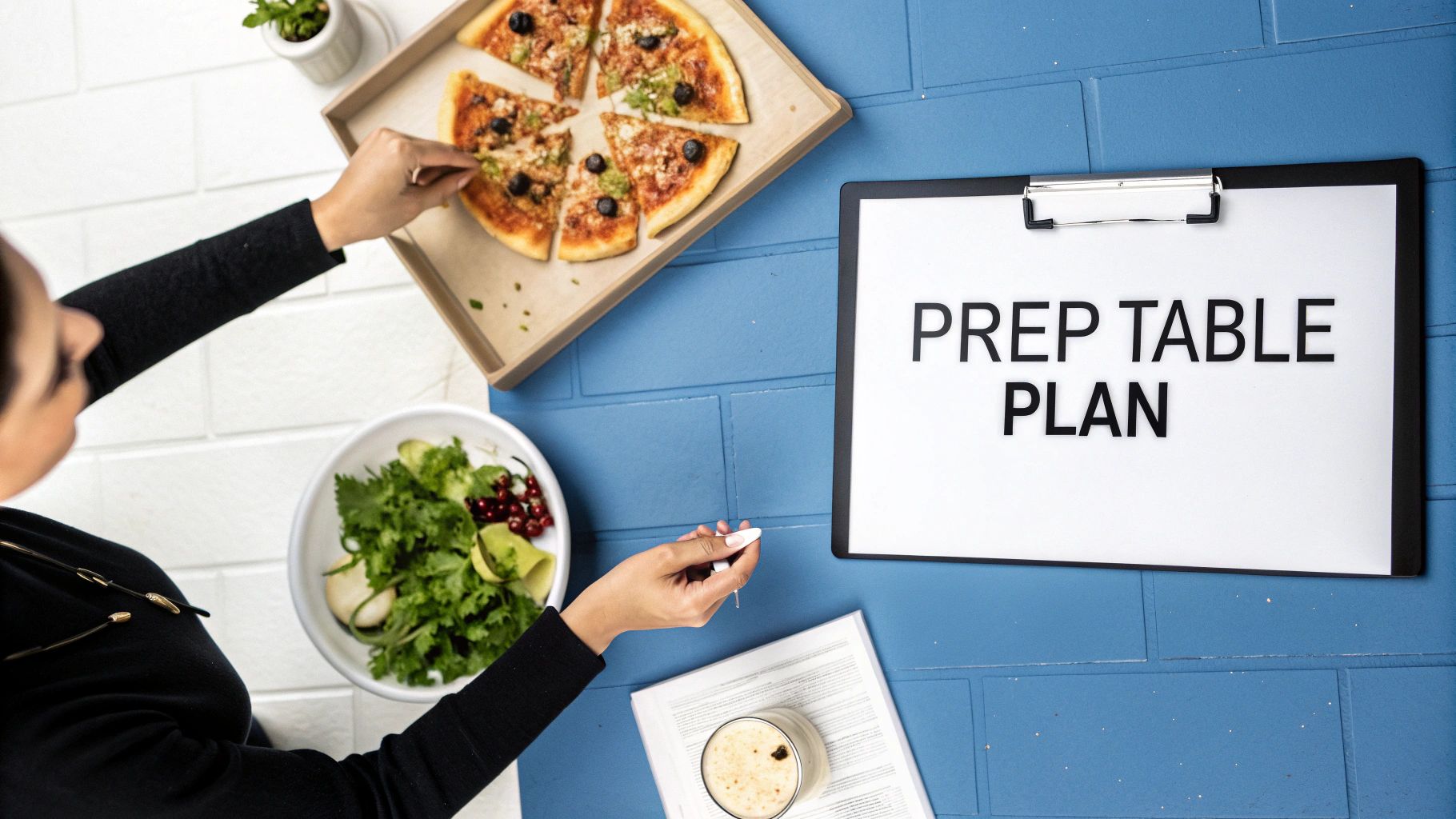
This focused approach strips away all the complexity, turning a confusing set of rules into a simple checklist for your most important workstation.
Step 1 and 2: Find the Danger and the Control Point
First things first, we have to identify the enemy. At the pizza prep table, the biggest biological hazard is the growth of nasty bacteria like Listeria or Staphylococcus aureus on your perishable toppings. Think about it—diced ham, cooked chicken, shredded cheese, and cut veggies are sitting out for hours at a time.
If the temperature creeps up into the "danger zone" (anything above 41°F), these bacteria can multiply like crazy. That makes the refrigerated rail of the pizza prep table our Critical Control Point (CCP). It's the one specific place where we can step in and apply a control to stop that hazard in its tracks.
Step 3: Draw a Line in the Sand
Now we need a clear, black-and-white rule. This is our critical limit—a measurable number that separates safe from unsafe. For this CCP, the science is crystal clear.
Critical Limit: All perishable toppings in the refrigerated pizza prep table rail must be kept at an internal product temperature of 41°F (5°C) or below. Period.
This isn't a suggestion; it's a hard line. Any temperature reading above this number means the hazard isn't controlled, and the food is at risk. It's a simple number your team can easily understand and act on.
Step 4: Set Up Your Monitoring Plan
How do we make sure we're actually hitting that critical limit? We need a solid monitoring plan that spells out who does what, when, and how. Consistency is everything here.
Our Monitoring Procedure:
- Who: The shift manager on duty.
- What: Measure the internal temperature of a high-risk topping (like diced ham) in the rail.
- Where: Take the reading in the warmest part of the rail, which is usually the pan at the very end or closest to the front.
- How: Use a calibrated, sanitized digital probe thermometer.
- When: Every two hours during service (e.g., 12 PM, 2 PM, 4 PM, etc.).
- Record: Write down the temperature, the time, and the initials of the person who took the reading in the "Daily Pizza Prep Table Temperature Log."
This simple routine builds accountability and gives you a written record proving that your CCP is being managed all day, every day.
Step 5: Plan for When Things Go Wrong
Look, sometimes things go sideways. A corrective action is your pre-planned response for when a monitoring check shows you've crossed that critical limit. It eliminates panic and ensures a consistent, safe outcome every time.
If a temp check shows the ham on the pizza prep table is at 48°F, these are the immediate, non-negotiable steps:
- Ditch the Product: Discard all affected toppings in the rail. Don't even think about trying to "cool them back down." It's not worth the risk.
- Alert Management: The shift manager has to let the general manager know about the issue right away.
- Play Detective: Figure out why the temperature is high. Did the unit get unplugged? Is the condenser blocked with dust? Was the lid left open too long?
- Document Everything: Record the temperature deviation, how much product you threw out, and the root cause in the corrective action log.
Step 6 and 7: Double-Check and Keep the Receipts
Finally, we need to check our own work and prove we did what we said we would. Verification is just making sure the plan is actually working. This could be the general manager reviewing all the pizza prep table temperature logs at the end of the week, looking for any missed checks or troubling patterns. Calibrating all your thermometers monthly is another key verification step.
Record-keeping is your proof. Your "Daily Pizza Prep Table Temperature Log" and your "Corrective Action Log" are your official documents. They show a health inspector—and more importantly, yourself—that you are actively managing what HACCP food safety truly means in your pizzeria.
Making Your HACCP Plan Stick with Training and Records
A brilliant HACCP plan is just paper without a well-trained team to bring it to life. To really bake food safety into your pizzeria's culture, you need to focus on two things: consistent staff training and meticulous record-keeping. These are what turn your plan from a document in a binder into a practical, day-to-day reality.
Your team doesn't just need to know the rules; they need to understand the "why" behind them. Training should be hands-on and tailored to their specific jobs. Show your pizza makers exactly how to use a probe thermometer on the pizza prep table and explain why holding toppings at 41°F or below is completely non-negotiable.
Empowering Your Team Through Training
Good training gives your staff the confidence to do the right thing, especially when things go wrong. They should know exactly what to do if a temperature log shows a reading in the danger zone or if a delivery of cheese arrives too warm. It’s about empowerment, not just enforcement.
Your training program should cover the essentials, like:
- How to properly monitor Critical Control Points (CCPs), like checking pizza oven temperatures before the first pie goes in.
- Understanding the right corrective actions for common hiccups at the pizza prep table.
- Following sanitation procedures to the letter. Learning about the 3 types of sanitizer solutions is a great place to start this training.
To make it all stick, you need clear, repeatable steps. Looking at examples of effective restaurant standard operating procedures (SOPs) can help you standardize your own food safety practices and make training much smoother.
The Power of Good Record-Keeping
Here’s the golden rule in any HACCP system: if you didn’t write it down, it didn’t happen. Consistent documentation is your proof—your evidence—that you are actively managing food safety every single day. These records aren't just for passing health inspections; they are your best defense in protecting your business.
Your daily temperature logs for the pizza prep table, corrective action reports, and training records are more than just paperwork. They are a detailed diary of your commitment to serving safe, high-quality pizza and proof that your HACCP plan is working.
Fortunately, this doesn't have to be a huge headache. You can use anything from a simple clipboard with printed log sheets to modern digital apps that track temperatures automatically. The tool you use matters far less than the consistency of using it. This written proof shows your system is effective.
And it works. When HACCP became mandatory in U.S. meat and poultry plants, it was estimated to have slashed foodborne illnesses by 20% in just seven years. That's the power of a plan that's followed and documented every single day.
Your Top HACCP Questions, Answered
Even when you've got a handle on the basics, a few questions always pop up. Let's tackle some of the most common things pizzeria owners ask when they start putting a real HACCP system into practice.
Do I Really Need a Formal HACCP Plan for My Pizzeria?
This is probably the biggest point of confusion out there. The short answer is: it depends on your local health department. Big food manufacturing plants? Absolutely, it's the law. For a local pizzeria, a formal, written-down-in-a-binder plan might not be legally mandatory.
But here’s the thing to remember: even if the paperwork isn't required, your health inspector 100% expects you to be following the principles of HACCP. You absolutely must be controlling temperatures at your pizza prep table, preventing cross-contamination, and cooking pizzas to the right temp. Think of it as the unwritten rulebook for not making people sick—and for making inspections a breeze.
Isn't This Just Another Health Inspection Checklist?
Not even close. This is a crucial difference to understand. A health inspection checklist is reactive. It’s a snapshot in time, checking off boxes on the day the inspector shows up.
HACCP, on the other hand, is proactive. It’s the system you build and run every single day to stop problems before they ever start.
A health inspection is a test to see if you're following the rules. Your HACCP plan is your personal playbook for preventing disasters 24/7, which makes passing that test a whole lot easier.
What's This Really Going to Cost Me?
The cost is more of an investment than an expense. Your initial spend will be on reliable tools—things like a good digital thermometer you can trust and maybe some better food storage containers. The biggest investment is your time, especially when it comes to training your pizza makers properly.
But those upfront costs are peanuts compared to the astronomical price of a foodborne illness outbreak. A single incident can trigger lawsuits, crippling fines, a trashed reputation, and could even shut your doors for good. Investing in a solid system and the right tools, like a dependable pizza prep table, pays for itself by preventing the one bad day that could destroy everything you've built.
A reliable refrigerated pizza prep table is the heart of any pizzeria's HACCP plan. At Pizza Prep Table, we provide the durable, NSF-compliant equipment you need to control your critical points with total confidence. Check out our selection today and build a safer kitchen from the ground up.