

How to Start a Pizza Catering Service From Home: Your Complete Guide
So, you're dreaming of turning that amazing pizza recipe into a real business, right from your own kitchen? Good. Launching a home-based pizza catering service is a fantastic way to break into the food industry without the massive overhead of a traditional restaurant. You get to start smaller, control your costs, and scale things up as the bookings roll in.
Let's talk numbers for a second. Getting a home-based pizza catering business off the ground requires a pretty modest initial investment. You're likely looking at a range of £14,300 to £29,800 (that’s about $18,000 to $37,500 USD), depending on how big you want to go right out of the gate. This budget covers the essentials: licenses, some smart marketing, and the gear that will make or break your efficiency—like a proper commercial-grade pizza prep table.
Your Blueprint for a Home Pizza Catering Business
To get from "great pizza idea" to "fully booked," you'll need a solid plan. I've seen too many passionate pizza makers jump in without a roadmap, and it almost always leads to headaches. We can break down the whole process into four key areas: getting legal, perfecting your pizza menu, setting up your kitchen, and actually finding people to feed.
For a pizza caterer, this means getting your kitchen certified, designing a menu that's not just delicious but also profitable, investing in a quality pizza prep table, and then shouting from the rooftops about what makes your pizza the best in town. Nail these four things, and you're building a business that lasts.
Charting Your Path from Concept to Client
The journey from a simple idea to your first paying client isn't a sprint; it's a well-paced marathon with distinct stages. I like to think of it in three phases: planning the business, launching the service, and then growing your brand. Each step builds on the last, and putting in the work upfront saves you from scrambling later.
This timeline gives you a bird's-eye view of what that journey looks like, from the early planning stages all the way to growth.
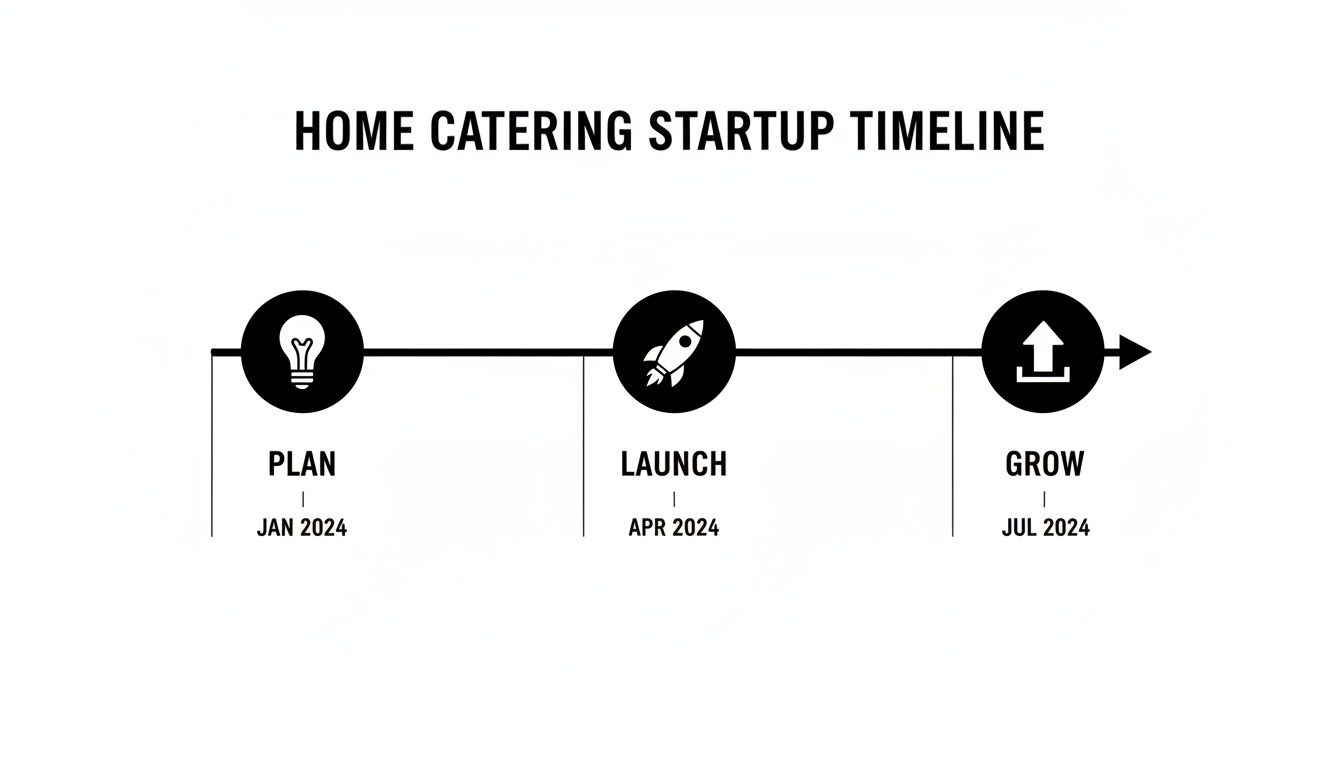
This isn't an overnight thing. A successful launch is all about careful preparation and smart execution, one step at a time.
To give you a clearer picture, here’s a table that breaks down the timeline into more detail.
Home Pizza Catering Startup Roadmap At a Glance
This table maps out the typical journey for a home pizza catering startup, showing what you should be focusing on and when.
| Phase | Months | Key Actions & Focus Areas |
|---|---|---|
| Plan | 1-3 | Researching cottage food laws, writing a solid business plan, developing and costing your pizza menu, and securing startup funding. |
| Launch | 4-6 | Buying essential equipment like a pizza prep table, setting up your kitchen workflow, getting all your permits and licenses, and starting your initial marketing push. |
| Grow | 7-12+ | Booking your first clients, gathering testimonials, refining your menu based on feedback, and scaling your marketing efforts to build a steady stream of business. |
Think of this as your guide. The timings can shift, but the core tasks in each phase are non-negotiable for building a stable business.
The Four Pillars of Success
A great pizza catering business stands on four strong pillars. If one of them is shaky, the whole thing can come tumbling down.
- Legal & Safety Compliance: This is the boring but critical stuff. You'll need to dig into your local cottage food laws, get the right permits, and become an expert in food safety. This ensures your home kitchen is operating at a professional, inspection-passing level.
- Menu & Costing Strategy: Your pizza menu is everything. It has to taste amazing, be easy to produce for events, and—most importantly—make you money. That means you need to meticulously cost out every single ingredient, from the flour for your dough to the last pinch of oregano.
- Essential Equipment & Workflow: The right tools define how efficient you are. For pizza catering, a refrigerated pizza prep table isn’t just a nice-to-have; it's the heart of your operation. It's what allows you to work quickly while keeping all your toppings at a safe temperature.
- Marketing & Customer Acquisition: You could make the best pizza on the planet, but if nobody knows about it, you don’t have a business. This pillar is all about how you'll find and book those crucial first clients.
If you do only one thing, make it this: write a detailed business plan. It forces you to think through every corner of your operation, from who your ideal customer is to your financial projections. It’s what turns a passion for pizza into a real, viable business.
While this guide zeroes in on the ins and outs of a pizza catering service, the core business principles apply to any culinary venture. For a broader look at getting started, check out this excellent step-by-step guide on how to start a catering business.
And since a solid plan is so crucial, you might also find our guide on creating a https://pizzapreptable.com/blogs/pizza/business-plan-for-a-pizza-shop useful; many of the insights there are directly transferable to a catering model.
Getting Licensed and Meeting Food Safety Standards
Let’s talk about the legal stuff. I know, it’s not the fun part of dreaming up pizza menus, but getting the licenses and permits sorted out is what separates a hobby from a real, professional business. Think of it less as red tape and more as your badge of honor—it shows your clients you’re serious about quality and safety right from day one.
The first thing you need to become an expert on is your local cottage food laws. These rules are wildly different depending on where you live. They’ll tell you exactly what you can sell, where you can sell it, and how much money you can make each year before you have to move into a commercial kitchen. For a pizza caterer, you absolutely have to know their stance on meat and cheese, as some laws get very picky about potentially hazardous foods like pepperoni and sausage.
Understanding Your Local Regulations
Imagine you’re starting a mobile pizza setup in Texas. A quick search would lead you to the Texas Cottage Food Law, which has a $50,000 annual gross income limit. It also says you have to sell directly to people, not to another business. That one little detail shapes your entire business plan from the get-go.
Finding your local rules is easier than you think. Just search for "[Your State] cottage food laws" or "[Your County] health department home kitchen". Those government sites will have the exact checklist you need to follow.
- Business License: Just about every city or county will require this. It’s how you operate legally and pay your taxes.
- Food Handler's Permit: This is non-negotiable. You and anyone who helps you will need to pass a food safety course to prove you know the basics of not making people sick.
- Kitchen Inspection: Yes, a health inspector will probably visit your home kitchen. Don't panic! They're not looking to shut you down; they’re there to see that you're clean, storing food properly, and keeping your pets out of the prep area while you work.
Passing Your Home Kitchen Inspection
A home kitchen inspection isn't like what you see on TV for a massive pizza restaurant. The inspector’s main goal is to prevent foodborne illness. They’ll be checking for simple but critical things like a dedicated hand-washing station, proper refrigerator temperatures, and cleanable surfaces.
The big thing they want to see is a clear separation between your business and personal life. That means dedicated shelves in the pantry and fridge for your catering ingredients, completely separate from your family’s groceries.
For a pizza operation, this is where having the right gear really helps, even at home. An inspector will zero in on your refrigeration. Your home fridge just isn't built to hold the safe, consistent temperatures needed for bulk cheese, meats, and sauces. This is a huge reason why investing in a small under-counter commercial fridge or a pizza prep table from the start is a brilliant move. It screams "I'm a professional" to the inspector.
Mastering Food Safety and HACCP Principles
Once you pass the inspection, your job isn't done. Every single day, you have to live and breathe food safety. This is where a system called HACCP (Hazard Analysis and Critical Control Points) comes in. It sounds complicated, but it’s just a smart way to identify and stop problems before they start.
For your pizza business, it boils down to a few key moments:
- Receiving: When that case of mozzarella arrives, is it cold? You need to check the temperature (it should be below 41°F or 5°C) before you even accept the delivery.
- Storage: In the fridge, raw sausage always goes on a shelf below the ready-to-eat veggies. This prevents any drips and cross-contamination.
- Preparation: This is a huge one. Assembling pizzas on the counter lets toppings sit in the "temperature danger zone" (41°F to 135°F). Using a refrigerated pizza prep table keeps everything safely chilled while you work.
- Cooking: Every pizza needs to be cooked to a high enough internal temperature to eliminate any nasty bacteria.
- Transport: You can’t just throw hot pizzas in your car. You need professional, insulated pizza carriers to keep them hot and safe all the way to the client’s door.
Following these steps isn’t just about the law. It’s about building a reputation for being reliable and safe. It’s what makes you a true pizza catering professional. For a deeper look, check out our guide on how HACCP principles create a food safety system. This knowledge is the foundation of a catering business built to last.
Crafting a Profitable Pizza Menu and Nailing Your Prices
This is where your passion for incredible pizza meets the hard reality of your bottom line. A great menu is so much more than just a list of things you sell; it's the engine that powers your entire home catering business. The real trick is finding that sweet spot between creativity and profitability, making sure every single pizza you send out the door doesn't just taste amazing but actually makes you money.

When you're just starting out from home, it’s tempting to want to offer every pizza topping under the sun. Fight that urge. A focused, streamlined menu—especially one built around consistently popular artisanal pizzas—is always the smarter play. It keeps your inventory simple, slashes potential waste, and helps you get known for doing one thing exceptionally well.
Design a Pizza Menu That Works for You
Your menu needs to be a reflection of your skills, but it also has to be practical for a home kitchen setup. I always tell new pizza caterers to think about items that share ingredients. This approach massively simplifies your shopping list and lowers the risk of expensive spoilage. For a pizza business, this is a natural fit: your margherita, pepperoni, and veggie supreme all start with the same fantastic dough, sauce, and cheese.
Keep these factors front and center as you build your menu:
- Scalability: Can you knock out 50 pizzas just as consistently as you can make five? Pizzas are brilliant for this because they follow a repeatable, almost assembly-line process.
- Ingredient Overlap: Build a menu where your core ingredients pull double or triple duty. That high-quality mozzarella can star on several different pizzas, while fresh basil can finish both a classic margherita and a side of Caprese skewers.
- Workflow Efficiency: How long does each pizza really take to prep and assemble? A menu designed around an efficient workflow at your pizza prep table means you can pump out orders quickly, which is absolutely critical during a hectic event.
Your first menu isn't set in stone. I've seen countless successful pizza caterers start with a core offering of just 5-7 killer pizzas. Once you've got your footing, you can start weaving in seasonal specials or new creations based on what your customers are asking for.
Breaking Down Your Food Costs
Profitability in this business boils down to one essential skill: knowing how to cost out your food. You have to calculate the price of every single thing that goes into a pizza. I’m not just talking about the big-ticket items; you need to account for every pinch of salt, every drizzle of olive oil, every pizza box.
The gold standard in the pizza industry is to keep your food cost percentage—that’s your total ingredient cost divided by your menu price—somewhere between 28% and 35%. If you creep above that range, your profit margin gets squeezed, fast.
Caterers who really master this can see net margins of 10% to 15%. For a home-based operation, that shows just how achievable a profitable business is with a bit of planning. You can dig deeper into these numbers with these catering industry trends and benchmarks.
A Real-World Example: Margherita Pizza Costing
Alright, let's get practical and break down the cost of a classic 12-inch margherita pizza. Remember, these are just example costs; your numbers will change based on your local suppliers.
| Ingredient | Unit Cost | Amount Used | Cost Per Pizza |
|---|---|---|---|
| Pizza Dough Ball | $1.00 | 1 ball | $1.00 |
| Pizza Sauce | $0.15/oz | 4 oz | $0.60 |
| Mozzarella Cheese | $0.30/oz | 6 oz | $1.80 |
| Fresh Basil | $0.10/leaf | 5 leaves | $0.50 |
| Olive Oil | $0.05/ml | 10 ml | $0.50 |
| Total Ingredient Cost | $4.40 |
So, your total ingredient cost for one margherita pizza is $4.40. To hit that sweet spot of a 30% food cost, you just divide your ingredient cost by your target percentage ($4.40 / 0.30). That gives you a menu price of $14.67. You’d likely round that up to a clean $15.00.
This simple piece of math is the most important calculation in your entire pizza business. It’s what separates guessing from strategy, ensuring you're building a sustainable, profitable venture with every single order you fulfill.
Equipping Your Kitchen for Professional Pizza Catering
Let’s be honest: your home oven and the fridge you keep your groceries in might be great for a family pizza night, but they’ll hit their limits fast when you start catering. Making the jump from passionate home cook to professional caterer means upgrading your gear. Getting the right commercial equipment isn’t just about making your life easier; it's about food safety, consistency, and the speed you need to pull off an event without a hitch.
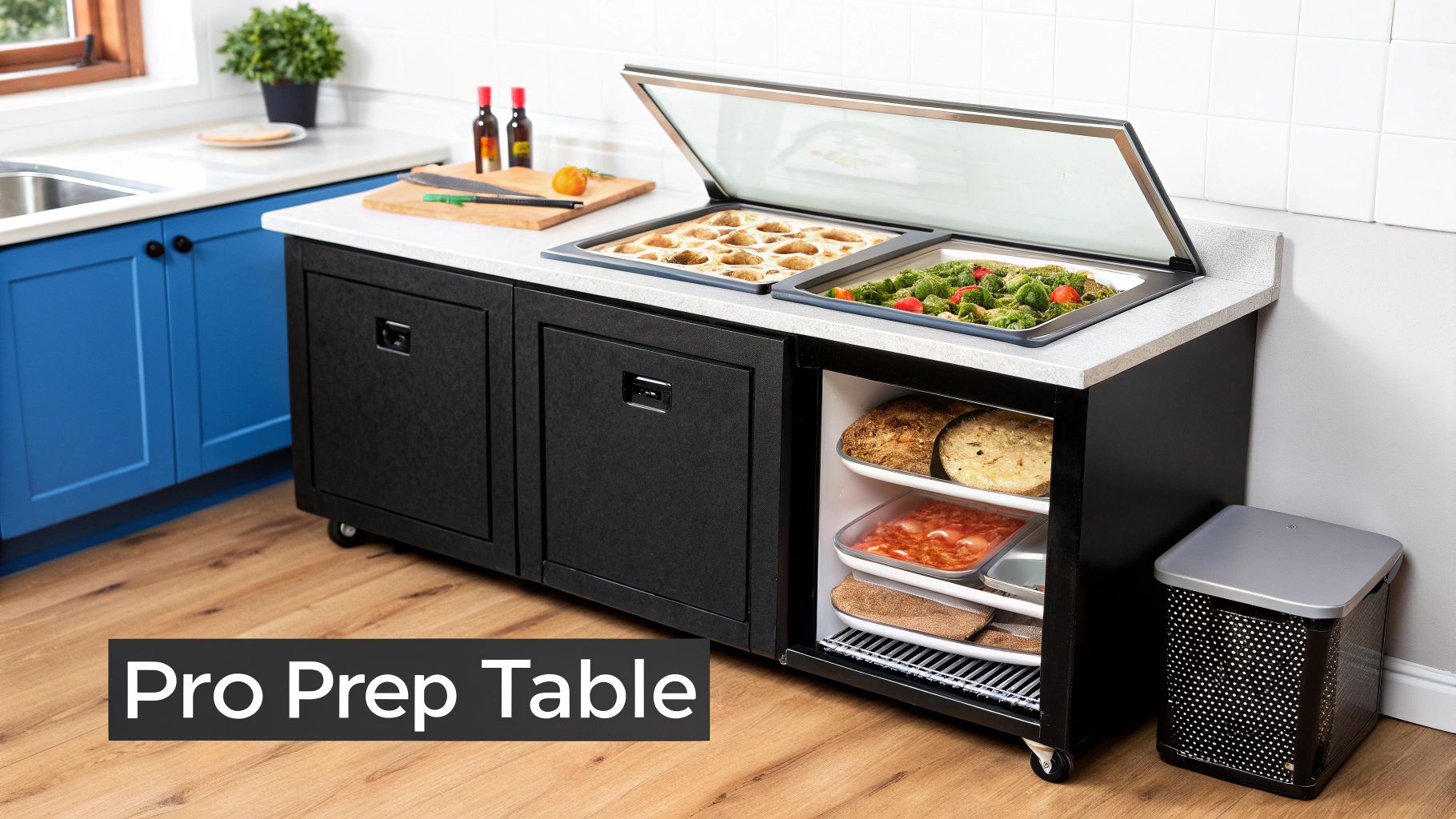
For a pizza catering business, one piece of equipment is the undeniable heart of the entire operation: the refrigerated pizza prep table. This single investment solves the biggest challenges you'll face in off-site food production, namely keeping ingredients at safe temperatures and assembling orders quickly.
The Pizza Prep Table: Your Operations Hub
Think of a pizza prep table as your command center. It’s a brilliant combination of a durable cutting board for assembly and refrigerated wells right at your fingertips. These chilled ingredient pans hold everything from pepperoni and mushrooms to mozzarella and sauce, all kept consistently below the food safety danger zone of 41°F (5°C).
This setup immediately stops the risky, time-wasting dance of pulling toppings from a separate fridge, letting them sit on the counter while you work, and then putting them back. With a pizza prep table, everything you need is within arm’s reach and held at a stable, safe temperature. This speeds up your workflow dramatically and ensures every single pizza you serve is as safe as it is delicious.
The real value of a pizza prep table is in the workflow. By keeping ingredients chilled and organized right where you build the pizza, you can slash prep time by 30-40% compared to a standard countertop setup. That's the kind of efficiency that lets a one-person show handle an order for 50 pizzas without breaking a sweat.
Choosing the Right Pizza Prep Table for Your Space
Pizza prep tables come in all sorts of sizes, so it's critical to match the unit to your available space and how much business you expect to handle. You don't want a massive unit that eats your entire kitchen, but you also don't want one so small it holds you back.
Here’s a quick look at common sizes to help you decide:
| Prep Table Size | Best For | Capacity (Approx. 1/3-Size Pans) |
|---|---|---|
| 44-Inch | Startups, small spaces, or caterers with a focused pizza menu. | 6-8 pans |
| 67-Inch | Growing businesses handling multiple events per week. | 9-12 pans |
| 93-Inch | High-volume operations, extensive menus, or shared kitchens. | 12-16 pans |
When you're starting a pizza catering service from home, a compact 44-inch model is often the perfect entry point. It gives you professional-grade refrigeration and an efficient prep surface without demanding the space of a full-on commercial kitchen. As your business grows, that initial investment will keep paying for itself.
Essential Supporting Equipment
While the pizza prep table is the star of the show, a few other pieces of commercial equipment are non-negotiable for running a professional home catering service. These items are the supporting cast that ensures the high-quality pizza you make in your kitchen reaches the customer perfectly every time.
Your must-have gear list should also include:
- Under-Counter Refrigerators: Your home fridge simply isn't built for the demands of commercial use. A dedicated under-counter unit gives you reliable, NSF-compliant cold storage for bulk items like cases of cheese, sauce, and dough boxes, keeping them safely separated from your family’s groceries.
- Insulated Pizza Carriers: Getting a perfectly cooked pizza to an event hot and ready is the final, crucial step. Professional-grade insulated pizza bags or boxes are absolutely essential. They’re designed to hold temperature for hours, preventing food from becoming lukewarm and unsafe on the way to a client.
Investing in this core equipment trio—a pizza prep table, an under-counter refrigerator, and insulated carriers—builds the foundation of a safe, efficient, and truly professional operation. You can find a more detailed breakdown in this commercial kitchen equipment checklist to make sure you have all your bases covered. This is how you start catering from home like a seasoned pro from day one.
Marketing Your Pizza Business and Winning Your First Clients
You've got the skills, the menu is dialed in, and the kitchen is ready to go. Now for the fun part: getting paid to do what you love. Marketing a new home pizza catering business isn't about having a giant budget; it's about smart, focused efforts to connect with hungry people right in your own community. Get this right, and you'll build momentum from your very first event.
The catering game has changed. Your online presence is now just as important as your dough recipe. The industry has shifted so much that roughly 75% of all catering orders are now placed online, either on a phone or a computer. This tells you one thing loud and clear: having a sharp digital storefront isn't a "nice-to-have" anymore—it's absolutely essential. You can dig into more of these modern catering industry trends on curate.co.
Building Your Digital Storefront
Think of your website as your 24/7 salesperson. It doesn't need to be complicated, but it has to look professional, be a breeze to navigate, and work perfectly on a phone. This is your virtual brochure, and it needs to scream "delicious and reliable."
You can use a simple platform like Squarespace or Wix to get a clean site up and running with just a few key pages:
- Home: This is your first impression. Hit them with a stunning photo of your best pizza and a clear, confident headline like "Artisanal Pizza Catering for Your Next Event in [Your City]."
- Menu: Lay out your pizza packages, sides, and any add-ons with drool-worthy descriptions and high-quality photos. No stock images allowed!
- About: Tell your story. People connect with passion, so share why you started this and what makes your pizza special.
- Booking/Contact: This is the money page. Make it dead simple for potential clients to request a quote, ask a question, or lock in a date with a simple form.
Harnessing the Power of Social Media
For any food business today, social media is your best friend—especially a visual-first platform like Instagram. It's practically built for making people crave your pizza. Your goal isn't just racking up followers; it's about attracting local clients who will actually book you.
Post mouth-watering photos and short, snappy videos of your pizzas. Show off the behind-the-scenes action at your pizza prep table, the vibrant, fresh ingredients you use, and—with their permission—happy clients enjoying your food at events. Start using local hashtags like #YourCityPizza or #YourTownCatering so you pop up in local searches. Making connections with other local businesses and event planners online is another great way to get your name out there.
Don't just post pictures of food; tell a story. A photo of a bubbling, cheesy pizza is great. A photo captioned, "Fueling the late-night strategy session at [Local Tech Company] with our classic pepperoni!" is even better. It shows your service in action and gives potential corporate clients a clear idea of how you can help them.
Mastering Local SEO to Get Found
What happens when a local office manager needs lunch for a last-minute meeting? They grab their phone and search for "pizza catering near me" or "corporate lunch catering [Your City]." Local Search Engine Optimization (SEO) is how you make sure your business is the one they find.
Your first move is to create a Google Business Profile. It’s free, and it's single-handedly the most powerful thing you can do for local visibility. Be meticulous here. Fill out every single section: your service area, hours, website, a link to your menu, and tons of great photos. As soon as you complete your first event, gently encourage that happy client to leave a review. Good reviews are like gold—they send a massive signal to both Google and future customers that you're the real deal.
Networking and Creating Irresistible Offers
While a solid online game is crucial, don't forget about the power of old-school, real-world connections. Introduce yourself to local event planners, wedding coordinators, and the office managers at nearby businesses. Let them know you exist and that you offer a delicious, reliable pizza catering solution for their events.
Make it incredibly easy for a new client to say "yes." Put together a simple, attractively priced package that solves a common problem.
For example, you could create:
- The "Corporate Pizza Lunch" Package: Price it per person and include a selection of three popular pizzas, a big garden salad, and drinks. This takes all the guesswork out of it for a busy office manager and makes booking a no-brainer.
This approach is all about landing those critical first few clients. Once you do, you can start building a portfolio of successful events and collecting the glowing testimonials that will fuel all your future growth.
A Few Common Questions About Starting a Home Catering Business
Jumping into the world of home catering always brings up a ton of practical questions. You've got the passion for pizza and a solid idea, but the day-to-day reality of running the business can feel a little murky. Let's tackle some of the most common questions I hear from aspiring pizza caterers to give you some clarity.
How Much Can I Realistically Earn?
This is the big one, and the answer is refreshingly simple: it's all about your pricing, your costs, and how often you book gigs. You're not going to get rich overnight, but a well-run home pizza catering business can absolutely be a profitable venture. After all your costs are paid, typical profit margins in catering hover around 10-15%.
Let's say you're doing artisanal pizza parties. You've crunched the numbers and priced your services to keep your food costs in check while fairly paying for your time.
Here’s what a month could look like with just two small events:
- Event 1: A corporate pizza lunch for 20 people at $25/head = $500
- Event 2: A weekend birthday party for 30 people at $30/head = $900
Just like that, you've brought in $1,400 in revenue. If you hit that 15% profit margin, you've pocketed $210. Now, imagine you start booking an event every weekend. You can see how quickly a side hustle can blossom into a serious income stream.
Do I Really Need Special Business Insurance?
Yes, you absolutely do. This is a complete non-negotiable for protecting yourself and your business. I see too many people assume their homeowner's or renter's insurance has them covered, but that's a dangerous mistake. The moment money changes hands for a pizza made in your home, it's a commercial activity, and standard home policies specifically exclude that.
To operate safely and legally, you'll need two critical types of business insurance:
- General Liability Insurance: This is your shield if someone gets hurt at an event you're catering (maybe they trip over your equipment) or if you accidentally cause property damage.
- Product Liability Insurance: For any food business, this is vital. It covers you if a client claims your pizza caused a foodborne illness or an allergic reaction.
Without this coverage, a single mishap could put your personal assets—your house, your savings—on the line. It's a fundamental cost of doing business, just like your ingredients.
Your homeowner's policy is built to protect you from personal risks, not business liabilities. Running a pizza catering service without proper commercial insurance is a huge financial gamble that just isn't worth taking.
What Are the Biggest Mistakes New Home Caterers Make?
Learning from the stumbles of others is one of the quickest ways to get ahead. New pizza caterers often trip over a few common, but totally avoidable, hurdles. Knowing about them from day one can save you a world of stress and lost profits.
One of the most frequent errors is underpricing services. In a rush to land those first clients, it’s so tempting to offer rock-bottom prices. But this strategy just devalues your hard work, squeezes your profit margins thin, and makes it incredibly difficult to raise your prices later without ticking off your early supporters.
Another major misstep is failing to invest in the right equipment upfront. Trying to cater an event for 50 people using your home refrigerator and a tiny bit of counter space is a recipe for chaos and potential food safety disasters. A professional-grade pizza prep table isn't a luxury; it's a foundational tool that guarantees the efficiency, safety, and consistency your reputation will be built on.
Finally, so many new caterers overlook local food safety laws. Just assuming you can start selling pizza from your kitchen without looking into cottage food laws or getting the right permits can lead to fines or even getting shut down. Your legal homework is the first, most crucial step to building a business that lasts.
At Pizza Prep Table, we understand that the right equipment is the foundation of a successful pizza catering business. A reliable, NSF-compliant refrigerated prep table streamlines your workflow, ensures food safety, and helps you deliver consistent quality that keeps clients coming back. Explore our range of professional prep tables and find the perfect fit for your new venture.