

Pizza Prep Table for Restaurant: Choosing the Right Setup
A prep table for restaurant work, especially in a place as hectic as a pizzeria, is the absolute heart of the operation. It's where speed and quality shake hands. Think of it as an all-in-one workstation that gives you a tough cutting board surface up top and refrigerated compartments down below, making sure everything from mozzarella to pepperoni stays perfectly chilled and right where you need it.
The Command Center Of Your Pizzeria
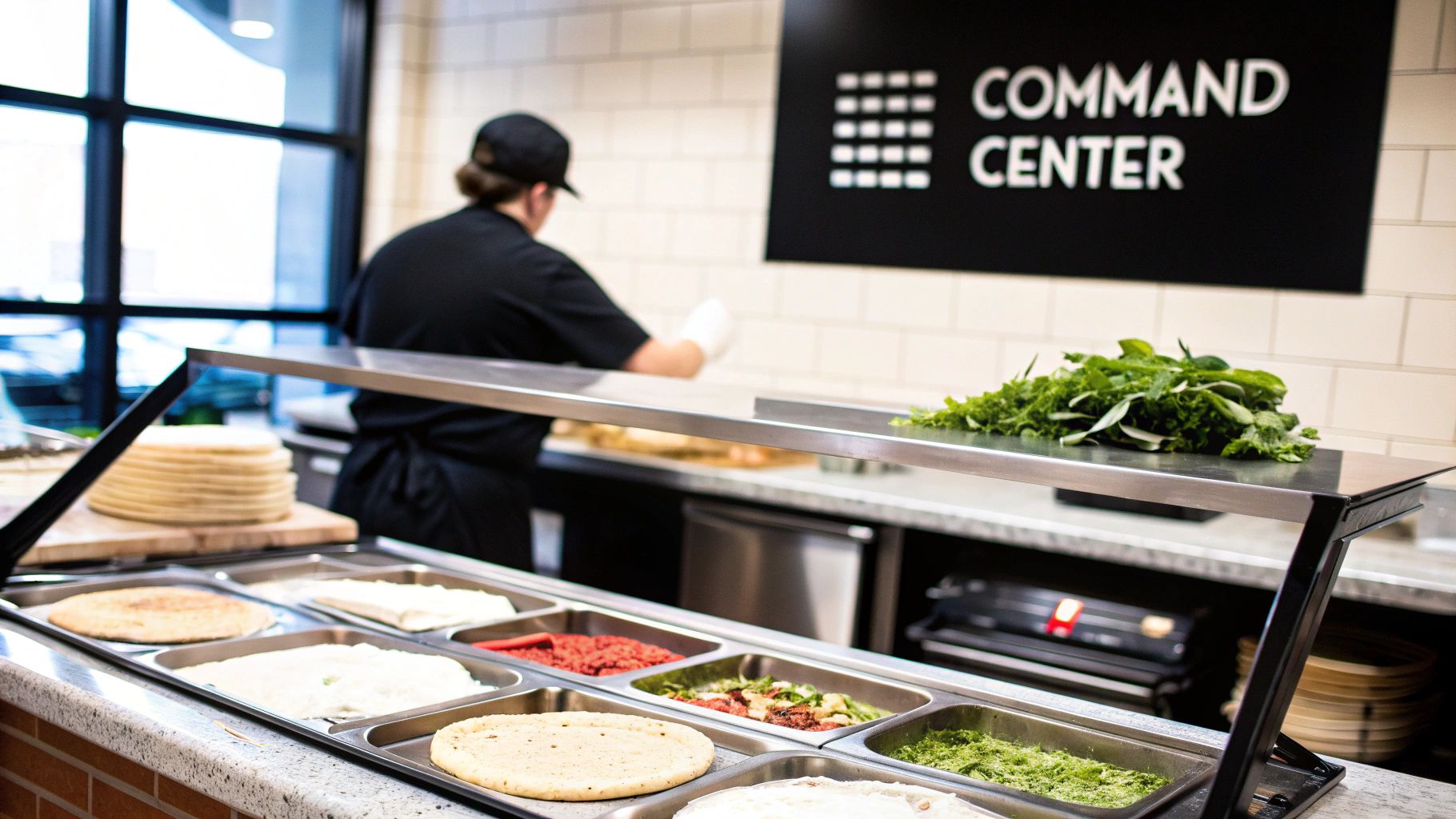
You really should think of your pizza prep table as the command center for the entire kitchen. It's so much more than a hunk of stainless steel; it’s the nerve center where your pizzeria's efficiency, consistency, and—let's be honest—its reputation are built with every single order. This is where the real work happens, turning simple ingredients into beautiful pizzas ready for the oven.
A well-thought-out prep table can transform kitchen chaos into a streamlined assembly line. The journey from a ball of dough to a finished pie should be a smooth, unbroken dance. The right setup gets rid of wasted steps, slashes ticket times, and lets your crew work faster and smarter, especially when the dinner rush hits.
From Disconnected Steps To A Seamless Workflow
Without a good prep station, making a pizza becomes a clumsy, disjointed mess. Your pizzaiolo has to walk to a cooler over here for cheese, another one over there for veggies, and yet another for the meats. Each of those little trips adds precious seconds to the order time and opens the door for mistakes.
A dedicated pizza prep table pulls that whole process into one tight, ergonomic spot. This integration is the key to keeping up the momentum. The whole point is to create a workspace where everything has a logical home and is just an arm's length away.
This kind of setup pays off immediately for any pizzeria:
- Increased Speed: You drastically cut down the time it takes to build each pizza by keeping your staff from having to roam around the kitchen.
- Enhanced Consistency: With every topping organized and held at the perfect temperature, every pizza gets made to the same high standard, no matter who's on the line.
- Improved Food Safety: Keeping perishable toppings in refrigerated wells means they stay in the safe zone, cutting down on spoilage and health risks.
A great pizza prep table isn’t just about holding ingredients; it’s about orchestrating a workflow. It sets the pace and rhythm of your kitchen, making sure quality and speed are partners, not enemies.
At the end of the day, investing in the right prep table for your restaurant is a bedrock decision. It affects everything from how happy your employees are to how loyal your customers become. It provides the backbone you need to handle high volume without ever sacrificing the quality that people know you for. This guide will walk you through exactly what to look for, so you can be sure your command center is built for battle.
Refrigerated Versus Non-Refrigerated Tables
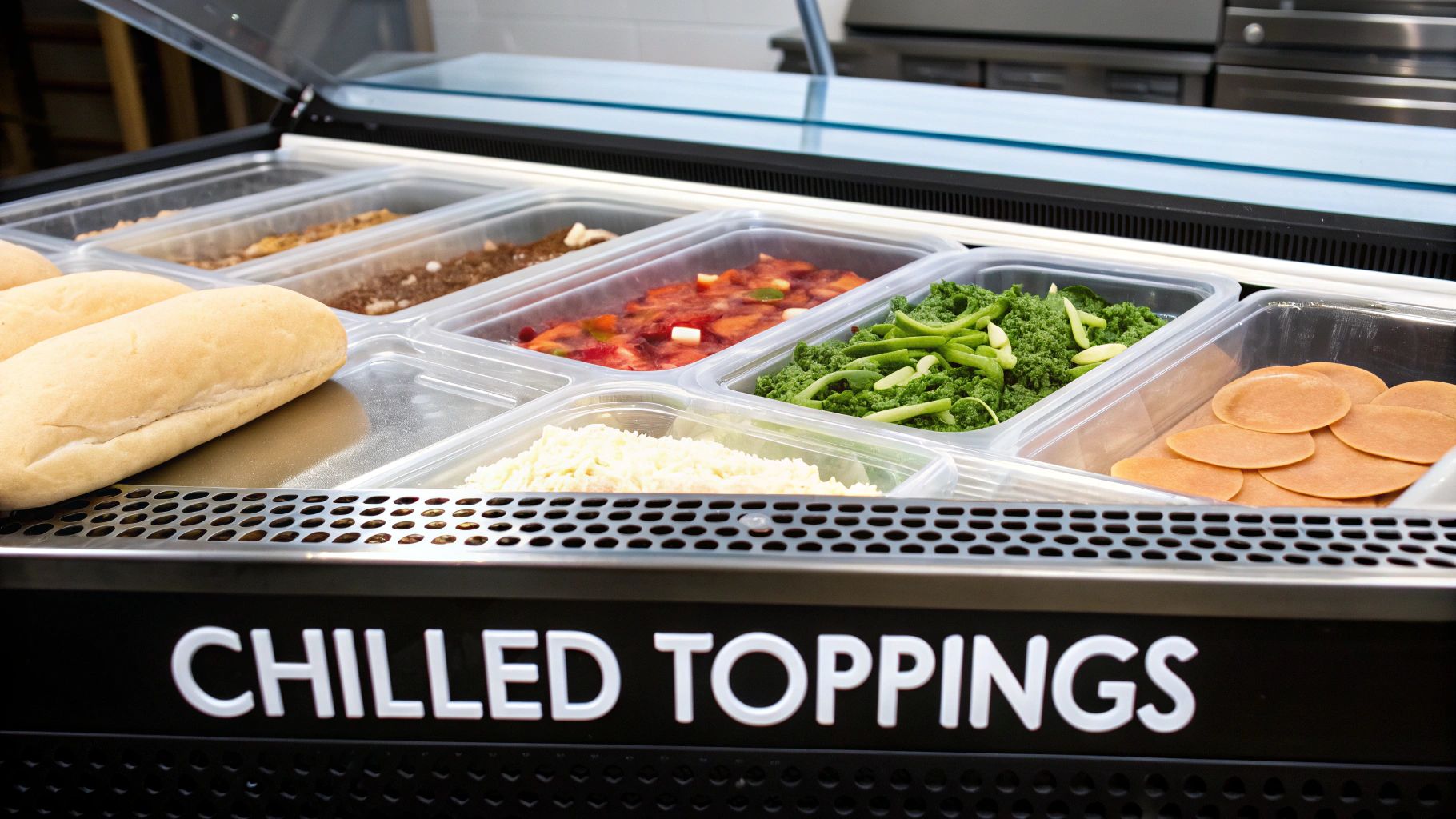
When you're setting up a pizzeria, one of the first big decisions you’ll make is choosing between a refrigerated and a non-refrigerated prep table. This isn't just about picking a piece of furniture; it's about defining your entire workflow. Get it right, and your kitchen will run like a well-oiled machine. Get it wrong, and you're setting yourself up for bottlenecks and food safety headaches.
Think of a refrigerated prep table for restaurant use as your pizza line’s command center. It’s your chef's personal pantry, assembly line, and food safety inspector all rolled into one sleek, stainless steel unit. It’s specifically designed to keep perishable toppings—your mozzarella, pepperoni, and fresh veggies—perfectly chilled and within arm's reach, even when the dinner rush is in full swing.
This seamless integration is what makes it a game-changer. It stops your pizza makers from constantly running back and forth to the walk-in cooler, shaving precious seconds off every single order. In the pizza business, those seconds add up fast, leading to quicker ticket times and happier, hungrier customers.
The Refrigerated Pizza Prep Table Advantage
The main job of a refrigerated pizza table is to maintain the cold chain all the way from the walk-in to the oven. These tables have refrigerated wells or pans right on top, usually cooled by a gentle stream of cold air. This ensures every topping stays in that critical food-safe zone (below 41°F or 5°C).
This design is your best defense against the two biggest enemies in a busy kitchen: wasted time and foodborne illness.
Here’s where they really shine:
- Speed and Efficiency: With every topping lined up and ready to go, your pizza maker can build pies in a smooth, unbroken rhythm.
- Rock-Solid Food Safety: It's your insurance policy, protecting your ingredients, your customers, and your reputation by keeping sensitive items properly chilled.
- Less Food Waste: By holding ingredients at the perfect temperature, these tables extend the life of your toppings, which means less spoilage and more money in your pocket.
The growing demand for these tables reflects a major shift in the industry toward smarter, safer kitchen layouts. In fact, the market for refrigerated prep tables is projected to jump from $3.48 billion to over $5.2 billion by 2035, pushed by stricter food safety rules.
The Unsung Hero: The Non-Refrigerated Work Table
While the refrigerated unit is the star of the topping station, the humble non-refrigerated table has its own crucial role to play—primarily as your dedicated dough station. These simple, sturdy stainless steel surfaces are the perfect home for any task that doesn't need active cooling.
A non-refrigerated table is the ideal spot for:
- Kneading, slapping, and stretching dough balls.
- Portioning out dough for the day's service.
- Staging dry goods or assembling pizza boxes on the fly.
A non-refrigerated table gives you a clean, dedicated zone for all your dough work. This prevents cross-contamination and keeps your main assembly line clear for what it does best: topping and finishing pizzas.
Think of it this way: your non-refrigerated table is where the pizza’s foundation is built. The refrigerated table is where its personality and flavor come alive. Smart, high-volume kitchens know that separating these two functions is the key to an organized, efficient flow.
Refrigerated vs. Non-Refrigerated Pizza Prep Tables
So, which table is right for which job? This quick comparison breaks down where each type excels in a pizzeria workflow.
| Feature | Refrigerated Prep Table (Pizza Line) | Non-Refrigerated Prep Table (Dough Station) |
|---|---|---|
| Primary Use | Assembling pizzas with perishable toppings like cheese, meats, and veggies. | Kneading, stretching, and portioning dough. Also used for staging dry goods. |
| Temperature Control | Actively chills ingredients to below 41°F to ensure food safety. | Room temperature surface. No cooling mechanism. |
| Key Benefit | Combines storage and prep space, maximizing speed and food safety. | Provides a dedicated, sanitary workspace for dough, preventing cross-contamination. |
| Workflow Stage | The final assembly line before the pizza hits the oven. | The first step in the pizza-making process, where the base is created. |
| Best For | High-volume topping stations where ingredients sit out during service. | Creating a focused, efficient dough preparation area separate from toppings. |
Ultimately, the smartest setup isn't about choosing one over the other. A truly efficient pizzeria uses both to create a logical, step-by-step production line. Dough gets prepped at a non-refrigerated station, then moves to the refrigerated prep table for restaurant assembly. It's a seamless handoff that maximizes both speed and safety, setting your kitchen up for success. For more layout ideas, check out our guide on setting up a refrigerated sandwich prep table—many of the same principles apply.
Finding the Right Size for Your Pizzeria
Choosing the right size prep table for restaurant operations is about more than just finding a spot where it fits. Think of it like buying a delivery vehicle. You wouldn't buy a compact car to deliver 50 pizzas on a Friday night, and you definitely wouldn't buy a semi-truck for a single pie. Your table needs to be perfectly matched to your pizzeria's daily grind and future ambitions.
A prep table that’s too small will create instant bottlenecks. Your team will be tripping over each other, constantly restocking toppings during the dinner rush, and struggling to keep up. On the flip side, a table that’s too large just eats up valuable floor space that could be used for another oven or a dough sheeter—all while burning extra electricity to cool empty space.
Connecting Table Size to Your Pizzeria's Reality
The trick is to connect the table’s dimensions—whether it's a compact 48-inch model, a versatile 60-inch, or a massive 93-inch workstation—to what’s actually happening in your kitchen. This means taking a quick, honest look at three things: your menu complexity, your peak volume, and your kitchen layout.
An artisanal pizzeria with a curated menu of eight specialty pies might find a 48-inch table is the perfect fit. It’s compact, efficient, and holds just enough variety without wasting an inch. But a high-volume shop that boasts a "build-your-own" model with 30 different toppings? They’re going to need a much bigger unit, likely a 93-inch table, just to keep everything organized and within arm's reach.
Calculate Your Topping Capacity Needs
The refrigerated rail on top of your pizza prep table is its most critical feature. The number and size of the food pans it can hold directly dictates your kitchen's speed. Before you even look at models, do this simple calculation:
- List Every Topping: Write down every single refrigerated topping on your menu, from pepperoni and sausage to mushrooms and jalapeños.
- Estimate Pan Size: Decide which size food pan each topping needs. Standard options are 1/3, 1/6, and 1/9 size pans. High-volume ingredients like mozzarella will need a bigger 1/3 size pan, while less common items like anchovies can go in a tiny 1/9 size pan.
- Calculate Total Rail Space: Add up the total space required. For example, a 60-inch table might hold around eight 1/3 size pans, while a 93-inch model can accommodate sixteen or more.
This simple exercise gives you a data-driven starting point. It stops you from buying a table that can't even hold your full menu, which is a one-way ticket to a chaotic service.
Don't just guess your capacity needs; calculate them. The number of topping pans your table can hold is a hard limit on your menu's complexity and your kitchen's speed during a rush.
The demand for smarter, more efficient kitchen equipment is growing fast. The global food prep table market is on a major upswing, projected to hit a valuation of around $3.2 billion by 2033. This growth is being driven by an expanding foodservice sector that needs better solutions for modern kitchens. You can see more insights about this market expansion on HTF Market Intelligence.
Consider Your Peak Production Volume
Next, think about your busiest hour on your busiest day. How many pizzas are flying out of the kitchen? This number determines not just your rail capacity but also the amount of under-counter refrigerated storage you’ll need. This is your backup—holding extra cheese, sauce, and prepped veggies to quickly restock the rail when you're in the weeds.
A low-volume cafe might get by just fine with a single-door under-counter cabinet. In contrast, a bustling pizzeria pushing out 100 pizzas an hour will need a three- or four-door model to avoid constant, time-wasting trips to the walk-in cooler. A well-stocked under-counter section ensures your pizza line never, ever runs dry.
For more detailed information, exploring different configurations of a food prep table can help you make an informed decision. Matching your table’s size and storage to your sales volume is one of the most important steps in building an efficient and profitable kitchen.
Designing an Efficient Pizza Production Line
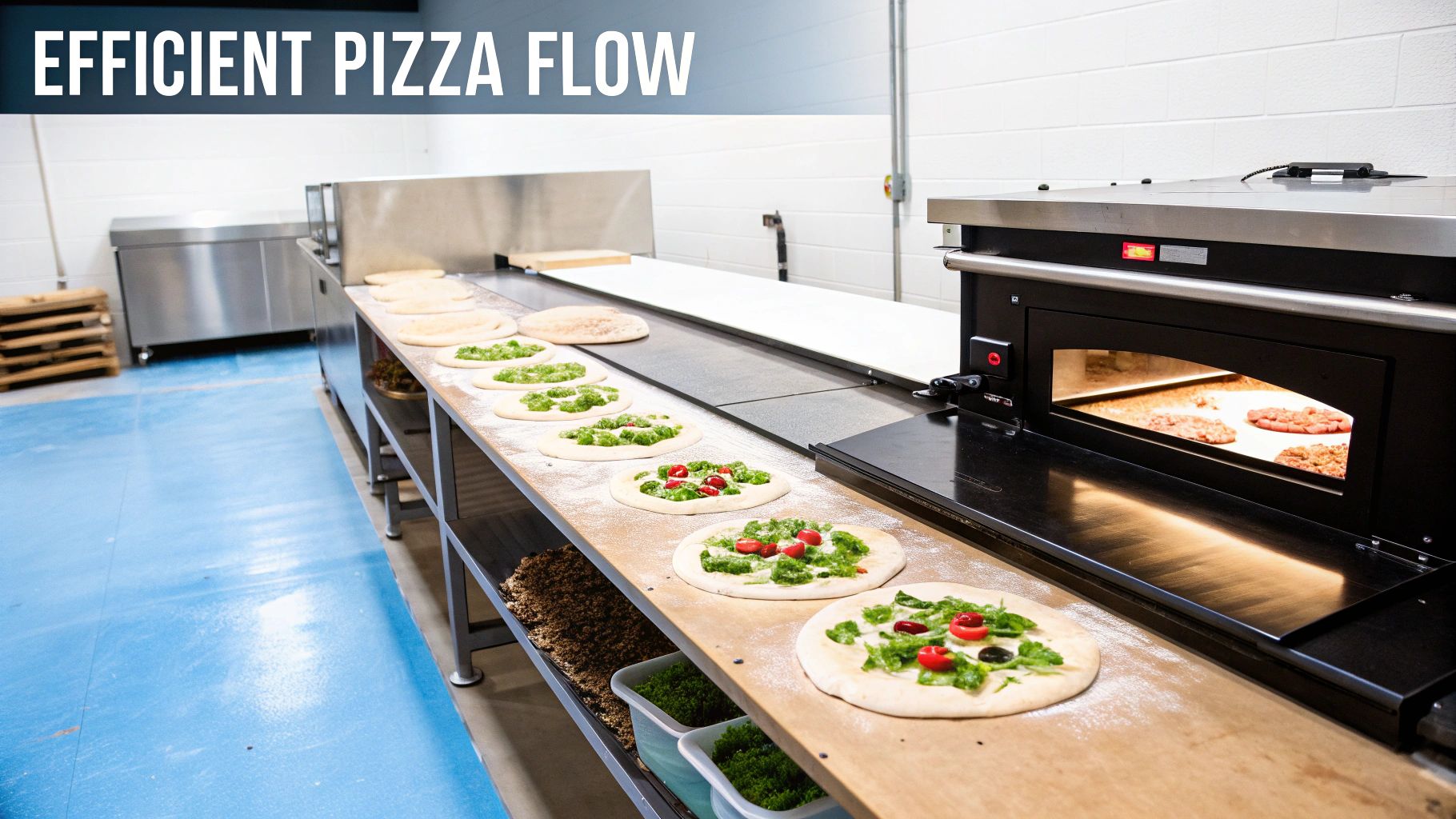
Your pizza prep table is so much more than a stainless steel box. It's the engine of your kitchen, the central hub where everything happens. How you place and integrate it into your workflow can be the difference between a smooth, profitable service and a chaotic bottleneck that leaves customers waiting.
The whole point is to create a seamless production line where every pizza glides logically from one station to the next. No wasted steps, no backtracking.
Think of it like choreographing a dance. The best kitchen layouts minimize the number of steps your pizza maker takes, making sure every tool and ingredient is an easy grab away. This kind of smart, ergonomic design doesn't just make you faster—it reduces physical strain on your crew, keeping them happier and more productive during those long, brutal shifts.
Mapping the Ideal Pizza Flow
The most successful pizzerias I've worked with all have one thing in common: they’ve mapped out a clear, linear path for every single order. This assembly-line approach is the secret to consistency and speed, turning the complex act of pizza-making into simple, repeatable steps.
It's a straightforward four-stage process:
- Dough Station: This is ground zero. Usually a simple, non-refrigerated work table is perfect for stretching, saucing, and getting the pizza base ready for its big moment.
- Topping Station: From the dough station, the sauced base slides right over to the refrigerated prep table for restaurant assembly. This is where your pizzaiolo works their magic, adding cheese, meats, and veggies from the chilled wells.
- Oven Station: The fully loaded pizza moves directly to the oven. In a perfect world, the prep table is just a pivot and a step away from the oven mouth to minimize travel time and potential mishaps.
- Cutting and Boxing Station: Once it’s cooked to perfection, the pizza lands at a final station for slicing, boxing, and handing off to a server or delivery driver.
This logical sequence keeps the kitchen humming and prevents staff from bumping into each other, which is absolutely critical when you’re working in tight quarters.
A great kitchen layout tells a story from left to right: dough becomes a base, the base gets toppings, the topped pizza gets cooked, and the finished product gets boxed. Each station is a chapter, and the pizza prep table is the climax of the action.
Layout Strategies for Different Kitchen Sizes
Look, there's no "one-size-fits-all" answer here. The perfect layout has to work with the space you've got, whether you're building out a huge restaurant or cramming an entire operation into a food truck. But the core principles of an efficient flow always apply.
If you really want to get into the weeds of squeezing every last drop of utility out of your floor plan, you might find some useful ideas in these optimal space planning strategies.
The Straight-Line Layout for Larger Kitchens
If you've got the space, a straight-line or assembly-line layout is the undisputed king. All four stations—dough, topping, oven, and boxing—are arranged in a single, efficient line. This is the gold standard for high-volume production because it allows multiple people to work on different pizzas at the same time without tripping over each other.
The L-Shaped Layout for Medium Spaces
When you're a bit more constrained on space, an L-shaped layout can be a fantastic solution. You might have the dough and prep stations form one leg of the "L," with the oven and cutting stations along the other. This keeps the core pizza-making action contained in one corner, freeing up the rest of your kitchen for other tasks.
The Compact Layout for Food Trucks and Small Pizzerias
In a food truck or a tiny storefront, every single inch counts. You're almost always forced into a galley-style layout, with workstations arranged in parallel lines. The trick here is to think vertically and choose equipment that can pull double-duty. Your pizza prep table isn't just a station; it becomes the undisputed centerpiece of your entire operation.
No matter the size of your kitchen, the right layout transforms your prep table for restaurant operations from a simple workstation into a powerful productivity hub. It's the key to turning out more pizzas, faster, and with less stress.
The Non-Negotiables: NSF Compliance and Maintenance
For any pizzeria owner, two things are absolutely sacred: keeping your food safe and making your equipment last. This is where getting a handle on NSF compliance and a solid maintenance routine for your prep table for restaurant operations is a game-changer. These aren’t just chores on a checklist; they're the bedrock practices that protect your customers, your reputation, and your bank account.
Think of the NSF seal on your pizza prep table as a badge of honor. It’s a sign that the equipment has been put through the wringer and certified by the National Sanitation Foundation to meet some seriously strict public health standards. It's your guarantee that the table is built for the demanding, high-stakes world of a commercial pizzeria.
This certification isn't just about acing a health inspection—it's about peace of mind. An NSF-certified table is engineered from the ground up to be safe and ridiculously easy to clean, which is a massive advantage when you're slammed during a dinner rush.
What That Little Blue NSF Seal Really Means
When you see that little blue seal, it’s not just a sticker. It confirms your prep table is built to prevent the very things that give health inspectors nightmares.
The NSF certification digs into several key areas:
- Material Safety: The materials used, like high-grade stainless steel, are non-porous and corrosion-resistant. Most importantly, they won't leach funky chemicals into your ingredients. This ensures the surface touching your dough and toppings is completely safe.
- Cleanability: The design features smooth, rounded corners and sealed joints. This gets rid of those tiny cracks and crevices where bacteria and old food particles love to hide, making your daily wipe-down faster and way more effective.
- Built to Last: The table is constructed to handle the daily abuse of a busy pizzeria—from the slam of a heavy dough bin to the constant scrape of pizza peels—without breaking down.
Choosing an NSF-certified pizza prep table isn't an optional upgrade; it's a fundamental requirement for any serious food business. It's a clear signal to your health inspector, your staff, and your customers that you put food safety first.
Building a Bulletproof Maintenance Routine
Once you've got your NSF-certified table, the next move is to protect that investment with a smart maintenance routine. A well-cared-for refrigerated prep table runs more efficiently, sips less energy, and is far less likely to die on you in the middle of a Friday night rush.
Regular care isn't rocket science, but it does demand consistency. It's the small, daily actions that stop minor issues from snowballing into expensive, service-killing emergencies.
Your Daily Cleaning Checklist
This is your frontline defense against bacteria and cross-contamination. Make this non-negotiable at the end of every single shift.
- Clear and Wipe Surfaces: Pull out all the food pans and tools. Use a food-safe cleaner and warm water to give the entire cutting board and all stainless steel surfaces a thorough wipe-down.
- Sanitize Everything: After cleaning, hit it with a food-safe sanitizer and let it air dry. Don't skip this—it’s what kills any germs left behind.
- Clean the Topping Rail: Wipe down the refrigerated rail and the gaskets around the lid. This removes any spilled toppings or moisture buildup that can turn gross overnight.
Weekly and Monthly Maintenance Tasks
Carving out a little extra time each week and month will dramatically extend the life of your equipment.
- Inspect Gaskets: Once a week, check the door gaskets for any cracks or tears. A bad gasket lets cold air pour out, forcing the compressor to work overtime and driving up your energy bill.
- Clear the Condenser Coils: Every month, unplug the unit and use a stiff brush or a shop vac to gently clean the dust and grease off the condenser coils. Clogged coils are the #1 cause of compressor failure. Seriously.
- Check Temperature Accuracy: Grab a reliable thermometer and verify the internal temp is holding steady (below 41°F). If it's bouncing around, your thermostat might need to be recalibrated.
By making NSF compliance a top priority from day one and sticking to a simple maintenance schedule, you ensure your pizza prep table remains a reliable workhorse—not a ticking time bomb.
Making a Smart Purchase and Investment
Getting the right prep table for your restaurant is a big decision, but it shouldn't have to empty your bank account on day one. A smart investment means looking at all your options—from shiny new models to second-hand steals—and knowing the financial tools that can get a top-tier table onto your kitchen floor. This way, you get the workhorse you need without putting a strain on your budget.
One of the first big questions every pizzeria owner asks is whether to buy new or used. A brand-new prep table comes with a full manufacturer's warranty, the latest energy-saving tech, and that unbeatable peace of mind of being the first and only owner. Of course, that comes with a higher price tag that can be a tough pill to swallow for a new business.
On the flip side, a used table can save you a bundle, sometimes 50% or more off the sticker price. That’s cash you can pour back into other critical parts of your business. After all, your kitchen isn't the only thing that needs investment—an effective outdoor restaurant sign is just as crucial for pulling in customers. But buying used has its own risks, like no warranty and the potential for surprise mechanical problems. For a solid game plan on what to look for, check out our guide on finding used pizza prep tables for sale; it’s got a full-blown inspection checklist.
Exploring Smart Financing Options
You don't always need a pile of cash to get the perfect prep table. Many suppliers offer financing that makes brand-new equipment totally doable, especially for businesses that are just getting their sea legs.
- Equipment Loans: These work just like a regular loan. You buy the table, you own it from the get-go, and you pay it off over time. Owning it outright can also be a nice little perk come tax season.
- Lease-to-Own Programs: This is a great option if you want flexibility. You make regular lease payments for a fixed period, and when the lease is up, you can buy the equipment for a set price. It’s a fantastic way to get a new table in your kitchen with a much smaller initial hit to your wallet.
Your Pre-Installation Checklist
Once you've sealed the deal, a little bit of planning will make installation day go off without a hitch. Running through a quick checklist beforehand helps you dodge the common headaches that lead to delays and surprise costs. Before that delivery truck even thinks about pulling up, make sure you've got this covered:
A successful installation begins long before the equipment arrives. Taking the time to measure doorways, check power sources, and clear a path will save you from a world of frustration on delivery day.
This flowchart gives you a visual on the first steps to protecting your new investment, starting with that all-important NSF certification.
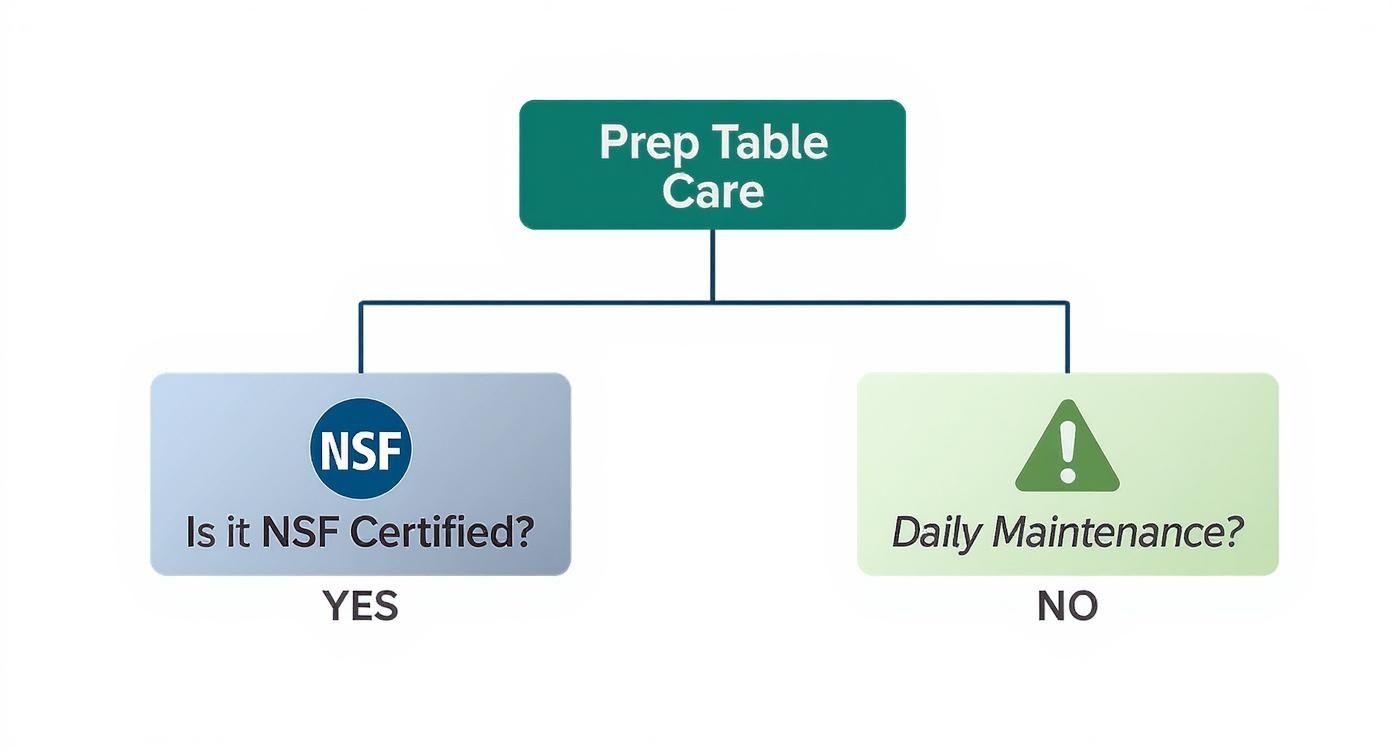
As you can see, making sure your table is NSF certified is the bedrock of proper care. From there, it flows directly into the daily maintenance routines that will keep it running like a champ for years.
Putting Your Prep Table Through Its Paces: Common Questions Answered
Even when you’ve found the perfect prep table for your restaurant, the daily grind of a busy pizzeria always throws a few curveballs. Getting straight answers to common questions helps you handle issues on the fly, keep your food quality high, and make smarter choices about your most important workstation.
Let's tackle some of the most frequent questions I hear from pizzeria owners in the trenches.
What’s the Magic Number for Pizza Topping Temperature?
This is the big one, and it's all about food safety. Every perishable topping in that refrigerated rail—your cheese, pepperoni, fresh veggies, you name it—has to be held at or below 41°F (5°C). Think of this temperature as the non-negotiable gold standard for slamming the brakes on bacterial growth and keeping your ingredients safe and delicious.
Make a habit of checking the table's built-in thermometer throughout the day. More importantly, use a separate, calibrated food thermometer to double-check its accuracy at least once a week. Consistent temperature management is your best defense for acing health inspections and protecting the reputation you've worked so hard to build.
Are All Pizza Prep Cutting Boards the Same?
Your prep table probably showed up with a standard white polyethylene cutting board, and honestly, it’s a solid all-rounder. But plenty of pizzerias level up by using a color-coded system to prevent cross-contamination—think red for meats, green for vegetables. It's a simple visual cue that makes a real difference during a chaotic rush.
The biggest difference you'll feel, though, comes down to thickness and material. A thicker board (say, ¾-inch versus the standard ½-inch) is way more durable and less likely to warp from constant use and cleaning. And while standard polyethylene is great, high-density polyethylene (HDPE) boards are tougher against knife scars and stains, which makes them much easier to sanitize.
At the end of the day, it's not the material that matters most—it's the condition. A cutting board riddled with deep grooves and cracks is impossible to clean properly. It's a ticking time bomb for bacteria. Replace it. Immediately.
When Is It Time to Finally Upgrade My Pizza Prep Table?
Knowing when to pull the plug on your old prep table is crucial for avoiding a catastrophic failure right in the middle of a Friday night dinner rush. Keep an eye out for these telltale signs that it’s time to start shopping:
- It Can't Keep Its Cool: If the unit is constantly struggling to stay below that critical 41°F mark, especially after you've already paid for a professional service call, its compressor is likely on its last legs.
- You and the Repair Tech Are Best Friends: Are you on a first-name basis with your repair technician? If service calls are becoming a regular line item on your budget, a new, reliable unit will almost certainly be cheaper in the long run.
- You See Rust or Corrosion: Any significant rust, especially on the inside surfaces, is a massive red flag. It compromises both the table's structural integrity and your food's safety.
- Your Menu Grew, But Your Table Didn't: Are your cooks constantly double-stacking topping pans or making extra trips to the walk-in? Your table is too small for your current volume. A larger prep table isn't just an expense; it's an investment in efficiency that pays for itself with faster service and less wasted motion.
Ready to find a prep table that can keep up with your pizzeria's demands? At Pizza Prep Table, we offer a wide selection of NSF-compliant, high-performance tables designed for speed and reliability. Explore our collection and build the perfect command center for your kitchen.