
Your Guide to Profitable Concession Stand Food for Pizza Restaurants
Picking the right concession stand food is what separates the pros from the amateurs, even for established pizza restaurants looking to expand into events or smaller venues. This isn't about guesswork; it's a strategic plan to build a menu around high-margin, crowd-pleasing items that you can produce quickly, with pizza leading the charge.
For any pizza-focused business, versatility is key. That makes a high-quality pizza prep table one of the smartest investments you can make for a concession-style operation. It’s all about leveraging what you already do well—making great pizza—and adapting it to a faster, higher-volume environment.
Building Your High-Margin Concession Menu
The charm of a concession stand often comes from nostalgia and convenience, but its survival depends entirely on profit. For a pizza restaurant, this means adapting your core menu to pinpoint the items that keep customers happy and deliver killer margins in a fast-paced setting.
Pizza is a consistent superstar on this front. It's a universally loved food that brings in a fantastic return on investment, especially when you can crank it out efficiently. This is where having the right equipment, specifically a pizza prep table, becomes the absolute cornerstone of your satellite or event operation.
The Power of Pizza in Concessions
Unlike a lot of other concession foods, pizza is incredibly flexible. You can customize it, scale production up or down, and sell it by the slice or as a whole pie. This lets your restaurant serve everyone from single customers to entire families, which is huge for maximizing sales during those insane rushes at games or festivals.
The core ingredients—dough, sauce, cheese, toppings—are staples in any pizza restaurant and have a good shelf life when stored properly in a refrigerated pizza prep station.
There's a growing hunger for better, more diverse food at entertainment venues. People are spending more, and the opportunity for smart pizza operators is massive.
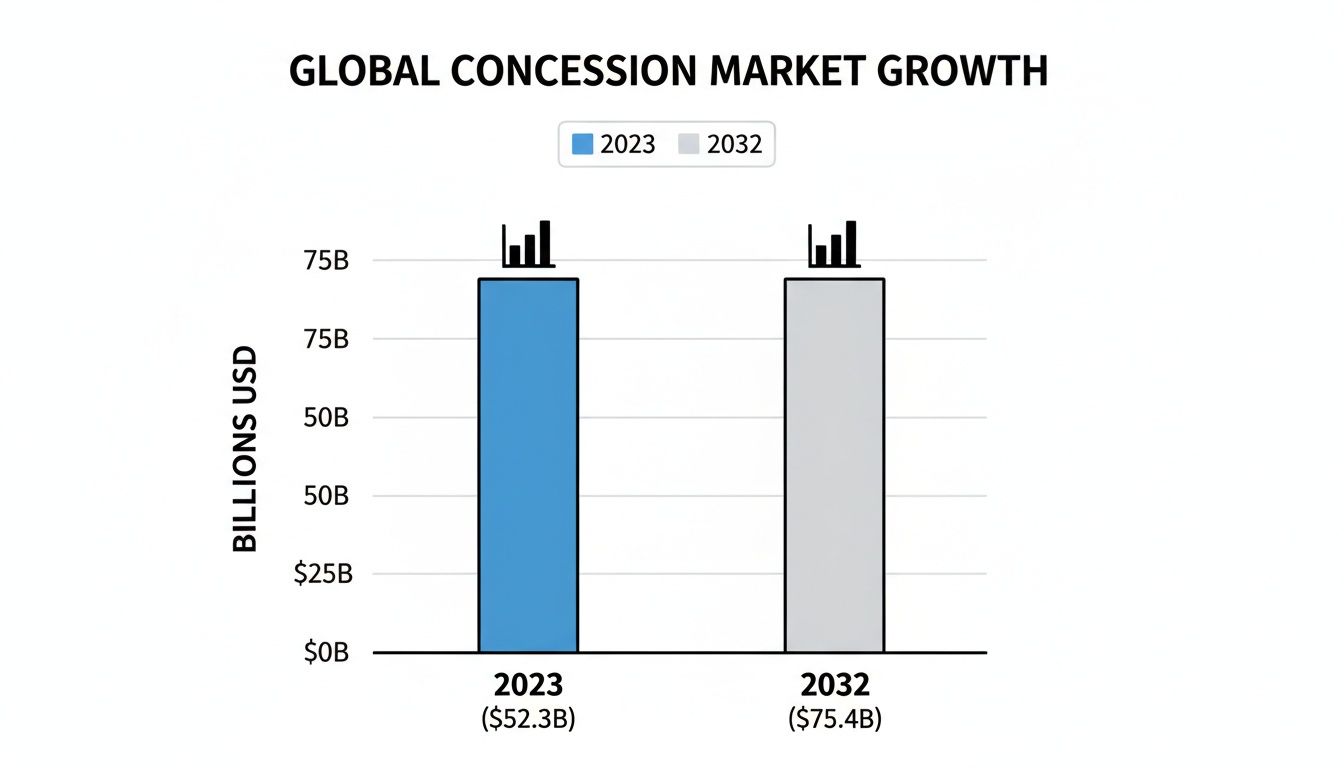
This trend shows a huge jump in what people are willing to spend, which means having an efficient system to meet that demand is more critical than ever. The global concession market was valued at around $52.3 billion in 2023 and is on track to hit $75.4 billion by 2032. For anyone in the pizza business looking to tap into this market, that growth screams one thing: get your systems right.
Beyond the Pie: A Versatile Workstation
Here’s the thing: a pizza prep table isn’t just for pizza. Think of it as a centralized, refrigerated workstation that makes your entire prep process faster and smoother, even for non-pizza items.
Those cooled wells on top are perfect for keeping high-turnover ingredients like shredded cheese, pepperoni, and fresh veggies at safe temperatures and right where you need them. In a fast-paced concession stand where every second counts, that kind of organization is gold.
The secret to a profitable concession menu lies in cross-utilization. An item that uses the same core ingredients as your main seller, but offers a different experience, is pure profit. A well-organized pizza prep table makes this possible.
You can use the exact same station to assemble other high-margin items that leverage your pizza toppings. Think meatball subs, loaded nachos with Italian sausage, or even fresh salads with mozzarella and olives. This lets you broaden your menu and appeal to more customers without dropping a ton of cash on extra, redundant equipment. By keeping all your prep in one spot, you create a killer workflow that cuts down ticket times and boosts your output.
To get the wheels turning, check out these other high-potential concession stand ideas that can be powered by the same core setup.
To help you visualize the profit potential, I've put together a quick comparison of popular concession foods. This table breaks down what you can expect in terms of food cost and what kind of equipment you'll need on hand.
High-Margin Concession Food Comparison
| Menu Item | Estimated Food Cost % | Core Equipment Needed | Profit Margin Potential |
|---|---|---|---|
| Pizza (by the slice) | 15-20% | Pizza Prep Table, Pizza Oven | Excellent |
| Hot Dogs | 25-30% | Roller Grill, Steamer | Good |
| French Fries | 15-25% | Deep Fryer, Freezer | Excellent |
| Nachos w/ Cheese | 10-15% | Cheese Warmer/Dispenser | Excellent |
| Popcorn | 5-10% | Popcorn Machine | Superior |
| Pretzels | 20-25% | Pretzel Warmer/Merchandiser | Very Good |
As you can see, items with low food costs like popcorn and nachos offer incredible margins, but pizza holds its own with massive popularity and a fantastic return. The key for a pizza restaurant is to leverage its star player while using the same prep station to offer a few other high-margin sides.
Choosing Equipment That Powers Your Menu
Your menu's ambition is directly tied to the equipment you have on hand. Even the most brilliant concession stand food ideas will fall flat if you don't have the right tools to bring them to life quickly and safely. This is where smart pizza restaurant owners connect their menu dreams to the reality of a busy event kitchen, and it all starts with the most versatile piece of gear you can own: the refrigerated pizza prep table.
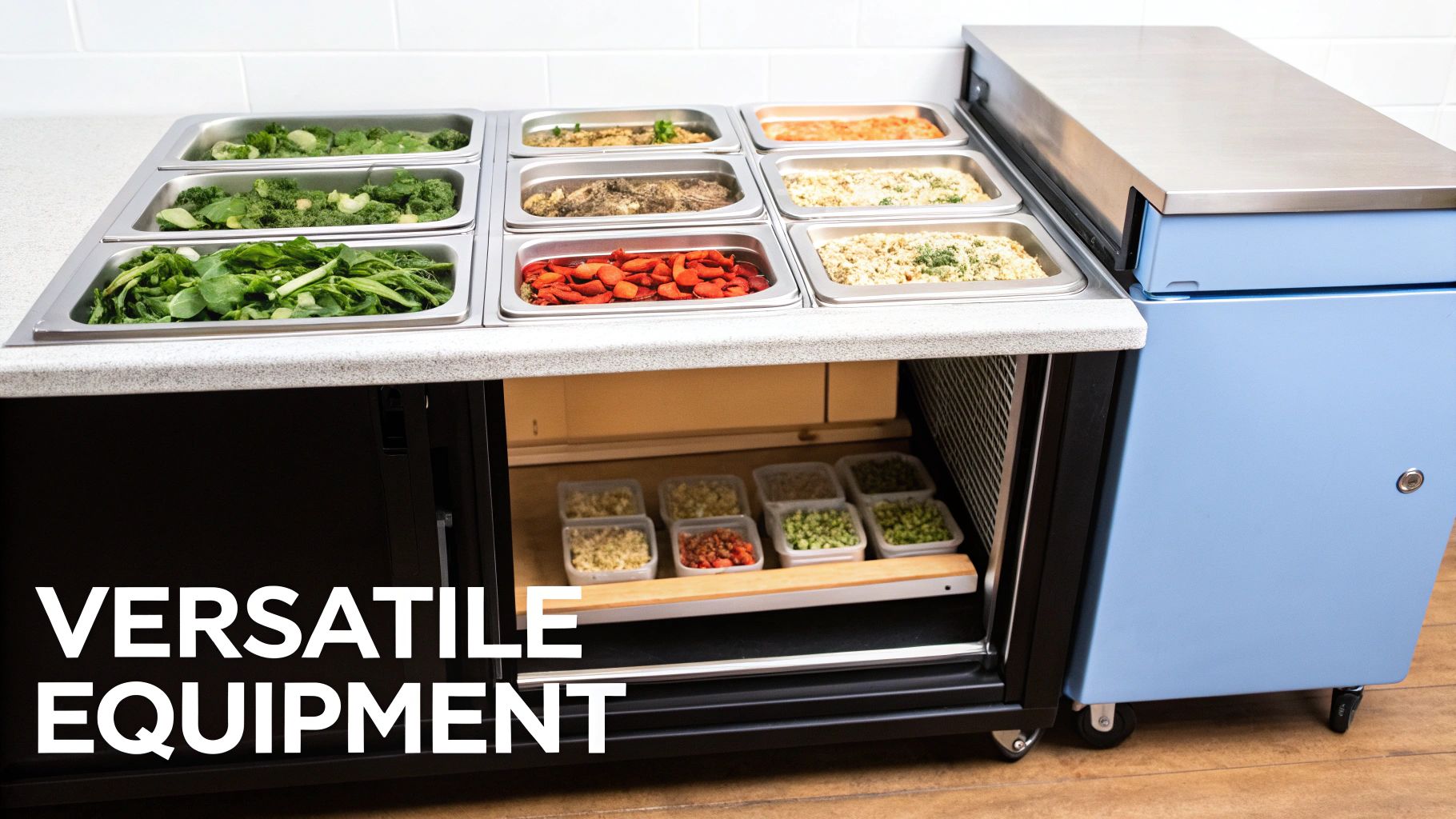
Forget thinking of it as just a place to make pies. A commercial pizza prep table is the command center for your entire operation. It masterfully combines refrigerated storage, an organized ingredient station, and a durable workspace into a single, efficient footprint. In the tight quarters of a concession stand where every square inch is prime real estate, that kind of consolidation is a game-changer.
Sizing Up Your Pizza Prep Table
Your first big decision is choosing the right size, and this choice will shape your entire workflow. Pizza prep tables come in a range of sizes, each built for different volumes and menu complexities.
- Compact Models (44-60 inches): I've seen these work wonders in smaller operations, food trucks, and stands with a focused menu. They give you just enough space for your core pizza toppings while leaving precious room for other gear.
- Mid-Range Models (67-72 inches): These are the sweet spot for businesses where pizza is the main seller, but you still need variety. They offer more refrigerated storage and a larger prep area, easily supporting a more diverse set of ingredients for both pizza and sides.
- Large Models (93+ inches): If you're running a high-volume spot at a large venue or festival, these massive workstations are non-negotiable. They can hold a huge number of ingredient pans, which means you can run a complex pizza menu and have multiple employees working side-by-side without tripping over each other.
A well-chosen pizza prep table drastically cuts down the time your staff wastes walking back and forth to separate coolers. When everything from pepperoni to peppers is held at a consistent, food-safe temperature right at their fingertips, order fulfillment gets a whole lot faster. For a deeper dive on outfitting a mobile kitchen, check out our guide to essential food truck equipment.
Building Your Kitchen Ecosystem
While the prep table is the heart of your pizza operation, it can't work alone. It needs a supporting cast of equipment to function as a complete kitchen. The goal is to create an ecosystem where every piece complements the others, creating a smooth, logical flow from prep to cooking to service.
Think about pairing your prep table with a high-capacity pizza oven. The oven’s output has to match what your prep station can handle, otherwise, you'll create a bottleneck that slows down the whole line. Beyond the oven itself, your fuel source is critical; learn more about choosing the right charcoal for your concession operation to nail that consistent quality and flavor your customers expect.
The most profitable concession stands I’ve seen operate like a well-oiled assembly line. Your pizza prep table is the main station, flanked by supporting players like under-counter refrigerators for dough and bulk cheese, and fryers for high-margin sides like wings or fries. This setup creates a powerful, efficient workflow that just prints money.
Designing an Efficient Kitchen Workflow
In the fast-paced world of concession food, speed is your number one asset. A clunky kitchen workflow doesn't just slow you down; it kicks off a disastrous domino effect of long lines, frazzled staff, and expensive mistakes. The secret to avoiding that chaos is a smart, ergonomic layout where every piece of equipment works together like a well-oiled machine.
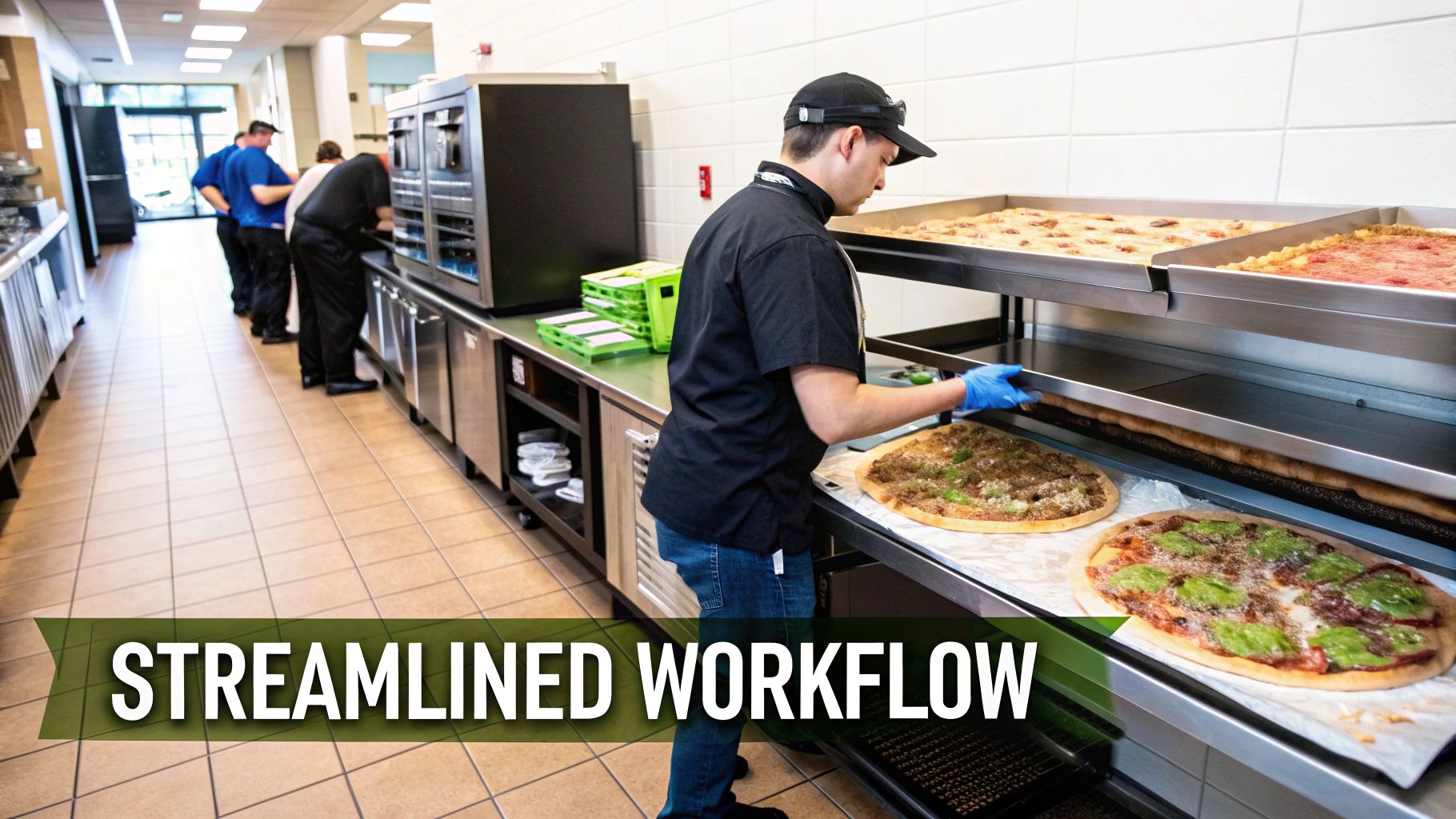
Your pizza prep table is the undisputed star of this show. Think of it as the command center, bridging the gap between your cold storage and your hot line. The first, non-negotiable step is to place it strategically between your main fridge and your pizza oven. This simple move creates a straight, logical path for food to follow, cutting down on wasted steps and preventing traffic jams.
Organizing Your Prep Table for Maximum Speed
Once your pizza prep table is in its proper home, the real magic comes from how you organize it. Those refrigerated wells on top—the "pans"—are your secret weapon for lightning-fast assembly. Don't just throw ingredients in there randomly. Arrange them based on how often you use them and the natural order of building a pizza.
For instance, your highest-volume items need to be in the most accessible pans. This almost always means your cheese and pepperoni go in the largest, easiest-to-reach wells. From there, organize the rest of the toppings with intention.
- Primary Toppings: Keep the crowd-pleasers like pepperoni, sausage, and mushrooms right in front of the main workstation.
- Secondary Toppings: Less common items like onions, peppers, and olives can go in the next row back.
- Specialty Items: Ingredients for special orders, such as jalapeños or pineapple, can be positioned a bit further away but still within easy reach.
This system means your team isn't wasting precious seconds hunting for toppings. Their hands should move in a predictable, repeatable pattern from dough to sauce to cheese, almost entirely on muscle memory. If you want to really dive deep, you can learn a lot from our guide on commercial kitchen layout design, which gets into the nitty-gritty of creating truly productive workspaces.
A well-designed workflow is all about eliminating wasted motion. Every step a team member saves walking back and forth to a cooler is a step that gets an order out to a hungry customer faster. This isn't just about speed; it's about reducing fatigue and keeping morale high during a long, busy event.
Creating Dedicated Work Zones
Finally, zoom out from the prep table and think about the bigger picture. You need to establish clear zones for each stage of production. This prevents your staff from tripping over each other and creating congestion when the pressure is on.
Your pizza concession kitchen should have three distinct areas:
- Prep Zone: This is where the magic begins. Your pizza prep table, dough sheeter, and bulk ingredient storage all live here.
- Cooking Zone: This area is all about the heat—your ovens are the main attraction. It needs a clear, safe path from the prep zone.
- Service Zone: This is the final hand-off point. It should include your warming racks, cutting stations, and the register where customers pay.
By creating these zones, you build an intuitive assembly line that guides your team smoothly through their tasks. This methodical approach is the foundation of a high-volume pizza concession operation that can handle any rush you throw at it.
Nailing Down Your Inventory and Portion Control
In the pizza business, profit isn’t made on one big sale; it’s built in the tiny, disciplined details of managing what you have. Every pinch of cheese and slice of pepperoni has a real cost attached to it. Nailing your inventory and controlling every single portion is how you protect those margins and turn a decent night into a fantastic one.
The cornerstone of all this is the first-in, first-out (FIFO) system. It’s a dead-simple but incredibly powerful idea: the first ingredients you buy are the first ones you use. This is absolutely critical for anything perishable you’re storing in your commercial refrigeration units and pizza prep table.
Putting FIFO into practice is easy. When new stock comes in, slide it behind the existing stock. Get a marker and label everything with the delivery date so your team can see, at a glance, what needs to be used next. This simple habit slashes spoilage and guarantees you're always serving the freshest product possible—and trust me, customers can tell the difference.
The Science of Scoops and Scales
Once your inventory is organized, the next battle is won with portion control. Inconsistency is a silent profit killer. If one employee is generous with the cheese while another is more reserved, you have no real way to track your food costs or give customers a predictable product.
This is where standardized tools become your best friend. They're non-negotiable for any serious pizza restaurant.
- Portion Scoops: Use specific, color-coded scoops for toppings like cheese, mushrooms, and onions. This ensures every single pizza gets the same amount, every time.
- Dough Balls: Pre-portioning your dough to a standard weight is a must. It guarantees a consistent crust size and thickness, which directly impacts your cook times and the final product's quality.
- Sauce Ladles: A designated ladle for sauce ensures you get even coverage without overusing a core, and surprisingly costly, ingredient.
Using a digital scale to weigh your dough and key toppings might feel tedious at first, but it pays for itself almost instantly. It transforms your food cost from a fuzzy guess into a hard, reliable number you can actually build your business on.
Your real goal is to create a 'recipe' for every single item on your menu. A 14-inch pepperoni pizza shouldn't just be 'dough, sauce, cheese, and pepperoni'—it should be 'one 12oz dough ball, one 4oz ladle of sauce, 6oz of shredded mozzarella, and 18 slices of pepperoni.' That's the level of detail that protects your profits.
Forecasting Demand to Cut Down on Waste
The final piece of this puzzle is ordering the right amount of food in the first place. Over-ordering perishables is the same as throwing cash directly into the trash can. To stop this, you need to become a student of your own business.
Start tracking your sales data against specific events. A high school football game on a Friday night is going to drive huge demand for classic pepperoni pizza. A local arts festival on a Sunday afternoon, on the other hand, might push more sales for veggie options. Look at your past sales records, factor in the weather, and think about the type of crowd you’re expecting.
This data lets you build smarter, more accurate orders. You'll reduce waste on items that don't move and—just as importantly—avoid running out of your most popular toppings mid-rush. That’s a costly mistake that disappoints customers and leaves money on the table.
Smart Pricing and Menu Presentation
Getting your pricing right is a delicate dance between cost, what customers are willing to pay, and the value you're offering. This is where the real money is made in concession stand food.
Even a small tweak, like how you price a pizza slice coming off a pizza prep table, can make a huge difference in your profit margins by the end of the night.
Let's dive into the two main ways to think about pricing—cost-plus and value-based—using pizza as the prime example. I'll also show you how simple changes in your menu's design can naturally guide people toward your most profitable items.
We'll look at two core strategies:
- Cost-Plus Pricing: This is your baseline. It makes sure every single ingredient in a pizza is paid for, then adds a healthy markup for profit.
- Value-Based Pricing: This approach is more fluid. It considers what people expect to pay in a certain setting, like a championship game versus a quiet Tuesday practice.
The magic happens when you use these two models together. For instance, your cost-plus model might tell you a pepperoni slice should be $3, but knowing you've got a packed house for a fireworks show, the value-based model lets you bump it to $3.50 without anyone batting an eye.
The only way to know when to make these moves is by keeping a close eye on your food cost percentage and actual sales data. That's what tells you which items have room for a price bump.
Pricing Models For Menu Items
Starting with cost-plus pricing is always a smart first step for any pizza restaurant. You calculate the total cost of ingredients for a single pizza, then apply a markup to hit your target profit.
- A common target for food cost is around 25%, so you'd set your markup to get there.
- It's a good idea to revisit these prices monthly. Ingredient costs change, and your menu prices should, too.
Value-based pricing, on the other hand, is all about perception. People will pay more for convenience, a unique topping, or just the classic nostalgia of ballpark food. By watching when your attendance peaks and what nearby competitors are charging, you can often raise prices slightly without seeing any drop in sales.
This is where your pricing strategy connects directly to how you lay out your menu board.
Menu Psychology And Layout
You can absolutely steer customers toward your high-margin items without being pushy. It all comes down to strategic placement and a few good descriptive words.
If you have a signature pizza, don't just list it—highlight it with a small icon or put a shaded box around it to make it pop.
- Place your best-sellers, like pepperoni pizza, in the top-right corner of the menu. That’s naturally where people’s eyes go first.
- Swap out boring words for sensory ones. "Crispy," "fresh," and "melty" sound a lot better than just listing ingredients.
- Group similar items together, like different pizza slice options. It makes the decision process faster and keeps the line moving.
“Visual cues on menus can increase high-margin item sales by 17%.”
It’s a subtle nudge that helps you raise the average ticket price without having to do any hard selling.
Combos And Suggestive Selling
Bundling items into combo deals is one of the most effective ways to increase how much each person spends.
Think about it: bundling a pizza slice with a drink and a side of garlic knots can easily boost that order's value by 20% or more.
- Create a couple of tiers, like a "Solo Slice Combo" and a "Family Pie Deal," to appeal to different group sizes.
- Make the savings obvious. A simple "Save $1.50" next to the combo price does the trick.
- Put up small, printed signs on the walls of your pizza prep stations to remind your staff to ask about add-ons.
Give your team a simple script to work with, like, ‘Would you like to make that a combo with a drink?’ It’s a low-pressure way to drive those crucial add-on sales.
When you combine smart pricing, thoughtful menu design, and a little suggestive selling, you create a powerful system for maximizing profit. These aren't just one-off tricks; they're proven methods that boost your profit on every single order while making the customer feel like they got a great deal.
Why not try one little change this week? Tweak a price, rearrange your menu, or introduce a new combo and see what happens.
Weaving Modern Tech and Sustainability into Your Stand
In the world of concession stands, especially during peak hours, speed isn't just a goal—it's everything. For a pizza restaurant, this is where modern tech can completely change your game. Digital menu boards, for instance, let you update pizza specials and pricing on the fly, which is a lifesaver when you run out of a popular topping.
Contactless payment systems are no longer a novelty; they're a necessity. In today's venues, they handle a whopping 60% of transactions. Think about it: every second you save by not handling cash is a second shaved off the queue. Faster lines mean happier customers who are more likely to come back for another slice. The data backs this up, showing a clear trend toward quicker service formats. You can see more details in concession stand market findings at Global Insight Services.
In North America alone, stadium outlets are responsible for 35% of all concession sales. The dominant players are quick-service setups with a 45% market share, all built around streamlined prep for things like pizza and sandwiches.
Here’s what that tech upgrade really gets your pizza business:
- Instant menu changes mean less time training staff on daily specials.
- Shorter lines lead to happier fans who tend to spend more.
- Real-time sales data helps you make smart pricing decisions in the middle of a rush.
Energy Efficient Pizza Prep Tables
Let's talk about equipment. Investing in an energy-efficient pizza prep table is one of the smartest moves you can make. These modern units can trim your power consumption by 15-25%. That's not just good for your wallet; it also resonates with the 40% of consumers who actively look for businesses with eco-friendly standards.
I know a local pizzeria owner who saw his monthly energy bill drop by about $300 just from swapping out an old, clunky prep table for a new energy-efficient one. The savings are real.
| Feature | Traditional Table | Energy-Efficient Table |
|---|---|---|
| Power Use | High | 15-25% Less |
| Cooling Tech | Standard | Improved Insulation |
| Consumer Appeal | Low | Eco-Friendly |
Sustainable Sourcing And Packaging
Going green extends beyond your equipment. The pizza toppings you choose and the packaging you use send a powerful message. We're seeing huge demand for plant-based options like roasted cauliflower or vegan cheese, especially at large events.
Switching to compostable pizza boxes, napkins, and cutlery is another easy win. It cuts down on landfill waste and scores major points with eco-conscious customers. As more businesses focus on their environmental impact, it's smart to look at what other industries are doing. For example, learning about eco friendly coffee practices can spark some great ideas for your own operation.
Key Takeaway: The choices you make on energy use and sourcing have a direct line to your profit margins and how customers see your brand.
Integrating Eco Practices Across Your Menu
A sustainable mindset shouldn't be an afterthought; it should be woven into your entire pizza menu. This allows you to proudly advertise your green options right alongside the classic pepperoni slice.
Get creative with waste reduction. Those leftover dough scraps? Turn them into garlic breadsticks. The offcuts from your veggies? They can become the base for a vibrant side salad. It's all about finding value where others see waste.
- Start by doing a quick menu audit to see which pizza toppings generate the most waste.
- Make the switch to certified compostable packaging wherever possible.
- Use your digital menu boards to show off your eco-friendly choices.
Future-Proofing Your Stand With Tech
Imagine your digital ordering kiosk talking directly to your pizza prep table. It sounds like science fiction, but it's happening now. This integration allows your systems to sync ingredient levels in real time.
Automatic alerts can ping your staff when a topping well is running low, completely eliminating those frantic mid-rush searches for more pepperoni. When your tech handles the inventory monitoring, your team is free to focus on what they do best: crafting perfect slices and serving customers with a smile.
- Kiosk analytics can drive dynamic pricing for pizza slices during slow periods.
- Tablet orders can feed directly into your inventory dashboards.
- IoT sensors can monitor fridge and prep table temperatures, ensuring food safety.
Tech Trends To Watch
Looking ahead, AI-driven demand forecasting is set to become a game-changer. This technology can predict pizza orders with startling accuracy, right down to the hour, which drastically cuts down on overproduction and food waste.
Mobile ordering is another big one. Letting fans order a slice right from their seat not only boosts your average ticket size but also helps manage the crowds at your counter.
Keep an eye out for these emerging trends:
- Voice-enabled kiosks for a completely hands-free ordering experience.
- Blockchain technology for transparent, farm-to-stand ingredient sourcing.
- Smart lighting systems that adjust based on foot traffic to save energy.
Pairing these tech trends with an energy-efficient pizza prep table creates a powerful, future-ready concession stand. By implementing tools like contactless kiosks and modern prep tables, you could see customer satisfaction jump by up to 20% while cutting your combined utility and labor costs by 15%.
Ultimately, blending smart technology with green practices isn't just about keeping up—it's about elevating your pizza concession stand to meet the expectations of today's customers and the demands of tomorrow.
Ready to upgrade your prep station? Visit Pizza Prep Table at https://pizzapreptable.com to find the perfect model for your concession stand.